Xu Jinhe, Xu Lihuan, Wang Baoshan, Kong Wencui, Chen Ying, Yu Zongyang
Fu Zong Clinical Medicine, Fujian Medical University, Fuzhou, China.
Department of Gastroenterology, Dongfang Hospital of Xiamen University, Fuzhou General Hospital of Fujian Medical University, The 900th Hospital of the Joint Logistic Support Force, PLA, Fuzhou, China.
Front Oncol. 2022 Jan 28;11:766148. doi: 10.3389/fonc.2021.766148. eCollection 2021.
Lung adenocarcinoma can transform into small-cell lung cancer (SCLC) when resistance to tyrosine kinase inhibitors (TKIs) develops. Approximately 3% to 10% of epidermal growth factor receptor (EGFR)-mutant non-small cell lung cancer (NSCLC) could transform to SCLC. This phenomenon has been described in several case reports and small patient series. However, the characteristics and treatment outcomes of this population have not been comprehensively reported, and their clinical course is poorly characterized.
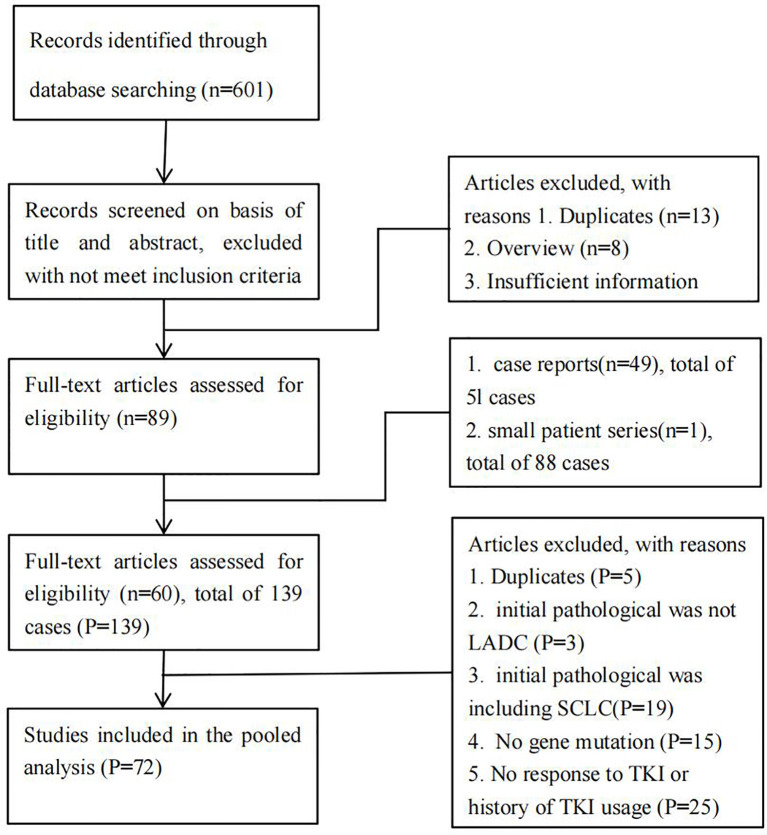
We performed a systematic review of the published literature to summarize the clinical and pathological features and prognosis of the reported cases and analyzed the demographics, disease features, and outcomes.
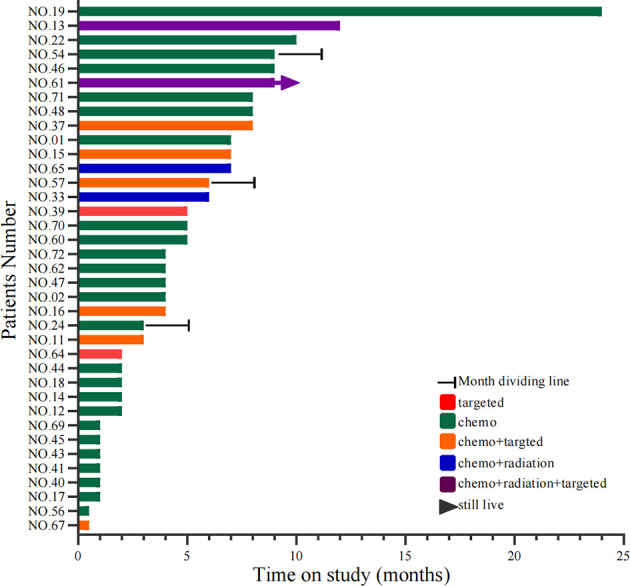
A total of 72 patients (50 females and 22 males) initially diagnosed with lung adenocarcinoma were included. EGFR mutations included 19-deletion (75%), L858R (22%), and G719X (3%). All patients received EGFR-TKIs before SCLC transformation. The median time from diagnosis to transformation was 20.5 months (95% CI, 15.45 to 26.55 months). Of the 67 patients with post-translational gene test results, 58 maintained their EGFR mutation, and only 1 of 18 with prior T790M positivity retained T790M mutation. After the pathological transformation, both conventional chemotherapy regimen and chemotherapy combined targeted therapy yielded high response rates. The disease control rate of first-line therapy after transformation was 76%, while the objective response rate was 48%. The median overall survival (OS) since diagnosis was 27 months (95% CI, 22.90 to 31.10 months), whereas median OS since SCLC transformation was 8.5 months (95% CI, 5.50 to 11.60 months).
The prognosis of transformed SCLC is worse than primary SCLC. The response rate to conventional chemotherapy was high. However, the progression-free survival and OS after transformation were short and the prognosis was poor with first-line therapies. New therapies are needed in the management of transformed SCLC.
当对酪氨酸激酶抑制剂(TKIs)产生耐药性时,肺腺癌可转化为小细胞肺癌(SCLC)。大约3%至10%的表皮生长因子受体(EGFR)突变的非小细胞肺癌(NSCLC)可转化为SCLC。这种现象已在几例病例报告和小样本患者系列中有所描述。然而,这一人群的特征和治疗结果尚未得到全面报道,其临床病程也缺乏明确特征。
我们对已发表的文献进行了系统综述,以总结所报道病例的临床和病理特征及预后,并分析了人口统计学、疾病特征和结局。
共纳入72例最初诊断为肺腺癌的患者(50例女性和22例男性)。EGFR突变包括19号外显子缺失(75%)、L858R(22%)和G719X(3%)。所有患者在SCLC转化前均接受了EGFR-TKIs治疗。从诊断到转化的中位时间为20.5个月(95%CI,15.45至26.55个月)。在67例有翻译后基因检测结果的患者中,58例维持EGFR突变,18例先前T790M阳性患者中只有1例保留T790M突变。病理转化后,传统化疗方案以及化疗联合靶向治疗均产生了较高的缓解率。转化后一线治疗的疾病控制率为76%,而客观缓解率为48%。自诊断以来的中位总生存期(OS)为27个月(95%CI,22.90至31.10个月),而自SCLC转化以来的中位OS为8.5个月(95%CI,5.50至11.60个月)。
转化型SCLC的预后比原发性SCLC更差。对传统化疗的缓解率较高。然而,转化后的无进展生存期和OS较短,一线治疗的预后较差。在转化型SCLC的管理中需要新的治疗方法。