Chen Xiaoyuan, Lu Yiwei, Shi Xiaoli, Han Guoyong, Zhao Jie, Gao Yun, Wang Xuehao
School of Medicine, Southeast University, Nanjing, China.
Hepatobiliary Center, The First Affiliated Hospital of Nanjing Medical University, Nanjing, China.
Front Oncol. 2022 Feb 11;12:835957. doi: 10.3389/fonc.2022.835957. eCollection 2022.
The evaluation of the nodal status of hepatocellular carcinoma (HCC) is a classic but controversial topic. This study aimed to investigate the incidence of lymph node metastasis (LNM), explore the role of lymph node dissection (LND), and develop and validate a novel model to predict LNM in patients with HCC, not other specified (NOS).
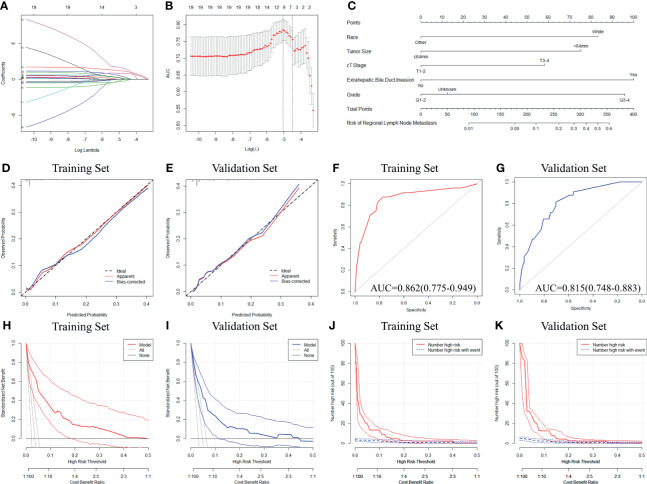
The study cohort was taken from the Surveillance, Epidemiology, and End Results database. The annual percent change (APC) was calculated using the Joinpoint regression. Survival analyses adopted the competing risk model. The nomogram was constructed based on the least absolute shrinkage and selection operator (LASSO) logistic regression algorithm and validated by calibration curves. The area under the receiver operating characteristic curve (AUROC) was obtained to compare prognostic performance. Decision curve and clinical impact curve analyses were introduced to examine the clinical value of the models.
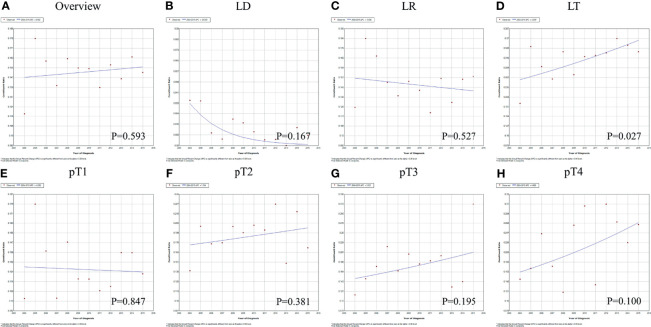
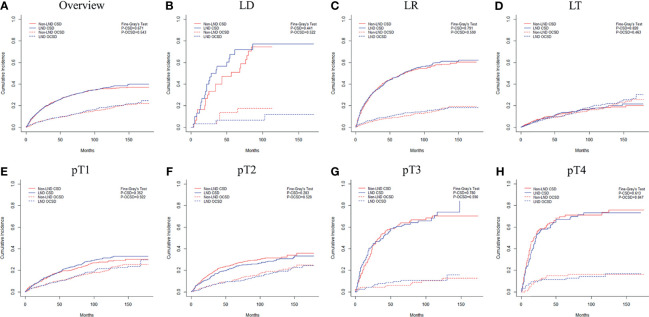
A total of 8,829 patients were finally enrolled in this study, and 1,346 (15.2%) patients received LND. The LND rate showed no noticeable fluctuation in the last decade, with an APC of 0.5% (P=0.593). LNM was identified in 56 (4.2%) patients and confirmed an independent prognostic factor of HCC patients (P=0.005). There were 2,497 lymph nodes retrieved, and 93 (3.7%) of them were positive. After propensity score matching, LND indicated no direct oncologic benefit and did not worsen competing risks. Moreover, an increased number of lymph nodes retrieved could not improve prognoses. 1,346 patients with LND were further randomly divided into the training and validation sets with the ratio of 1:1. Race, tumor size, clinical T stage, extrahepatic bile duct invasion, and tumor grade were independent risk factors for LNM. The constructed model was well calibrated and showed good discrimination power and net benefits in clinical practice.
LNM is an independent prognostic factor in HCC, but routine LND seems to be unnecessary in HCC patients. The constructed model could predict the presence of LNM in HCC patients with good performance, which is meaningful to patient stratification and individual treatment strategies optimization.
肝细胞癌(HCC)淋巴结状态的评估是一个经典但存在争议的话题。本研究旨在调查淋巴结转移(LNM)的发生率,探讨淋巴结清扫术(LND)的作用,并开发和验证一种预测非其他特定类型(NOS)HCC患者LNM的新模型。
研究队列取自监测、流行病学和最终结果数据库。使用Joinpoint回归计算年度百分比变化(APC)。生存分析采用竞争风险模型。基于最小绝对收缩和选择算子(LASSO)逻辑回归算法构建列线图,并通过校准曲线进行验证。获得受试者操作特征曲线下面积(AUROC)以比较预后性能。引入决策曲线和临床影响曲线分析来检验模型的临床价值。
本研究最终纳入8829例患者,其中1346例(15.2%)患者接受了LND。LND率在过去十年中没有明显波动,APC为0.5%(P = 0.593)。56例(4.2%)患者被确定有LNM,证实其为HCC患者的独立预后因素(P = 0.005)。共获取2497个淋巴结,其中93个(3.7%)为阳性。倾向评分匹配后,LND未显示出直接的肿瘤学益处,也未增加竞争风险。此外,获取的淋巴结数量增加并不能改善预后。1346例接受LND的患者进一步随机分为训练集和验证集,比例为1:1。种族、肿瘤大小、临床T分期、肝外胆管侵犯和肿瘤分级是LNM的独立危险因素。构建的模型校准良好,在临床实践中显示出良好的区分能力和净效益。
LNM是HCC的独立预后因素,但常规LND在HCC患者中似乎没有必要。构建的模型能够较好地预测HCC患者LNM的存在,这对患者分层和个体化治疗策略优化具有重要意义。