Valdés-López Juan Felipe, Fernandez Geysson J, Urcuqui-Inchima Silvio
Grupo Inmunovirología, Facultad de Medicina, Universidad de Antioquia UdeA, Medellín, Colombia.
Front Cell Dev Biol. 2022 Feb 9;10:812110. doi: 10.3389/fcell.2022.812110. eCollection 2022.
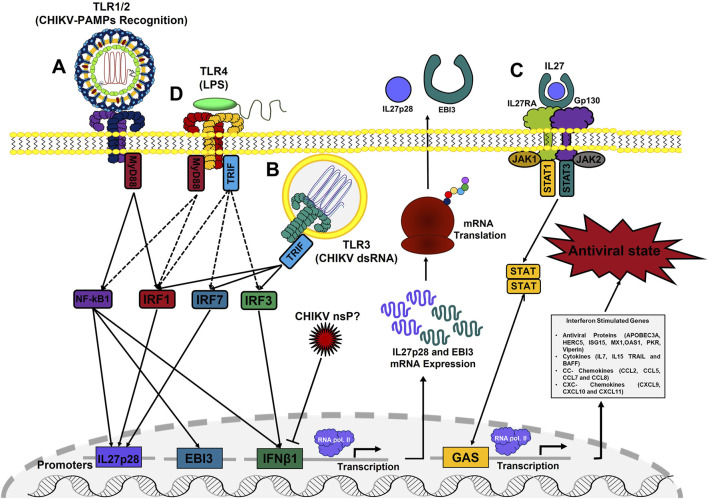
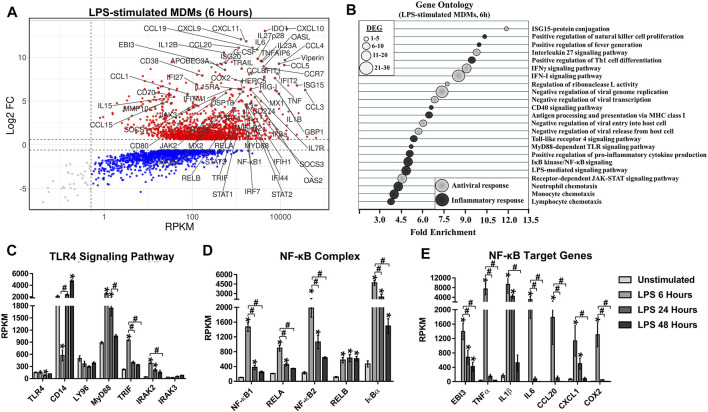
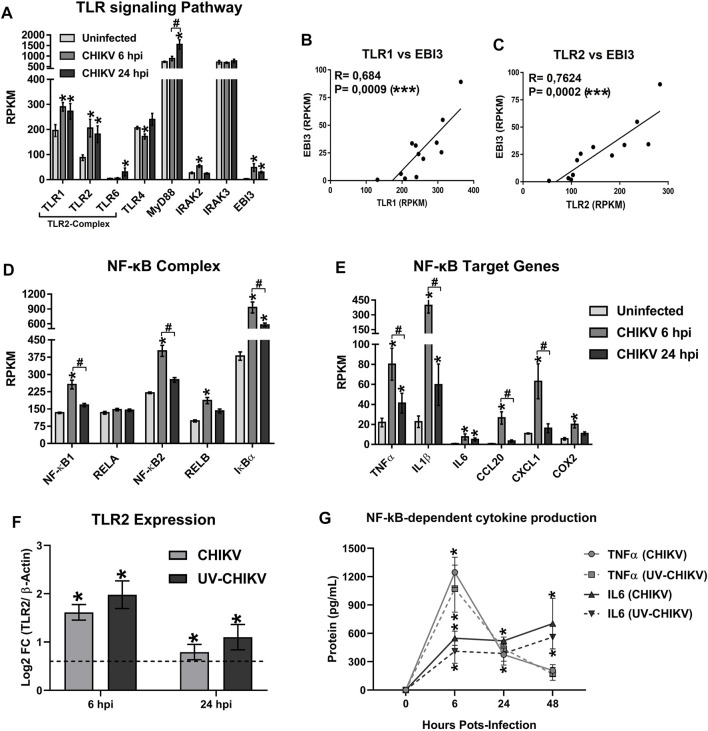
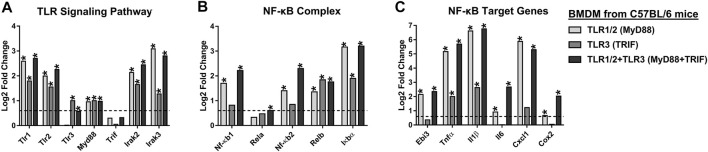
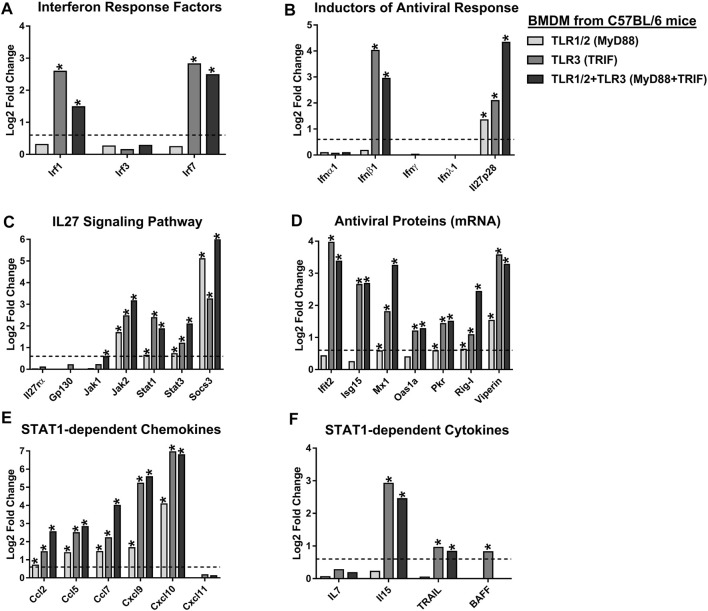
Chikungunya virus (CHIKV) is the etiological agent of chikungunya fever (CHIKF), a self-limiting disease characterized by myalgia and severe acute or chronic arthralgia. CHIKF is associated with immunopathology and high levels of pro-inflammatory factors. CHIKV is known to have a wide range of tropism in human cell types, including keratinocytes, fibroblasts, endothelial cells, monocytes, and macrophages. Previously, we reported that CHIKV-infected monocytes-derived macrophages (MDMs) express high levels of interleukin 27 (IL27), a heterodimeric cytokine consisting of IL27p28 and EBI3 subunits, that triggers JAK-STAT signaling and promotes pro-inflammatory and antiviral response, in interferon (IFN)-independent manner. Based on the transcriptomic analysis, we now report that induction of IL27-dependent pro-inflammatory and antiviral response in CHIKV-infected MDMs relies on two signaling pathways: an early signal dependent on recognition of CHIKV-PAMPs by TLR1/2-MyD88 to activate NF-κB-complex that induces the expression of EBI3 mRNA; and second signaling dependent on the recognition of intermediates of CHIKV replication (such as dsRNA) by TLR3-TRIF, to activate IRF1 and the induction of IL27p28 mRNA expression. Both signaling pathways were required to produce a functional IL27 protein involved in the induction of ISGs, including antiviral proteins, cytokines, CC- and CXC- chemokines in an IFN-independent manner in MDMs. Furthermore, we reported that activation of TLR4 by LPS, both in human MDMs and murine BMDM, results in the induction of both subunits of IL27 that trigger strong IL27-dependent pro-inflammatory and antiviral response independent of IFNs signaling. Our findings are a significant contribution to the understanding of molecular and cellular mechanisms of CHIKV infection.
基孔肯雅病毒(CHIKV)是基孔肯雅热(CHIKF)的病原体,这是一种自限性疾病,其特征为肌痛以及严重的急性或慢性关节痛。CHIKF与免疫病理学以及高水平的促炎因子相关。已知CHIKV在人类细胞类型中具有广泛的嗜性,包括角质形成细胞、成纤维细胞、内皮细胞、单核细胞和巨噬细胞。此前,我们报道过,感染CHIKV的单核细胞衍生巨噬细胞(MDM)表达高水平的白细胞介素27(IL27),这是一种由IL27p28和EBI3亚基组成的异二聚体细胞因子,它以不依赖干扰素(IFN)的方式触发JAK-STAT信号传导并促进促炎和抗病毒反应。基于转录组分析,我们现在报告,在感染CHIKV的MDM中诱导依赖IL27的促炎和抗病毒反应依赖于两条信号通路:一条早期信号通路依赖于TLR1/2-MyD88识别CHIKV-PAMP以激活NF-κB复合物,从而诱导EBI3 mRNA的表达;第二条信号通路依赖于TLR3-TRIF识别CHIKV复制中间体(如双链RNA),以激活IRF1并诱导IL27p28 mRNA的表达。两条信号通路对于产生功能性IL27蛋白都是必需的,该蛋白以不依赖IFN的方式参与在MDM中诱导包括抗病毒蛋白、细胞因子、CC和CXC趋化因子在内的ISG。此外,我们报道,在人类MDM和小鼠BMDM中,LPS激活TLR4会导致诱导IL27的两个亚基,从而触发强烈的依赖IL27的促炎和抗病毒反应,且不依赖IFN信号传导。我们的发现对理解CHIKV感染的分子和细胞机制做出了重要贡献。