Department of Psychiatry, NYU Grossman School of Medicine, One Park Avenue, 8th Floor, New York, NY, 10016, USA.
Rory Meyers College of Nursing, New York University, 433 1st Avenue, New York, NY, 10010, USA.
J Cancer Surviv. 2023 Oct;17(5):1510-1521. doi: 10.1007/s11764-022-01195-y. Epub 2022 Feb 28.
Breast cancer survivors may demonstrate elevated psychological distress, which can also hinder adherence to survivorship care plans. Our goal was to study heterogeneity of behavioral health and functioning in breast cancer survivors, and identify both risk and protective factors to improve targets for wellness interventions.
Breast cancer survivors (n = 187) consented to complete self-reported psychological measures and to access their medical records. Latent class analysis (LCA) was used to classify heterogeneous subpopulations based on levels of depression, post-traumatic stress, fear of cancer recurrence, cancer-related pain, and fatigue. Multinomial logistic regression and auxiliary analysis in a 3-step modeling conditional approach was used to identify characteristics of the group based on demographics, treatment history and characteristics, and current medication prescriptions.
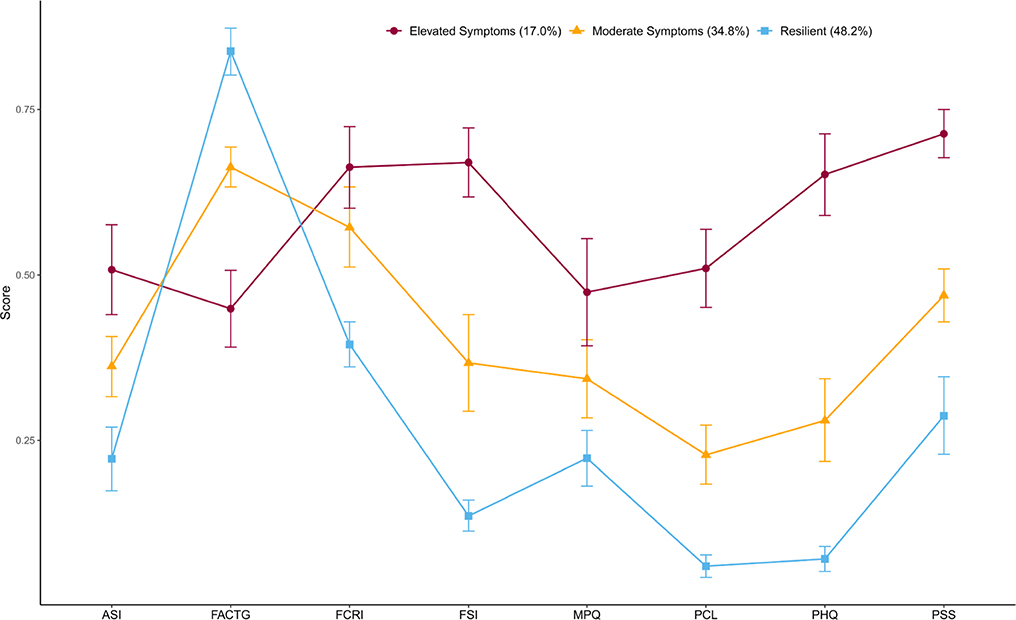
Three subpopulations of breast cancer survivors were identified from the LCA: a modal Resilient group (48.2%, n = 90), a Moderate Symptoms group (34%, n = 65), and an Elevated Symptoms group (n = 17%, n = 32) with clinically-relevant impairment. Results from the logistic regression indicated that individuals in the Elevated Symptoms group were less likely to have a family history of breast cancer; they were more likely to be closer to time of diagnosis and younger, have received chemotherapy and psychotropic prescriptions, and have higher BMI. Survivors in the Elevated Symptoms group were also less likely to be prescribed estrogen inhibitors than the Moderate Symptoms group.
This study identified subgroups of breast cancer survivors based on behavioral, psychological, and treatment-related characteristics, with implications for targeted monitoring and survivorship care plans.
Results showed the majority of cancer survivors were resilient, with minimal psychological distress. Results also suggest the importance of paying special attention to younger patients getting chemotherapy, especially those without a family history of breast cancer.
乳腺癌幸存者可能表现出较高的心理困扰,这也会妨碍他们遵循生存护理计划。我们的目标是研究乳腺癌幸存者的行为健康和功能的异质性,并确定风险和保护因素,以改善健康干预的目标。
乳腺癌幸存者(n=187)同意完成自我报告的心理测量,并查阅他们的病历。潜在类别分析(LCA)用于根据抑郁、创伤后应激、癌症复发恐惧、癌症相关疼痛和疲劳的水平对异质亚群进行分类。多分类逻辑回归和辅助分析采用 3 步建模条件方法,用于根据人口统计学、治疗史和特征以及当前药物处方确定基于组的特征。
从 LCA 中确定了乳腺癌幸存者的三个亚群:一个模态的恢复力组(48.2%,n=90),一个中度症状组(34%,n=65)和一个高症状组(n=17%,n=32)具有临床相关的损伤。逻辑回归的结果表明,高症状组的个体患乳腺癌家族史的可能性较小;他们更接近诊断时间和年龄较小,接受过化疗和精神药物处方,并且 BMI 较高。与中度症状组相比,高症状组的幸存者服用雌激素抑制剂的可能性也较小。
本研究根据行为、心理和治疗相关特征确定了乳腺癌幸存者的亚组,这对有针对性的监测和生存护理计划具有重要意义。
结果表明,大多数癌症幸存者具有恢复力,心理困扰最小。结果还表明,特别关注接受化疗的年轻患者,尤其是那些没有乳腺癌家族史的患者的重要性。