Center for Innovative Medical Devices and Sensors (REDDI Lab), Clemson University.
Center for Innovative Medical Devices and Sensors (REDDI Lab), Clemson University; Department of Bioengineering, Clemson University.
J Vis Exp. 2022 Feb 11(180). doi: 10.3791/63395.
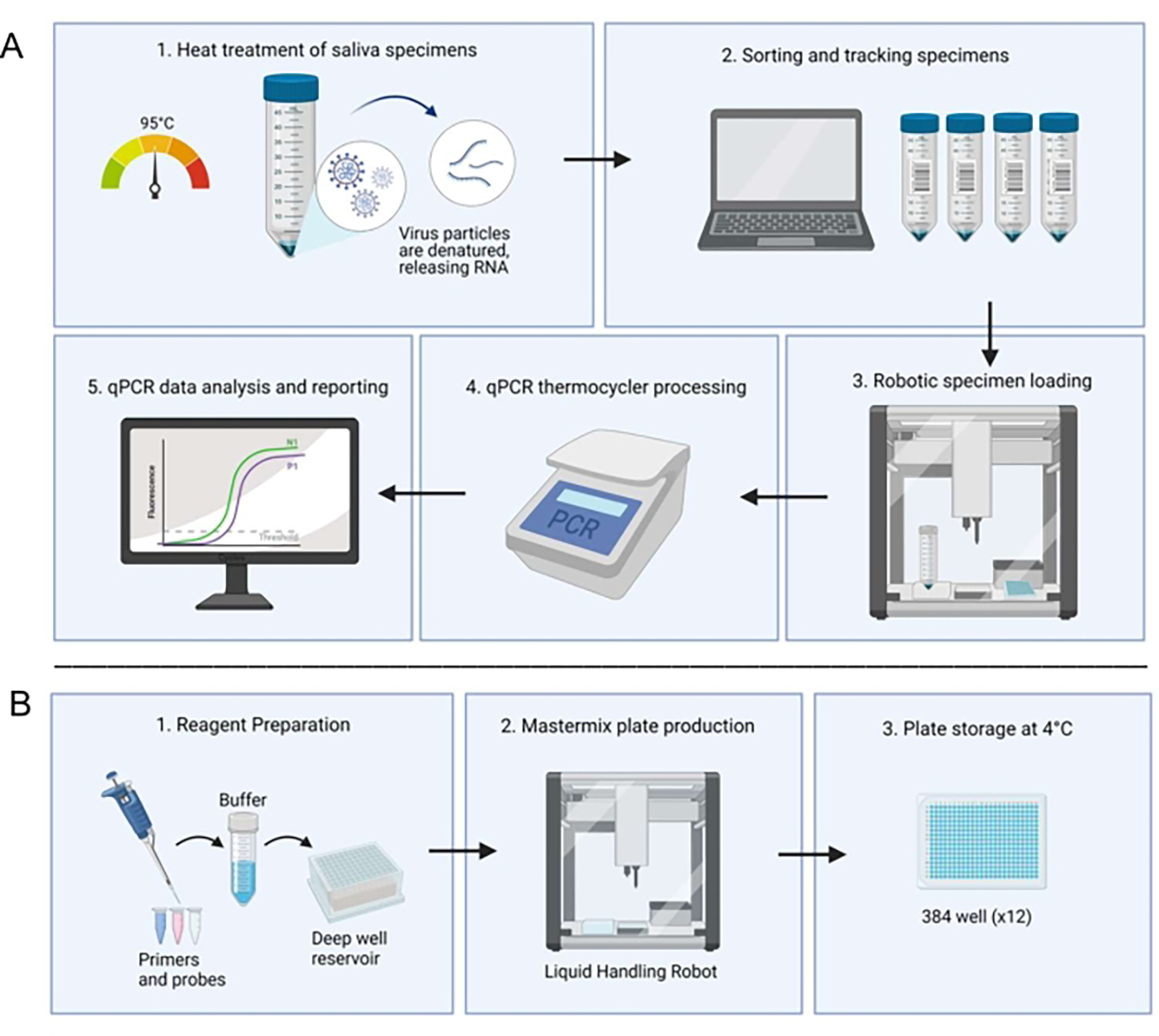
The emergence of the recent SARS-CoV-2 global health crisis introduced key challenges for epidemiological research and clinical testing. Characterized by a high rate of transmission and low mortality, the COVID-19 pandemic necessitated accurate and efficient diagnostic testing, particularly in closed populations such as residential universities. Initial availability of nucleic acid testing, like nasopharyngeal swabs, was limited due to supply chain pressure which also delayed reporting of test results. Saliva-based reverse transcriptase quantitative polymerase chain reaction (RT-qPCR) testing has shown to be comparable in sensitivity and specificity to other testing methods, and saliva collection is less physically invasive to participants. Consequently, we developed a multiplex RT-qPCR diagnostic assay for population surveillance of Clemson University and the surrounding community. The assay utilized open-source liquid handling robots and thermocyclers instead of complex clinical automation systems to optimize workflow and system flexibility. Automation of saliva-based RT-qPCR enables rapid and accurate detection of a wide range of viral RNA concentrations for both large- and small-scale testing demands. The average turnaround for the automated system was < 9 h for 95% of samples and < 24 h for 99% of samples. The cost for a single test was $2.80 when all reagents were purchased in bulk quantities.
最近 SARS-CoV-2 引发的全球卫生危机给流行病学研究和临床检测带来了重大挑战。COVID-19 疫情具有高传播率和低死亡率的特点,因此需要进行准确和高效的诊断检测,特别是在像住宿制大学这样的封闭人群中。由于供应链压力,最初可用的核酸检测(如鼻咽拭子)受到限制,这也导致检测结果的报告延迟。基于唾液的逆转录定量聚合酶链反应(RT-qPCR)检测在灵敏度和特异性方面与其他检测方法相当,且对参与者的身体侵入性较小。因此,我们开发了一种用于克莱姆森大学及周边社区人群监测的多重 RT-qPCR 诊断检测方法。该检测方法利用开源的液体处理机器人和热循环仪,而不是复杂的临床自动化系统,以优化工作流程和系统灵活性。基于唾液的 RT-qPCR 的自动化可快速准确地检测广泛范围的病毒 RNA 浓度,适用于大规模和小规模的检测需求。自动化系统的平均周转时间为<9 小时,占样本的 95%;<24 小时,占样本的 99%。当所有试剂都以批量购买时,单次检测的成本为 2.80 美元。