Ewha Institute for Age Integration Research, Ewha Womans University, 52 Ewhayeodae-gil, Sedaemun-gu, Seoul, 03760, Republic of Korea.
College of Social Welfare, Kangnam University, 40 Kangnam-Ro, Giheung-Gu, Yongin-Si, Gyeonggi-Do, 16979, Republic of Korea.
BMC Cancer. 2022 Feb 28;22(1):217. doi: 10.1186/s12885-021-08909-y.
Fear of cancer recurrence (FCR) has been addressed as a cause of emotional distress among breast cancer survivors (BCSs). This study aimed to systematically review the evidence on randomized controlled trials (RCTs) of cognitive behavioral therapy (CBT) designed to reduce FCR among BCSs.
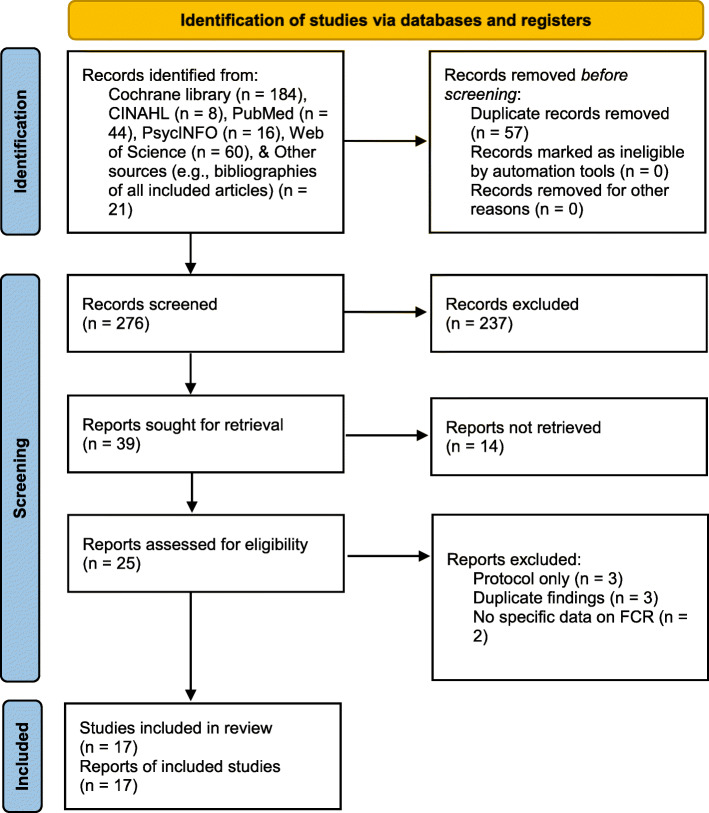
A systematic review of published original research articles meeting the inclusion criteria was conducted. Five electronic databases, including the Cochrane Library, CINAHL, PubMed, PsycINFO, and Web of Science, were independently searched to identify relevant articles. The Consolidated Standards of Reporting Trials (CONSORT) 2010 checklist was used to evaluate the quality of the eligible studies.
Through a database search and a manual review process, seventeen quantitative studies with an RCT study design were included in the current systematic review. The interventions varied greatly in length and intensity, but the study designs and methodologies were similar. RCTs with face-to-face interventions of at least 1 month seemed to be more effective in reducing FCR outcomes and complying with than the CONSORT 2010 criteria than those with a brief online or telephone format of interventions; nevertheless, most RCT interventions appeared to be effective.
These findings highlight the importance of conducting well-designed CBT interventions to reduce FCR in BCSs with diverse populations at multiple sites, thereby improving the quality of research in this area.
癌症复发恐惧(FCR)已被视为乳腺癌幸存者(BCSs)情绪困扰的一个原因。本研究旨在系统地回顾旨在降低 BCSs 中 FCR 的认知行为疗法(CBT)的随机对照试验(RCT)的证据。
对符合纳入标准的已发表的原始研究文章进行了系统评价。独立检索了五个电子数据库,包括 Cochrane Library、CINAHL、PubMed、PsycINFO 和 Web of Science,以确定相关文章。使用 CONSORT 2010 清单评估合格研究的质量。
通过数据库搜索和手动审查过程,本系统评价纳入了 17 项具有 RCT 研究设计的定量研究。干预措施在长度和强度上差异很大,但研究设计和方法相似。与简短的在线或电话干预形式相比,至少 1 个月的面对面干预 RCT 似乎更能有效降低 FCR 结局并符合 CONSORT 2010 标准;然而,大多数 RCT 干预似乎都有效。
这些发现强调了在多个地点对不同人群进行精心设计的 CBT 干预以降低 BCSs 中 FCR 的重要性,从而提高该领域研究的质量。