Wang Yubo, Gavan Sean P, Steinke Douglas, Cheung Kwok-Leung, Chen Li-Chia
Centre for Pharmacoepidemiology and Drug Safety, Division of Pharmacy and Optometry, School of Health Sciences, Faculty of Biology, Medicine and Health, The University of Manchester, 1st Floor Stopford Building, Oxford Road, Manchester, M13 9PT, UK.
Manchester Centre for Health Economics, Division of Population Health, Health Services Research and Primary Care, School of Health Sciences, Faculty of Biology, Medicine and Health, The University of Manchester, Oxford Road, Manchester, M13 9PL, UK.
Cost Eff Resour Alloc. 2022 Mar 1;20(1):9. doi: 10.1186/s12962-022-00342-7.
To appraise the sources of evidence and methods to estimate input parameter values in decision-analytic model-based cost-effectiveness analyses of treatments for primary breast cancer (PBC) in older patients (≥ 70 years old).
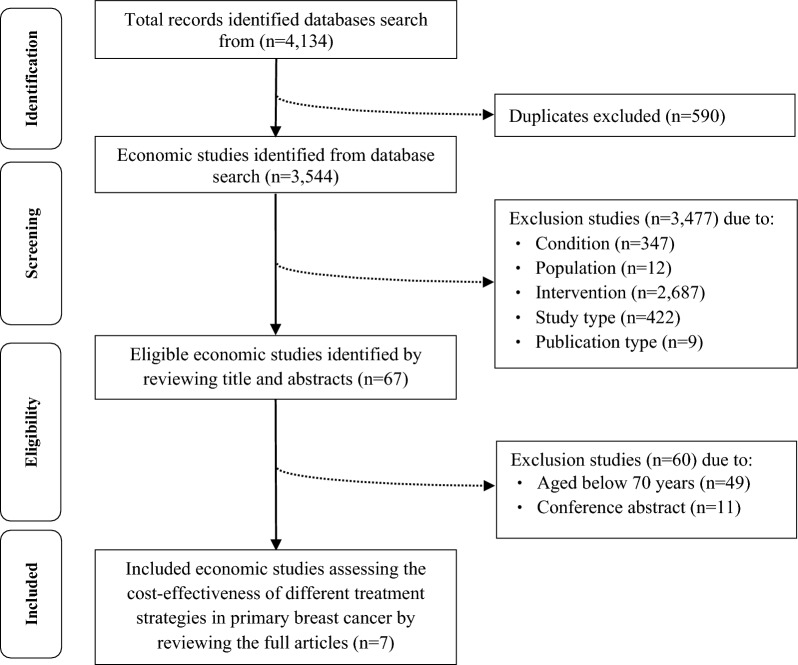
Two electronic databases (Ovid Medline, Ovid EMBASE) were searched (inception until 5 September-2021) to identify model-based full economic evaluations of treatments for older women with PBC as part of their base-case target population or age-subgroup analysis. Data sources and methods to estimate four types of input parameters including health-related quality of life (HRQoL); natural history; treatment effect; resource use were extracted and appraised. Quality assessment was completed by reference to the Consolidated Health Economic Evaluation Reporting Standards.
Seven model-based economic evaluations were included (older patients as part of their base-case (n = 3) or subgroup (n = 4) analysis). Data from younger patients (< 70 years) were used frequently to estimate input parameters. Different methods were adopted to adjust these estimates for an older population (HRQoL: disutility multipliers, additive utility decrements; Natural history: calibration of absolute values, one-way sensitivity analyses; Treatment effect: observational data analysis, age-specific behavioural parameters, plausible scenario analyses; Resource use: matched control observational data analysis, age-dependent follow-up costs).
Improving estimated input parameters for older PBC patients will improve estimates of cost-effectiveness, decision uncertainty, and the value of further research. The methods reported in this review can inform future cost-effectiveness analyses to overcome data challenges for this population. A better understanding of the value of treatments for these patients will improve population health outcomes, clinical decision-making, and resource allocation decisions.
评估在基于决策分析模型的老年患者(≥70岁)原发性乳腺癌(PBC)治疗成本效益分析中,证据来源及估计输入参数值的方法。
检索两个电子数据库(Ovid Medline、Ovid EMBASE)(从数据库建立至2021年9月5日),以确定作为其基础病例目标人群或年龄亚组分析一部分的、基于模型的老年PBC女性患者治疗的全面经济评估。提取并评估估计四种类型输入参数的数据源和方法,这四种参数包括健康相关生活质量(HRQoL)、自然病史、治疗效果、资源利用。参照《卫生经济评估报告标准合并版》完成质量评估。
纳入了七项基于模型的经济评估(老年患者作为其基础病例(n = 3)或亚组(n = 4)分析的一部分)。经常使用来自年轻患者(<70岁)的数据来估计输入参数。采用了不同方法针对老年人群调整这些估计值(HRQoL:负效用乘数、附加效用递减;自然病史:绝对值校准、单向敏感性分析;治疗效果:观察数据分析、特定年龄行为参数、合理情景分析;资源利用:匹配对照观察数据分析、年龄相关随访成本)。
改进老年PBC患者输入参数的估计将改善成本效益估计、决策不确定性以及进一步研究的价值。本综述中报告的方法可为未来的成本效益分析提供参考,以克服该人群的数据挑战。更好地理解这些患者治疗方法的价值将改善人群健康结局、临床决策及资源分配决策。