Department of Aging Medicine and Aging Research, University of Zurich and University Hospital Zurich, Switzerland, Zurich, Switzerland.
Center on Aging and Mobility (CAM), University of Zurich, University Hospital Zurich, and City Hospital Zurich, Waid, Switzerland.
BMC Geriatr. 2022 Mar 2;22(1):174. doi: 10.1186/s12877-022-02755-8.
To compare the prevalence of healthy aging among adults age 70 and older from 5 European countries recruited for the DO-HEALTH clinical trial. Participants were selected for absence of prior major health events.
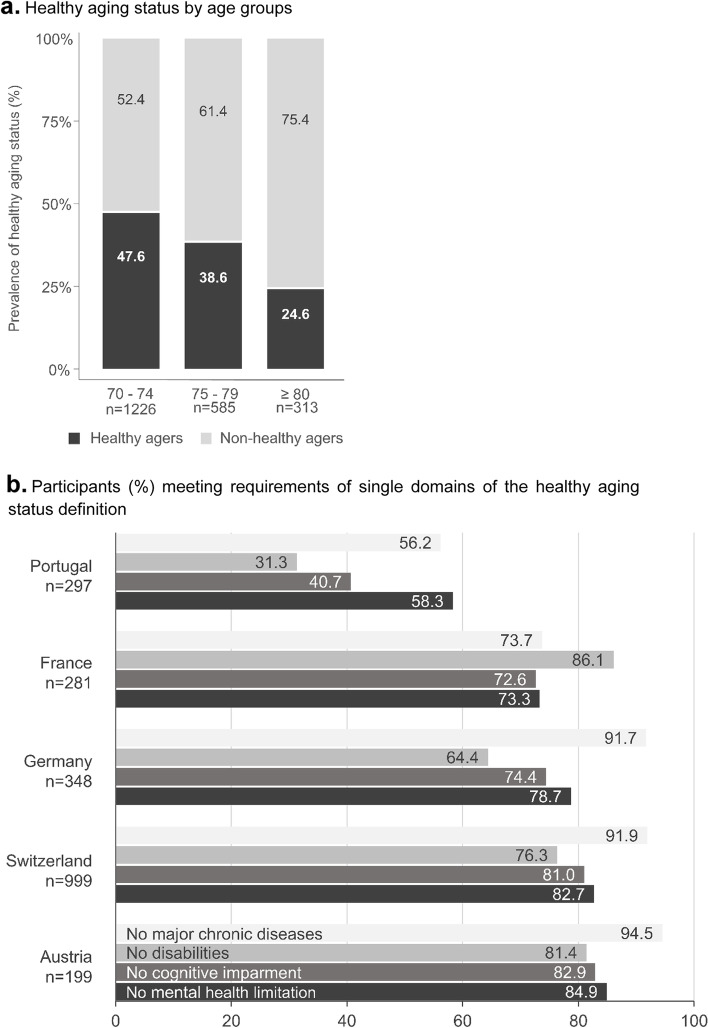
Cross-sectional analysis of DO-HEALTH baseline data. All 2,157 participants (mean age 74.9, SD 4.4; 61.7% women) were included and 2,123 had data for all domains of the healthy aging status (HA) definition. HA was assessed based on the Nurses` Health Study (NHS) definition requiring four domains: no major chronic diseases, no disabilities, no cognitive impairment (Montreal Cognitive Assessment, MoCA ≥25), no mental health limitation (GDS-5 <2, and no diagnosis of depression). Association between HA and age, BMI, gender, and physical function (sit-to-stand, gait speed, grip strength) was assessed by multivariate logistic regression analyses adjusting for center.
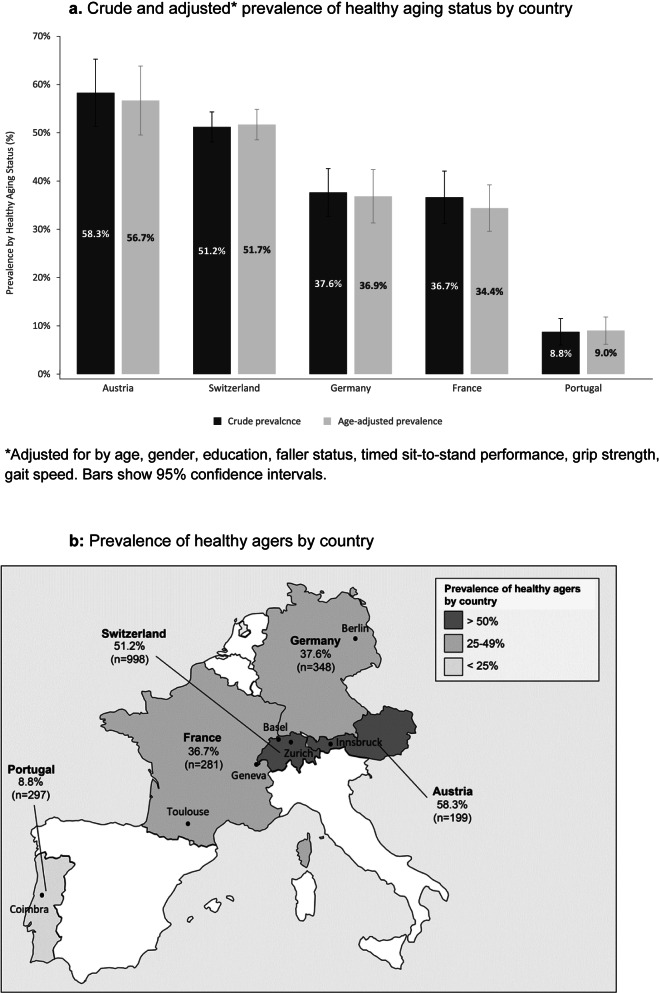
Overall, 41.8% of DO-HEALTH participants were healthy agers with significant variability by country: Austria (Innsbruck) 58.3%, Switzerland (Zurich, Basel, Geneva) 51.2%, Germany (Berlin) 37.6%, France (Toulouse) 36.7% and Portugal (Coimbra) 8.8% (p <0.0001). Differences in prevalence by country persisted after adjustment for age. In the multivariate model, younger age (OR = 0.95, 95% CI 0.93 to 0.98), female gender (OR = 1.36, 95% CI 1.03 to 1.81), lower BMI (OR = 0.94, 95% CI 0.91 to 0.96), faster gait speed (OR = 4.70, 95% CI 2.68 to 8.25) and faster performance in sit-to-stand test (OR = 0.90, 95% CI 0.87 to 0.93) were independently and significantly associated with HA.
Despite the same inclusion and exclusion criteria preselecting relatively healthy adults age 70 years and older, HA prevalence in DO-HEALTH varied significantly between countries and was highest in participants from Austria and Switzerland, lowest in participants from Portugal. Independent of country, younger age, female gender, lower BMI and better physical function were associated with HA.
DO-HEALTH was registered under the protocol NCT01745263 at the International Trials Registry ( clinicaltrials.gov ), and under the protocol number 2012-001249-41 at the Registration at the European Community Clinical Trial System (EudraCT).
本研究旨在比较来自 5 个欧洲国家的参加 DO-HEALTH 临床试验的 70 岁及以上成年人的健康老龄化流行率。参与者被选为无既往重大健康事件者。
本研究为 DO-HEALTH 基线数据的横断面分析。共纳入 2157 名参与者(平均年龄 74.9 岁,标准差 4.4 岁;61.7%为女性),其中 2123 名参与者的健康老龄化状态(HA)定义的所有领域均有数据。HA 基于护士健康研究(NHS)定义进行评估,需要四个领域:无主要慢性疾病、无残疾、无认知障碍(蒙特利尔认知评估,MoCA≥25)、无心理健康限制(GDS-5<2,且无抑郁诊断)。采用多元逻辑回归分析调整中心后,评估 HA 与年龄、BMI、性别和身体功能(从坐到站、步态速度、握力)之间的关联。
总体而言,DO-HEALTH 参与者中有 41.8%为健康老龄化者,且各国间存在显著差异:奥地利(因斯布鲁克)为 58.3%、瑞士(苏黎世、巴塞尔、日内瓦)为 51.2%、德国(柏林)为 37.6%、法国(图卢兹)为 36.7%和葡萄牙(科英布拉)为 8.8%(p<0.0001)。经年龄调整后,各国间的患病率差异仍然存在。在多变量模型中,年龄较小(OR=0.95,95%CI 0.93 至 0.98)、女性(OR=1.36,95%CI 1.03 至 1.81)、较低的 BMI(OR=0.94,95%CI 0.91 至 0.96)、较快的步态速度(OR=4.70,95%CI 2.68 至 8.25)和较快的从坐到站测试表现(OR=0.90,95%CI 0.87 至 0.93)与 HA 独立且显著相关。
尽管 DO-HEALTH 采用相同的纳入和排除标准,预先选择了相对健康的 70 岁及以上成年人,但各国间的 HA 患病率存在显著差异,奥地利和瑞士参与者的患病率最高,葡萄牙参与者的患病率最低。与国家无关,年龄较小、女性、较低的 BMI 和较好的身体功能与 HA 相关。
DO-HEALTH 在国际试验注册处(clinicaltrials.gov)根据协议 NCT01745263 进行注册,并根据协议号 2012-001249-41 在欧洲共同体临床试验系统(EudraCT)进行注册。