Torch Consortium FAMPOP Faculty of Medicine and Health Sciences, University of Antwerp, Antwerp, Belgium.
ADReM Data Lab, Department of Computer Science, University of Antwerp, Antwerp, Belgium.
BMC Med Inform Decis Mak. 2022 Mar 2;22(1):56. doi: 10.1186/s12911-022-01790-0.
Personalized medicine tailors care based on the patient's or pathogen's genotypic and phenotypic characteristics. An automated Clinical Decision Support System (CDSS) could help translate the genotypic and phenotypic characteristics into optimal treatment and thus facilitate implementation of individualized treatment by less experienced physicians.
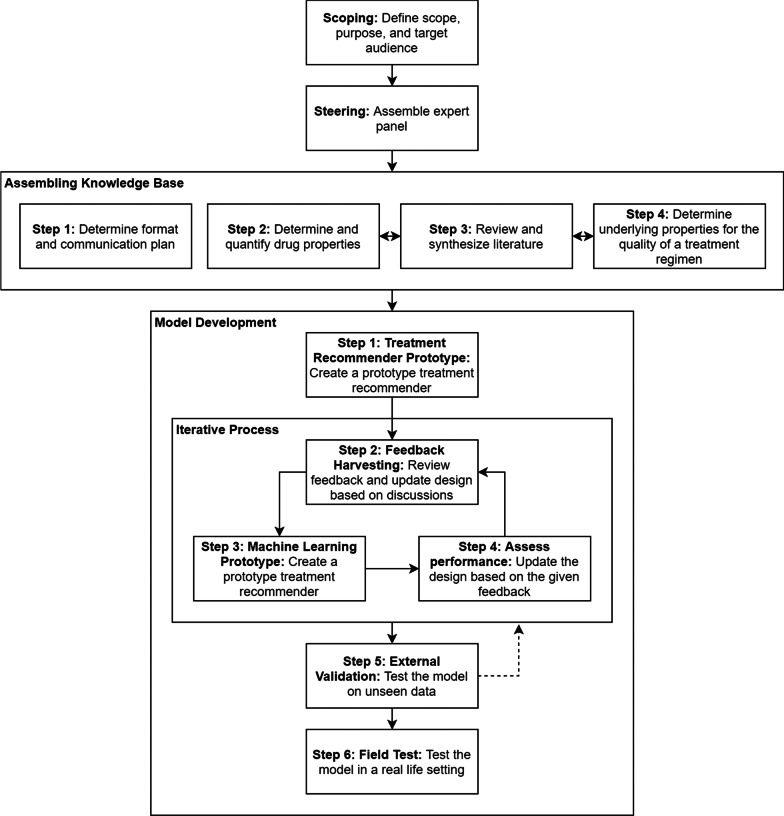
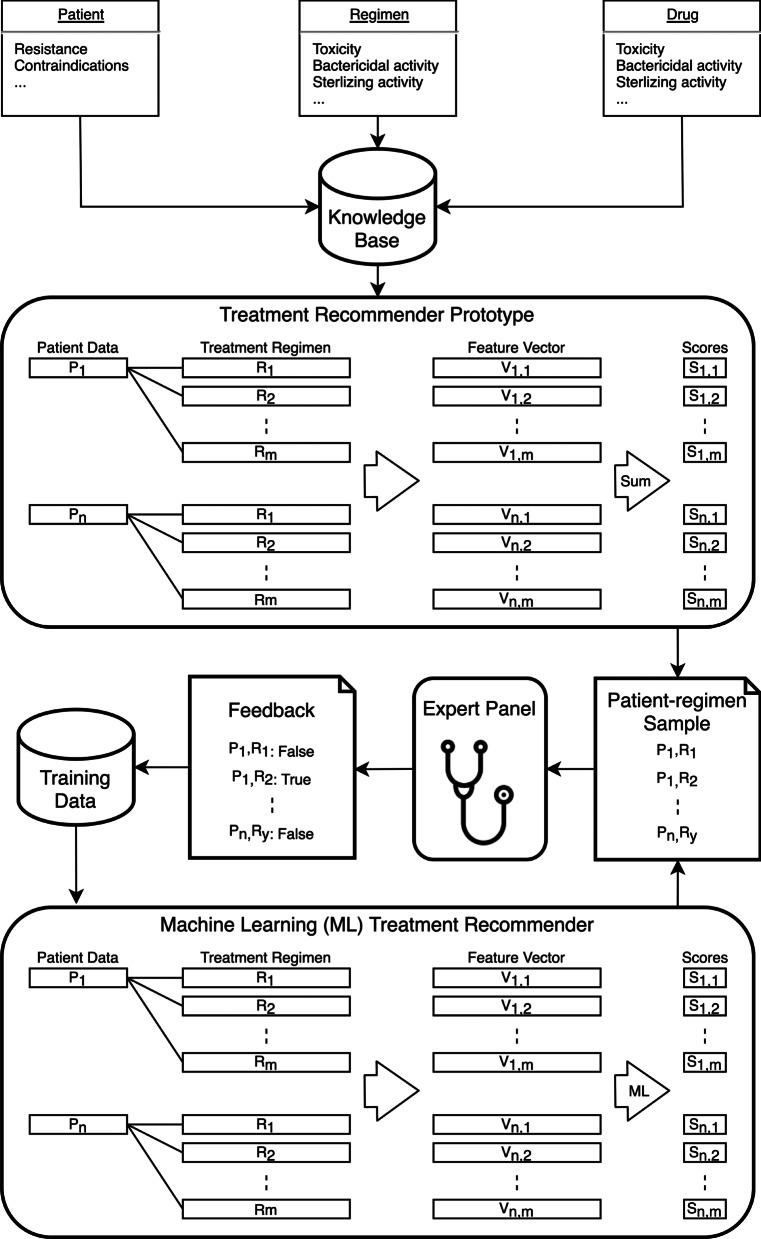
We developed a hybrid knowledge- and data-driven treatment recommender CDSS. Stakeholders and experts first define the knowledge base by identifying and quantifying drug and regimen features for the prototype model input. In an iterative manner, feedback from experts is harvested to generate model training datasets, machine learning methods are applied to identify complex relations and patterns in the data, and model performance is assessed by estimating the precision at one, mean reciprocal rank and mean average precision. Once the model performance no longer iteratively increases, a validation dataset is used to assess model overfitting.
We applied the novel methodology to develop a treatment recommender CDSS for individualized treatment of drug resistant tuberculosis as a proof of concept. Using input from stakeholders and three rounds of expert feedback on a dataset of 355 patients with 129 unique drug resistance profiles, the model had a 95% precision at 1 indicating that the highest ranked treatment regimen was considered appropriate by the experts in 95% of cases. Use of a validation data set however suggested substantial model overfitting, with a reduction in precision at 1 to 78%.
Our novel and flexible hybrid knowledge- and data-driven treatment recommender CDSS is a first step towards the automation of individualized treatment for personalized medicine. Further research should assess its value in fields other than drug resistant tuberculosis, develop solid statistical approaches to assess model performance, and evaluate their accuracy in real-life clinical settings.
个性化医学根据患者或病原体的基因型和表型特征来定制护理。自动化临床决策支持系统(CDSS)可以帮助将基因型和表型特征转化为最佳治疗方案,从而帮助经验较少的医生实施个体化治疗。
我们开发了一种混合知识和数据驱动的治疗推荐 CDSS。利益相关者和专家首先通过确定和量化原型模型输入的药物和方案特征来定义知识库。以迭代的方式,从专家那里收集反馈信息,生成模型训练数据集,应用机器学习方法识别数据中的复杂关系和模式,并通过估计精度、平均倒数秩和平均平均精度来评估模型性能。一旦模型性能不再迭代提高,就会使用验证数据集来评估模型的过拟合。
我们应用新方法开发了一种针对耐药结核病个体化治疗的治疗推荐 CDSS,作为概念验证。使用来自利益相关者的输入以及专家对 355 名患者的 129 个独特耐药谱数据集进行三轮反馈,该模型在 1 处的精度达到 95%,表明在 95%的情况下,最高排名的治疗方案被专家认为是合适的。然而,使用验证数据集表明模型存在严重的过拟合,在 1 处的精度降低到 78%。
我们的新型灵活的混合知识和数据驱动的治疗推荐 CDSS 是迈向个性化医学个体化治疗自动化的第一步。进一步的研究应该评估其在耐药结核病以外的领域的价值,开发评估模型性能的可靠统计方法,并评估其在实际临床环境中的准确性。