Department of Biomedical Engineering, Whiting School of Engineering, Johns Hopkins University, Baltimore, Maryland, USA.
Department of Radiation Oncology and Molecular Radiation Sciences, Johns Hopkins University School of Medicine, Baltimore, Maryland, USA.
Wiley Interdiscip Rev Nanomed Nanobiotechnol. 2022 May;14(3):e1779. doi: 10.1002/wnan.1779. Epub 2022 Mar 3.
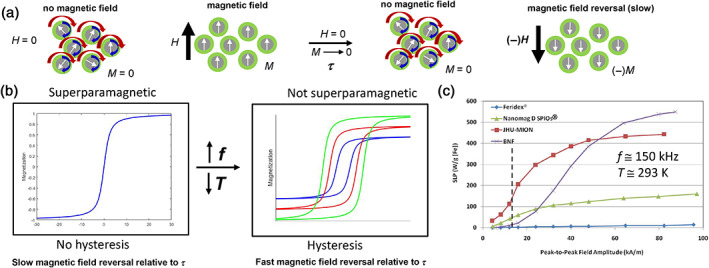
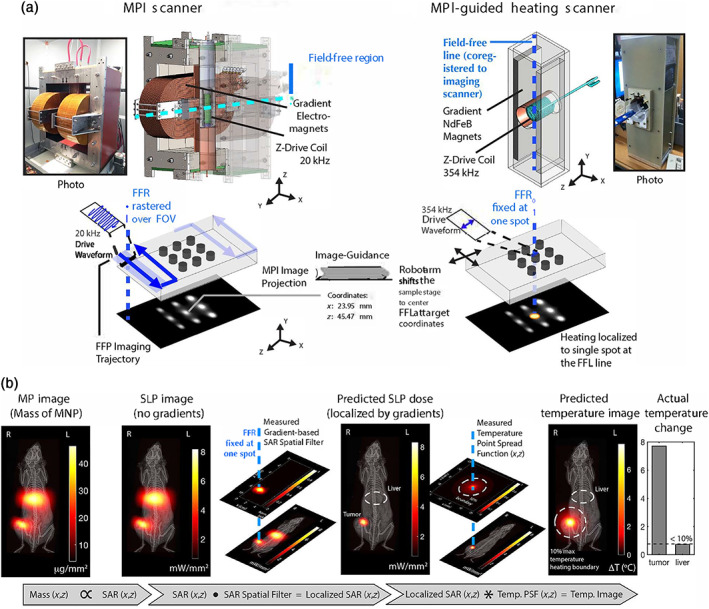
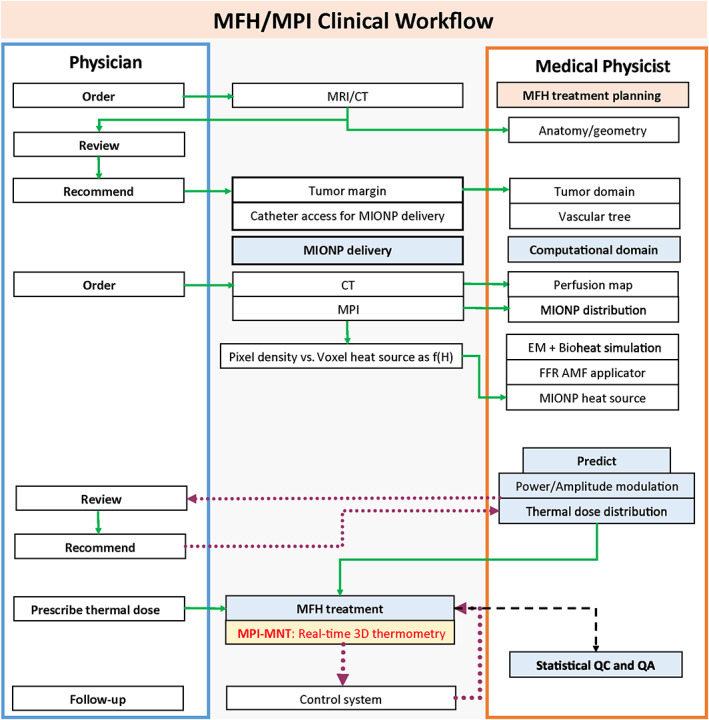
Magnetic nanomaterials that respond to clinical magnetic devices have significant potential as cancer nanotheranostics. The complexities of their physics, however, introduce challenges for these applications. Hyperthermia is a heat-based cancer therapy that improves treatment outcomes and patient survival when controlled energy delivery is combined with accurate thermometry. To date, few technologies have achieved the needed evolution for the demands of the clinic. Magnetic fluid hyperthermia (MFH) offers this potential, but to be successful it requires particle-imaging technology that provides real-time thermometry. Presently, the only technology having the potential to meet these requirements is magnetic particle imaging (MPI), for which a proof-of-principle demonstration with MFH has been achieved. Successful clinical translation and adoption of integrated MPI/MFH technology will depend on successful resolution of the technological challenges discussed. This article is categorized under: Therapeutic Approaches and Drug Discovery > Nanomedicine for Oncologic Disease Diagnostic Tools > In Vivo Nanodiagnostics and Imaging.
对临床磁设备有响应的磁性纳米材料在癌症纳米治疗学中有很大的应用潜力。然而,它们的物理复杂性给这些应用带来了挑战。热疗是一种基于热量的癌症治疗方法,当控制能量传递与精确的测温相结合时,可以改善治疗效果和患者的生存率。迄今为止,很少有技术能够满足临床的需求。磁流体热疗(MFH)具有这种潜力,但要成功,它需要提供实时测温的粒子成像技术。目前,唯一有可能满足这些要求的技术是磁粒子成像(MPI),已经用 MFH 对其进行了原理验证演示。集成 MPI/MFH 技术的成功临床转化和应用将取决于对所讨论的技术挑战的成功解决。本文属于以下类别:治疗方法和药物发现 > 用于肿瘤疾病的纳米医学 > 体内纳米诊断和成像。