Shakeri-Zadeh Ali, Kuddannaya Shreyas, Bibic Adnan, Bulte Jeff W M
The Russell H. Morgan Department of Radiology and Radiological Science, Division of MR Research, The Johns Hopkins University School of Medicine, Baltimore, MD, USA.
Cellular Imaging Section and Vascular Biology Program, Institute for Cell Engineering, The Johns Hopkins University School of Medicine, Baltimore, MD, USA.
Npj Imaging. 2025 May 6;3(1):20. doi: 10.1038/s44303-025-00084-0.
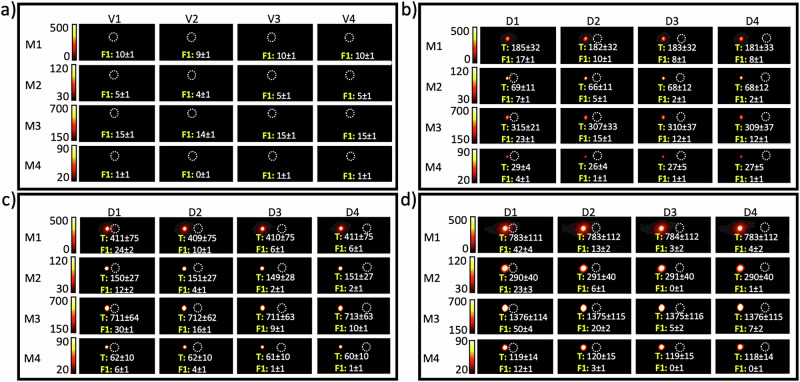
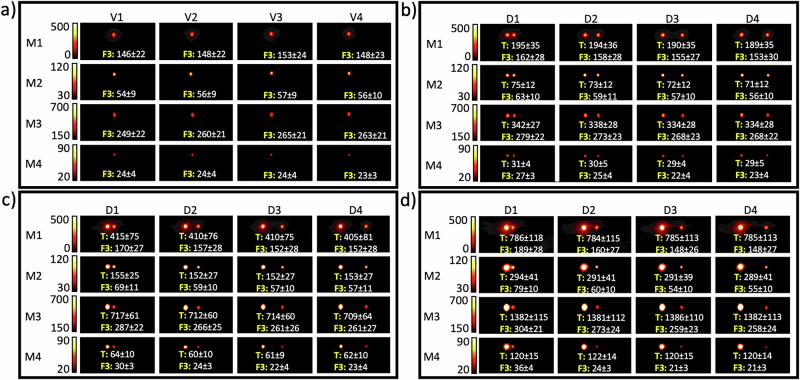
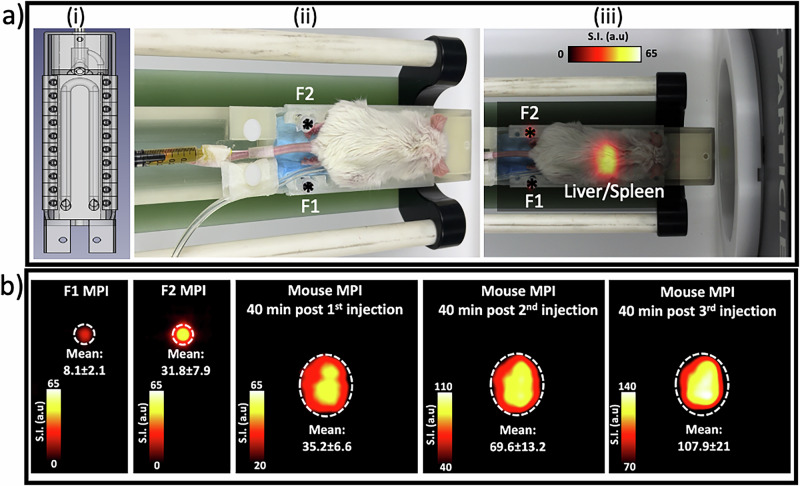
Accurate quantification of the magnetic particle imaging (MPI) signal in vivo remains a significant technical challenge. We assessed the "spillover effect", defined as leakage of signal from adjacent areas within a region of interest, within a field of view containing multiple hot spots, a scenario frequently encountered in vivo after systemic administration of a magnetic tracer. Using custom-designed phantom and in vivo mouse studies we determined the impact of fiducial positioning, iron content, and the iron concentration ratios within those hot spots, as well as the suitability of four different MPI scan modes for accurate signal quantification. Adjustment of the specific "target-to-fiducial distance (TFD)" and "target-to-fiducial Fe concentration ratios (TFCR)" significantly reduced the spillover effect. It's implementation to mitigate spillover effects will increase the accuracy of MPI for in vivo magnetic tracer quantification.
在体内对磁粒子成像(MPI)信号进行准确量化仍然是一项重大的技术挑战。我们评估了“溢出效应”,其定义为在包含多个热点的视野范围内,感兴趣区域内信号从相邻区域泄漏的情况,这是在全身注射磁性示踪剂后体内经常遇到的场景。通过定制设计的体模和体内小鼠研究,我们确定了基准定位、铁含量、这些热点内的铁浓度比的影响,以及四种不同MPI扫描模式对准确信号量化的适用性。调整特定的“目标到基准距离(TFD)”和“目标到基准铁浓度比(TFCR)”可显著降低溢出效应。实施该方法以减轻溢出效应将提高MPI在体内磁性示踪剂量化方面的准确性。