Department of Medical Ultrasonics, Institute of Diagnostic and Interventional Ultrasound, The First Affiliated Hospital of Sun Yat-Sen University, 58 Zhongshan Road 2, Guangzhou, 510080, People's Republic of China.
Department of Hepatobiliary Surgery, The First Affiliated Hospital of Sun Yat-Sen University, Guangzhou, China.
BMC Med Imaging. 2022 Mar 3;22(1):36. doi: 10.1186/s12880-022-00765-x.
The imaging findings of combined hepatocellular cholangiocarcinoma (CHC) may be similar to those of hepatocellular carcinoma (HCC). CEUS LI-RADS may not perform well in distinguishing CHC from HCC. Studies have shown that radiomics has an excellent imaging analysis ability. This study aimed to establish and confirm an ultrasomics model for differentiating CHC from HCC.
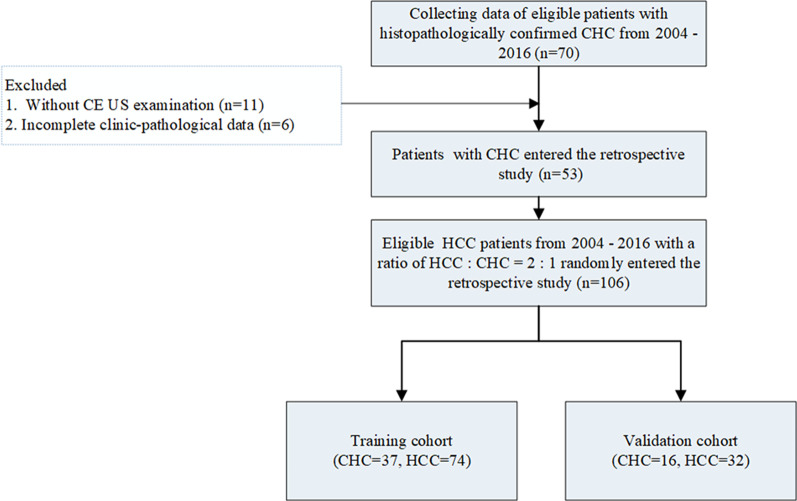
Between 2004 and 2016, we retrospectively identified 53 eligible CHC patients and randomly included 106 eligible HCC patients with a ratio of HCC:CHC = 2:1, all of whom were categorized according to Contrast-Enhanced (CE) ultrasonography (US) Liver Imaging Reporting and Data System (LI-RADS) version 2017. The model based on ultrasomics features of CE US was developed in 74 HCC and 37 CHC and confirmed in 32 HCC and 16 CHC. The diagnostic performance of the LI-RADS or ultrasomics model was assessed by the area under the curve (AUC), accuracy, sensitivity and specificity.
In the entire and validation cohorts, 67.0% and 81.3% of HCC cases were correctly assigned to LR-5 or LR-TIV contiguous with LR-5, and 73.6% and 87.5% of CHC cases were assigned to LR-M correctly. Up to 33.0% of HCC and 26.4% of CHC were misclassified by CE US LI-RADS. A total of 90.6% of HCC as well as 87.5% of CHC correctly diagnosed by the ultrasomics model in the validation cohort. The AUC, accuracy, sensitivity of the ultrasomics model were higher though without significant difference than those of CE US LI-RADS in the validation cohort.
The proposed ultrasomics model showed higher ability though the difference was not significantly different for differentiating CHC from HCC, which may be helpful in clinical diagnosis.
混合细胞型肝癌(CHC)的影像学表现可能与肝细胞癌(HCC)相似。CEUS LI-RADS 可能无法很好地区分 CHC 与 HCC。研究表明,放射组学具有出色的影像分析能力。本研究旨在建立和验证一种超声组学模型,用于区分 CHC 与 HCC。
回顾性纳入 2004 年至 2016 年间符合条件的 53 例 CHC 患者,随机纳入符合条件的 HCC 患者 106 例,HCC:CHC 比例为 2:1,并按照对比增强超声(CEUS)肝脏影像报告和数据系统(LI-RADS)版本 2017 进行分类。在 74 例 HCC 和 37 例 CHC 中建立基于 CEUS 超声组学特征的模型,并在 32 例 HCC 和 16 例 CHC 中进行验证。通过曲线下面积(AUC)、准确性、敏感性和特异性评估 LI-RADS 或超声组学模型的诊断性能。
在整个队列和验证队列中,67.0%和 81.3%的 HCC 病例被正确分配到 LR-5 或与 LR-5 连续的 LR-TIV,73.6%和 87.5%的 CHC 病例被正确分配到 LR-M。CEUS LI-RADS 错误分类 HCC 为 33.0%,CHC 为 26.4%。验证队列中,超声组学模型对 HCC 的诊断准确率为 90.6%,对 CHC 的诊断准确率为 87.5%。验证队列中,超声组学模型的 AUC、准确性、敏感性均高于 CEUS LI-RADS,但差异无统计学意义。
提出的超声组学模型在区分 CHC 与 HCC 方面具有更高的能力,尽管差异无统计学意义,但可能有助于临床诊断。