Faculty of Human Life Science, Miyagi Gakuin Women's University, 9-1-1 Sakuragaoka, Aobaku, Sendai, 981-8557, Japan.
Department of First Internal Medicine, Nagasaki University, Nagasaki, Japan.
BMC Cancer. 2022 Mar 3;22(1):235. doi: 10.1186/s12885-022-09341-6.
Overdiagnosis of thyroid cancer has become a major global medical issue. Ultrasound-based thyroid cancer screening has promoted overdiagnosis, and recently international recommendations state that it should not be conducted, even after a nuclear accident. The Fukushima thyroid cancer screening program was initiated in 2011 as a health policy after the nuclear accident. The risk of radiation-induced thyroid cancer was unlikely given the low radiation levels, but the thyroid cancer screening program has continued at 2-year intervals with a relatively high participation rate and is now in its fifth round. It is therefore crucial to clarify whether those targeted for screening understand the disadvantages of screening, and to identify factors that influenced their decision to participate.
We conducted an anonymous mail-based questionnaire among young people from Fukushima Prefecture (subjects) and a neighboring prefecture that was not targeted for screening (non-subjects). We asked them about the significance of the thyroid cancer screening in Fukushima Prefecture, their reasons for accepting or refusing screening, their perception of the harms of screening, and their opinions on thyroid examination at school. We compared the results of the questionnaire between subjects and non-subjects and between examinees (who were screened) and non-examinees (who declined screening).
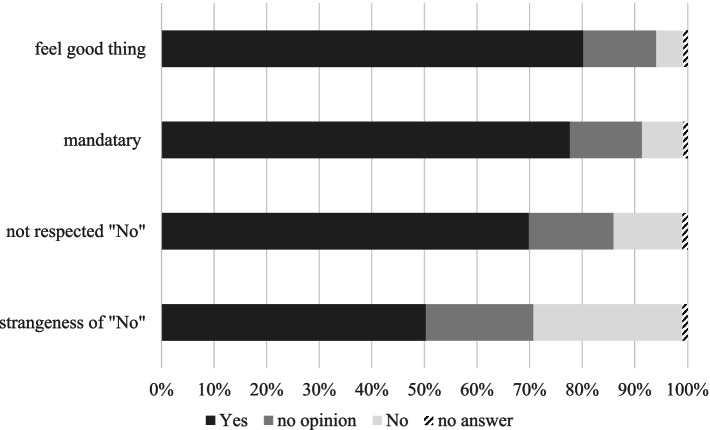
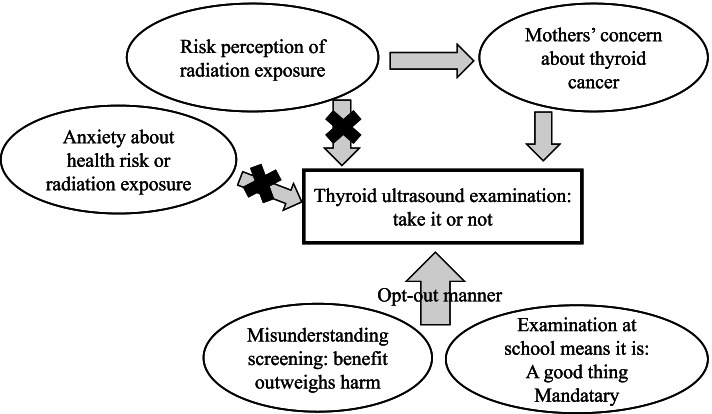
Only 16.5% of respondents were aware of the harms associated with thyroid cancer screening, with most perceiving that the benefits outweighed the harms. Comparison of subjects' and non-subjects' responses showed there were no significant differences between the two groups. Among subjects, there were also no differences in responses between examinees and non-examinees. The most common reason for participation in screening was that the screening was conducted in schools and perceived as obligatory.
These results highlighted a serious ethical issue in that school-based screening leads to making young people think that it is mandatory screening in an opt-out and default setting manner, with a lack of knowledge about the disadvantages of screening. Based on the autonomy of the subjects and the ethical principle of the post-disaster, surveys after a nuclear disaster should be conducted in an opt-in style without an opt-out style such as school-based screening.
甲状腺癌的过度诊断已成为一个全球性的医学问题。基于超声的甲状腺癌筛查促进了过度诊断,最近国际建议指出,即使在核事故后也不应进行这种筛查。福岛甲状腺癌筛查计划于 2011 年核事故后作为一项健康政策启动。鉴于辐射水平较低,发生辐射诱导的甲状腺癌的风险不大,但甲状腺癌筛查计划仍以每两年一次的间隔继续进行,参与率相对较高,现已进入第五轮。因此,必须明确接受筛查的人群是否了解筛查的弊端,并确定影响他们参与决策的因素。
我们对来自福岛县(对象)和未进行筛查的邻县(非对象)的年轻人进行了匿名邮寄问卷调查。我们询问了他们对福岛县甲状腺癌筛查的重要性、接受或拒绝筛查的原因、对筛查危害的认识以及对学校甲状腺检查的看法。我们比较了对象和非对象以及检查者(接受筛查)和非检查者(拒绝筛查)之间的问卷结果。
只有 16.5%的受访者意识到与甲状腺癌筛查相关的危害,大多数人认为筛查的益处大于危害。对象和非对象的比较结果显示,两组之间没有显著差异。在对象中,检查者和非检查者之间的反应也没有差异。参与筛查的最常见原因是筛查在学校进行,被认为是强制性的。
这些结果突出了一个严重的伦理问题,即基于学校的筛查导致年轻人认为这是一种在默认设置下的强制性筛查,而对筛查的弊端缺乏了解。基于受试者的自主性和核灾难后的伦理原则,核灾难后的调查应采用选择加入方式进行,而不是采用学校筛查等选择退出方式。