Ross Aaron M, Osella Silvio, Policht Veronica R, Zheng Meng, Maggini Michele, Marangi Fabio, Cerullo Giulio, Gatti Teresa, Scotognella Francesco
Department of Physics, Politecnico di Milano, Piazza Leonardo da Vinci 32, 20133 Milano, Italy.
Chemical and Biological Systems Simulation Lab, Centre of New Technologies, University of Warsaw, Banacha 2C, 02-097 Warsaw, Poland.
J Phys Chem C Nanomater Interfaces. 2022 Feb 24;126(7):3569-3581. doi: 10.1021/acs.jpcc.1c10570. Epub 2022 Feb 16.
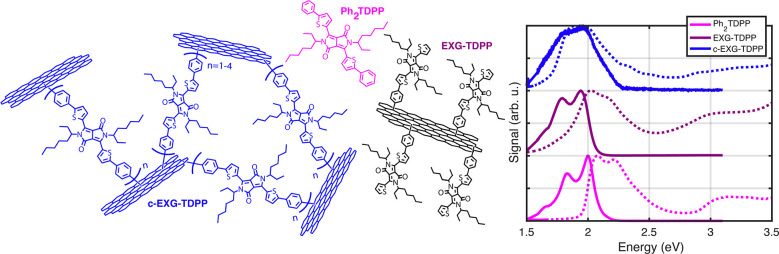
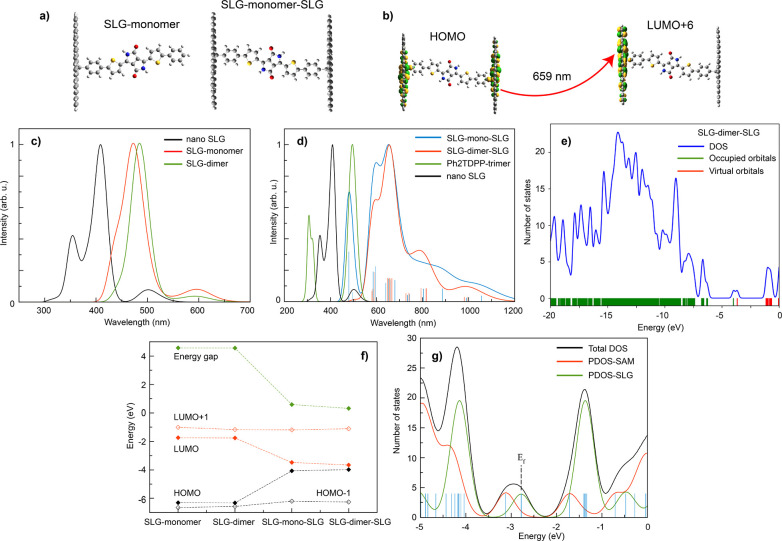
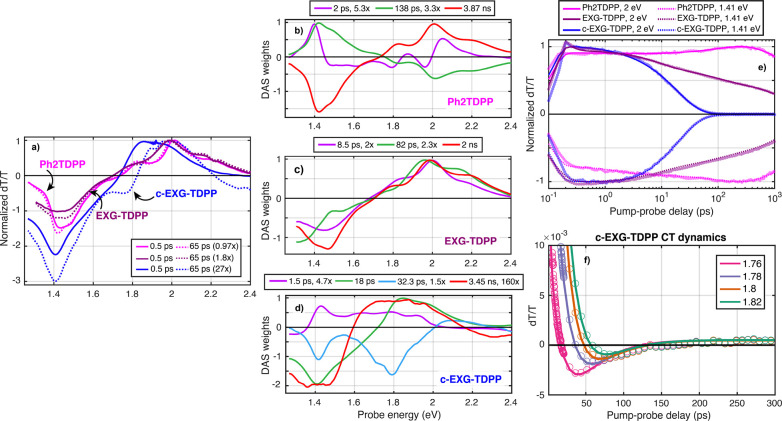
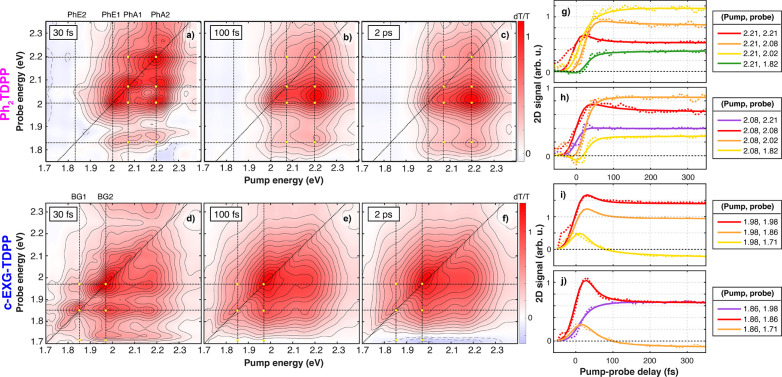
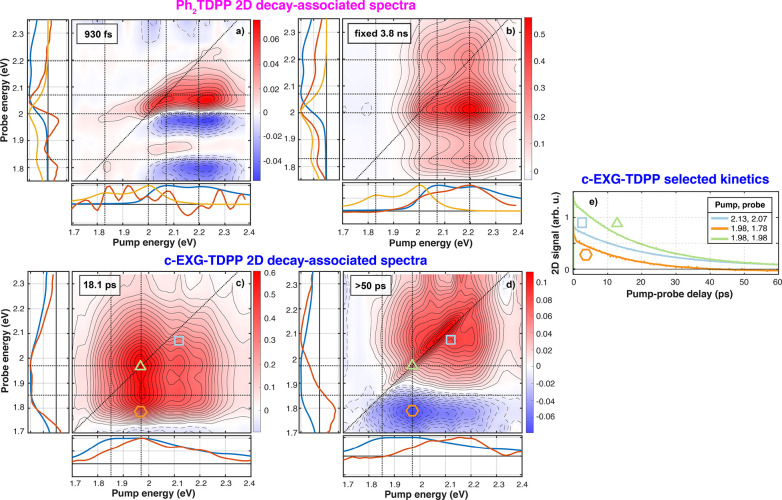
The search for synthetic materials that mimic natural photosynthesis by converting solar energy into other more useful forms of energy is an ever-growing research endeavor. Graphene-based materials, with their exceptional electronic and optical properties, are exemplary candidates for high-efficiency solar energy harvesting devices. High photoactivity can be conveniently achieved by functionalizing graphene with small molecule organic semiconductors whose band-gaps can be tuned by structural modification, leading to interactions between the π-conjugated electronic systems in both the semiconductor and graphene. Here we investigate the ultrafast transient optical properties of a cross-linked graphene-dye (diphenyl-dithiophenediketopyrrolopyrrole) nanohybrid material, in which oligomers of the organic semiconductor dye are covalently bound to a random network of few-layer graphene flakes, and compare the results to those obtained for the reference dye monomer. Using a combination of ultrafast transient absorption and two-dimensional electronic spectroscopy, we provide substantial evidence for photoinduced charge transfer that occurs within 18 ps in the nanohybrid system. Notably, subpicosecond photoinduced torsional relaxation observed in the constituent dye monomer is absent in the cross-linked nanohybrid system. Through density functional theory calculations, we compare the competing effects of covalent bonding, increasing conjugation length, and the presence of multiple graphene flakes. We find evidence that the observed ultrafast charge transfer process occurs through a superexchange mechanism in which the oligomeric dye bridge provides virtual states enabling charge transfer between graphene-dye covalent bond sites.
寻找能够通过将太阳能转化为其他更有用的能量形式来模拟自然光合作用的合成材料,是一项不断发展的研究工作。基于石墨烯的材料具有卓越的电子和光学特性,是高效太阳能收集装置的典范候选材料。通过用小分子有机半导体对石墨烯进行功能化,可以方便地实现高光活性,这些小分子有机半导体的带隙可以通过结构修饰来调节,从而导致半导体和石墨烯中π共轭电子系统之间的相互作用。在这里,我们研究了一种交联的石墨烯-染料(二苯基二噻吩二酮吡咯并吡咯)纳米杂化材料的超快瞬态光学性质,其中有机半导体染料的低聚物共价连接到几层石墨烯薄片的随机网络上,并将结果与参考染料单体的结果进行比较。通过结合超快瞬态吸收和二维电子光谱,我们提供了大量证据,证明在纳米杂化系统中18皮秒内发生了光致电荷转移。值得注意的是,在交联的纳米杂化系统中不存在在组成染料单体中观察到的亚皮秒光致扭转弛豫。通过密度泛函理论计算,我们比较了共价键合、增加共轭长度和多个石墨烯薄片的存在所产生的竞争效应。我们发现证据表明,观察到的超快电荷转移过程是通过一种超交换机制发生的,其中低聚物染料桥提供了虚拟态,使得电荷能够在石墨烯-染料共价键位点之间转移。