Ebina Junya, Ebihara Satoru, Kano Osamu
Department of Neurology, Toho University Faculty of Medicine, Tokyo, Japan.
Department of Rehabilitation Medicine, Toho University Graduate School of Medicine, Tokyo, Japan.
Geriatr Gerontol Int. 2022 Apr;22(4):259-270. doi: 10.1111/ggi.14362. Epub 2022 Mar 3.
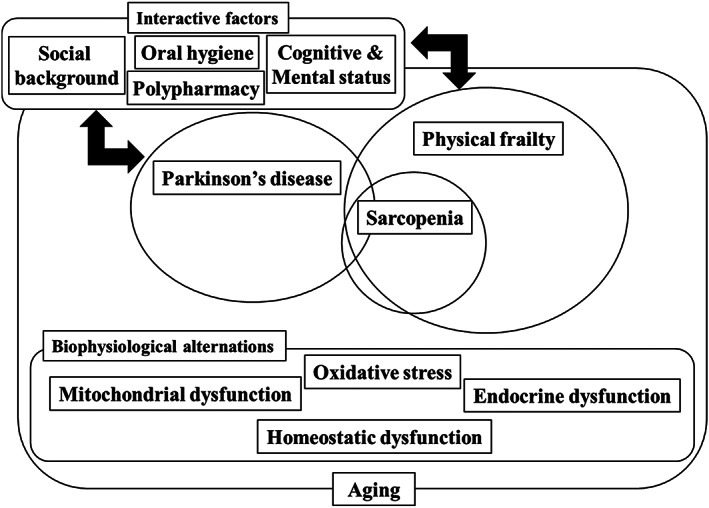
Parkinson's disease is a neurodegenerative disorder clinically characterized by bradykinesia, rest tremor, rigidity, and postural and gait disturbances, which are frequently observed in older people. It also shows non-motor symptoms, such as depression, anxiety, cognitive impairment and dementia. The number of patients is gradually increasing worldwide. Aging is a risk factor for the onset of Parkinson's disease, and various physiological effects of aging influence its progression. Frailty is a geriatric syndrome in which the reversible and vulnerable status between robustness and disability is affected by various physiological stressors with aging. Frailty consists of physical, psychological and social aspects. Furthermore, sarcopenia, a syndrome characterized by the loss of muscle mass, strength and function, is also significantly associated with frailty. To maintain the quality of life of older people, frailty, including sarcopenia, should be quickly and appropriately managed. Polypharmacy is an important factor causing the progression of frailty in geriatric syndrome. Although Parkinson's disease and frailty have similar symptoms, and are considered to affect each other, the clinical features and mechanisms of both largely remain unclear. Nevertheless, little literature on the relationship between frailty and Parkinson's disease is currently available. This narrative review aims to clarify the relationships between Parkinson's disease and frailty, not only on the physical, but also on the mental, cognitive, and social aspects and issues regarding polypharmacy in Parkinson's disease explored by previous studies. Geriatr Gerontol Int 2022; 22: 259-270.
帕金森病是一种神经退行性疾病,临床上以运动迟缓、静止性震颤、肌强直以及姿势和步态障碍为特征,这些症状在老年人中很常见。它还表现出非运动症状,如抑郁、焦虑、认知障碍和痴呆。全球帕金森病患者数量正在逐渐增加。衰老为帕金森病的发病风险因素,衰老的各种生理效应会影响其病情进展。衰弱是一种老年综合征,随着年龄增长,其在强健和残疾之间的可逆且脆弱状态会受到各种生理应激源的影响。衰弱包括身体、心理和社会等方面。此外,肌少症是一种以肌肉质量、力量和功能丧失为特征的综合征,也与衰弱显著相关。为维持老年人的生活质量,应迅速且适当地处理包括肌少症在内的衰弱问题。多重用药是导致老年综合征中衰弱进展的一个重要因素。尽管帕金森病和衰弱有相似症状,且被认为相互影响,但其临床特征和机制在很大程度上仍不明确。然而,目前关于衰弱与帕金森病之间关系的文献较少。本叙述性综述旨在阐明帕金森病与衰弱之间的关系,不仅涉及身体方面,还包括心理、认知和社会方面,以及以往研究中探讨的帕金森病多重用药问题。《老年医学与老年病学国际杂志》2022年;22卷:259 - 270页