Enteric Neuroscience Program, Mayo Clinic, Rochester, Minnesota.
Section of Pharmacology and Toxicology, Department of Neuroscience, Psychology, Drug Research and Child Health (NEUROFARBA), University of Florence, Florence, Italy.
Cell Mol Gastroenterol Hepatol. 2022;13(6):1849-1862. doi: 10.1016/j.jcmgh.2022.02.017. Epub 2022 Mar 2.
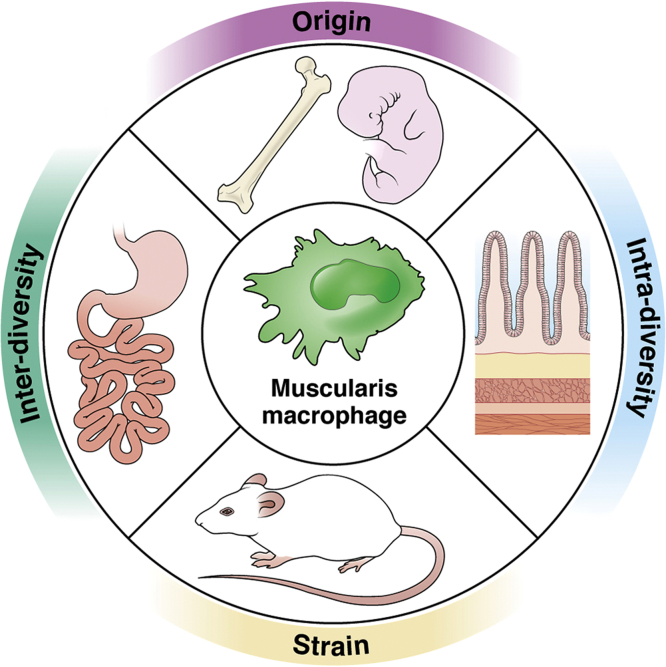
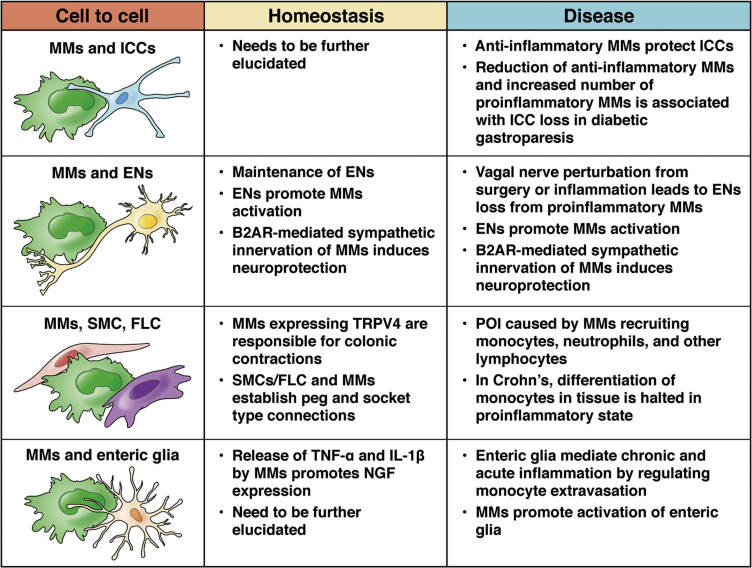
The gut contains the largest macrophage pool in the body, with populations of macrophages residing in the mucosa and muscularis propria of the gastrointestinal (GI) tract. Muscularis macrophages (MMs), which are located within the muscularis propria, interact with cells essential for GI function, such as interstitial cells of Cajal, enteric neurons, smooth muscle cells, enteric glia, and fibroblast-like cells, suggesting that these immune cells contribute to several aspects of GI function. This review focuses on the latest insights on the factors contributing to MM heterogeneity and the functional interaction of MMs with other cell types essential for GI function. This review integrates the latest findings on macrophages in other organs with increasing knowledge of MMs to better understand their role in a healthy and diseased gut. We describe the factors that contribute to (muscularis macrophage) MM heterogeneity, and the nature of MM interactions with cells regulating GI function. Finally, we also describe the increasing evidence suggesting a critical role of another immune cell type, the mast cell, in normal and diseased GI physiology.
肠道包含体内最大的巨噬细胞池,其中巨噬细胞存在于胃肠道(GI)的黏膜和肌层中。位于肌层中的肌层巨噬细胞(MMs)与对 GI 功能至关重要的细胞相互作用,如 Cajal 间质细胞、肠神经元、平滑肌细胞、肠胶质细胞和成纤维样细胞,这表明这些免疫细胞有助于 GI 功能的几个方面。这篇综述重点介绍了导致 MM 异质性的最新因素以及 MMs 与对 GI 功能至关重要的其他细胞类型之间的功能相互作用。本综述将其他器官中巨噬细胞的最新发现与对 MMs 的日益了解相结合,以更好地理解它们在健康和患病肠道中的作用。我们描述了导致(肌层巨噬细胞)MM 异质性的因素,以及 MM 与调节 GI 功能的细胞相互作用的性质。最后,我们还描述了越来越多的证据表明另一种免疫细胞类型——肥大细胞——在正常和患病的 GI 生理学中起着关键作用。