Centre for Nutrition, Prevention and Health Services, National Institute for Public Health and the Environment, Bilthoven, The Netherlands.
Institute of Health Sciences, VU University, Amsterdam, The Netherlands.
BMC Public Health. 2022 Mar 4;22(1):437. doi: 10.1186/s12889-022-12862-1.
This study aims to describe individual leisure-time physical activity patterns among Dutch adults over a 20-year period, and to compare baseline characteristics of participants with different patterns.
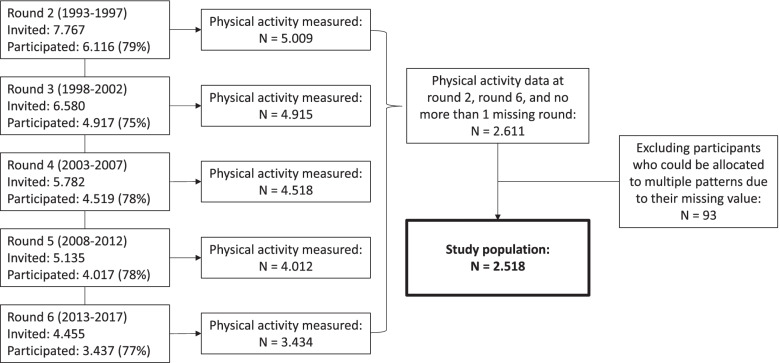
The study population consisted of 2,518 adults (53% women) aged 26-65 years at baseline, measured every 5 years over a 20-year period. Self-reported physical activity measurements (from 1994 to 2017) were used to compose five (predefined) patterns: stable active, becoming active, becoming inactive, stable inactive, and varying physical activity. Multivariate logistic regression analyses were used to compare baseline socio-demographic, lifestyle, and health-related characteristics of these patterns.
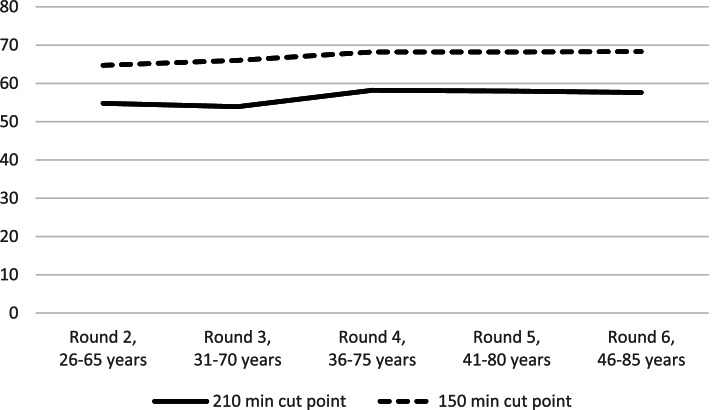
The total population shows a stable percentage being active in each round (between 55 and 58%). However over a period of 20 years, 32.6% of the participants were stable active, 19.9% were stable inactive, 15.2% became active, 11.6% became inactive, and 20.8% had varying physical activity behaviour. Compared to participants who were stable active, becoming active was associated with being 46-55 years old, having an intermediate level of education, and smoking, at baseline. Participants who became inactive were less likely to be 46-55 years old and more likely to be obese. Stable inactivity was associated with an intermediate level of education, low adherence to dietary guidelines, smoking, low levels of alcohol use and a moderate/poor perceived health. Participants with a varying physical activity level were more likely to have low adherence to dietary guidelines and to smoke.
Almost half of the participants changed their physical activity behaviour over 20 years. Baseline age, level of education, smoking, alcohol consumption, adherence to dietary guidelines, weight status and perceived health were associated with different physical activity patterns.
本研究旨在描述荷兰成年人在 20 年内的个体休闲时间体力活动模式,并比较不同模式参与者的基线特征。
研究人群由 2518 名 26-65 岁的成年人(女性占 53%)组成,在 20 年内每 5 年测量一次。使用自我报告的体力活动测量值(1994 年至 2017 年)组成五个(预先定义的)模式:稳定活跃、变得活跃、变得不活跃、稳定不活跃和体力活动变化。多变量逻辑回归分析用于比较这些模式的基线社会人口统计学、生活方式和与健康相关的特征。
总人口在每一轮中都表现出稳定的活跃百分比(在 55%至 58%之间)。然而,在 20 年内,32.6%的参与者为稳定活跃,19.9%为稳定不活跃,15.2%变得活跃,11.6%变得不活跃,20.8%的人具有变化的体力活动行为。与稳定活跃的参与者相比,变得活跃的参与者在基线时更可能处于 46-55 岁,具有中等教育水平并且吸烟。变得不活跃的参与者不太可能处于 46-55 岁,并且更有可能肥胖。稳定的不活跃与中等教育水平、低饮食指南依从性、吸烟、低酒精使用水平和中等/较差的感知健康相关。体力活动水平变化的参与者更有可能低饮食指南依从性和吸烟。
近一半的参与者在 20 年内改变了他们的体力活动行为。基线年龄、教育水平、吸烟、饮酒、饮食指南依从性、体重状况和感知健康与不同的体力活动模式相关。