Centre for Health, Exercise and Sports Medicine, Department of Physiotherapy, University of Melbourne, Melbourne, Victoria, Australia.
Department of Medicine (St Vincent's), University of Melbourne, Melbourne, Australia.
BMC Musculoskelet Disord. 2022 Mar 5;23(1):215. doi: 10.1186/s12891-022-05128-9.
Hip osteoarthritis (OA) is a leading cause of musculoskeletal pain. Exercise is a core recommended treatment. Despite some clinical guidelines also recommending weight loss for hip OA, there is no evidence from randomised controlled trials (RCT) to substantiate these recommendations. This superiority, 2-group, parallel RCT will compare a combined diet and exercise program to an exercise only program, over 6 months.
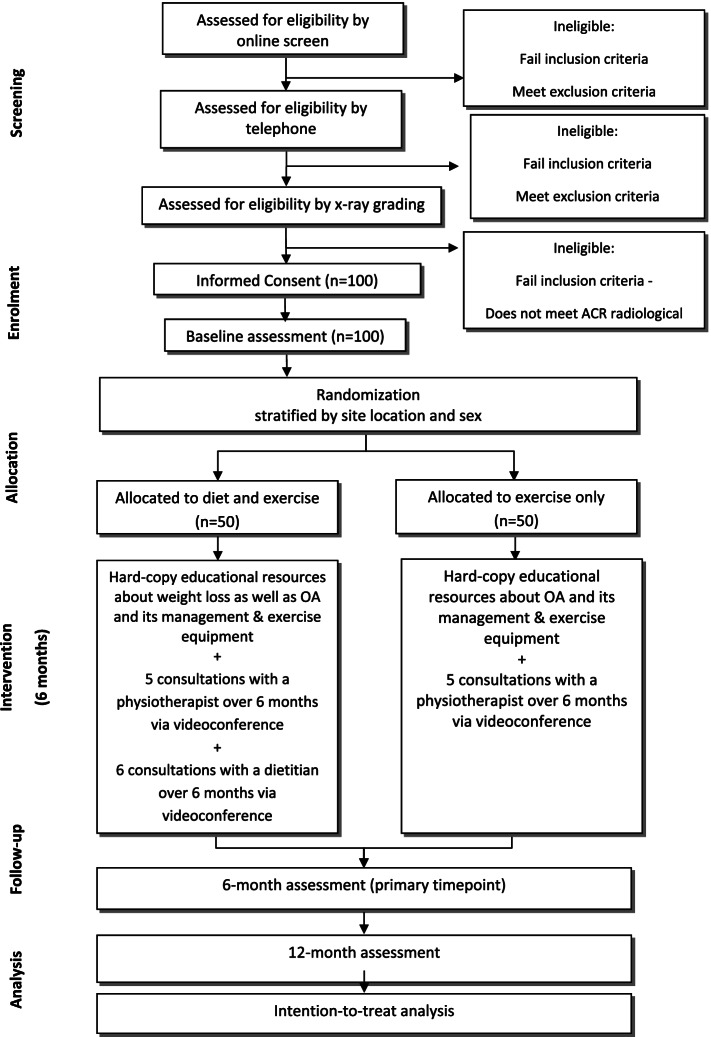
One hundred people with symptomatic and radiographic hip OA will be recruited from the community. Following baseline assessment, participants will be randomly allocated to either, i) diet and exercise or; ii) exercise only. Participants in the diet and exercise group will have six consultations with a dietitian and five consultations with a physiotherapist via videoconferencing over 6 months. The exercise only group will have five consultations with a physiotherapist via videoconferencing over 6 months. The exercise program for both groups will include prescription of strengthening exercise and a physical activity plan, advice about OA management and additional educational resources. The diet intervention includes prescription of a ketogenic very low-calorie diet with meal replacements and educational resources to support weight loss and healthy eating. Primary outcome is self-reported hip pain via an 11-point numeric rating scale (0 = 'no pain' and 10 = 'worst pain possible') at 6 months. Secondary outcomes include self-reported body weight (at 0, 6 and 12 months) and body mass index (at 0, 6 and 12 months), visceral fat (measured using dual energy x-ray absorptiometry at 0 and 6 months), pain, physical function, quality of life (all measured using subscales of the Hip Osteoarthritis Outcome Scale at 0, 6 and 12 months), and change in pain and physical activity (measured using 7-point global rating of change Likert scale at 6 and 12 months). Additional measures include adherence, adverse events and cost-effectiveness.
This study will determine whether a diet intervention in addition to exercise provides greater hip pain-relief, compared to exercise alone. Findings will assist clinicians in providing evidence-based advice regarding the effect of a dietary intervention on hip OA pain.
ClinicalTrials.gov . Identifier: NCT04825483 . Registered 31st March 2021.
髋骨关节炎(OA)是肌肉骨骼疼痛的主要原因。运动是一种核心推荐的治疗方法。尽管一些临床指南也建议髋 OA 患者减肥,但随机对照试验(RCT)并没有证据支持这些建议。这项优势、2 组平行 RCT 将比较综合饮食和运动计划与仅运动计划,持续 6 个月。
将从社区招募 100 名有症状和影像学髋 OA 的患者。基线评估后,参与者将被随机分配到以下两种方案:i)饮食和运动组;或 ii)仅运动组。饮食和运动组的参与者将在 6 个月内通过视频会议与营养师进行 6 次咨询,并与物理治疗师进行 5 次咨询。仅运动组将在 6 个月内通过视频会议与物理治疗师进行 5 次咨询。两组的运动方案都包括强化运动处方和身体活动计划,OA 管理建议和其他教育资源。饮食干预包括处方生酮极低卡路里饮食,用代餐代替,并提供支持减肥和健康饮食的教育资源。主要结果是在 6 个月时通过 11 点数字评分量表(0=“无疼痛”,10=“可能的最疼痛”)自我报告髋部疼痛。次要结果包括自我报告的体重(0、6 和 12 个月时)和身体质量指数(0、6 和 12 个月时)、内脏脂肪(0 和 6 个月时用双能 X 射线吸收法测量)、疼痛、身体功能、生活质量(所有在 0、6 和 12 个月时用髋关节骨关节炎结果量表的子量表测量),以及疼痛和身体活动的变化(在 6 和 12 个月时用 7 点全球变化评分 Likert 量表测量)。其他措施包括依从性、不良事件和成本效益。
本研究将确定与仅运动相比,饮食干预是否能提供更大的髋部疼痛缓解。研究结果将有助于临床医生就饮食干预对髋 OA 疼痛的影响提供循证建议。
ClinicalTrials.gov。标识符:NCT04825483。注册于 2021 年 3 月 31 日。