Department of Medical Laboratory Sciences, College of Health Sciences, Addis Ababa University, Addis Ababa, Ethiopia.
Tikur Anbessa Specialized Hospital, College of Health Sciences, Addis Ababa University, Addis Ababa, Ethiopia.
BMC Endocr Disord. 2022 Mar 7;22(1):54. doi: 10.1186/s12902-022-00974-z.
The goals of glycemic management for patients with diabetes are to prevent or delay complications and optimize quality of life. However, in clinical practice, the recommended glycemic control target is difficult to achieve. Therefore, it is important to identify factors that influence the outcomes of glycemia to improve the quality of diabetic management. The study aimed to evaluate the level and factors associated with glycemic control among type 2 diabetic outpatients at Tikur Anbessa Specialized Hospital, Addis Ababa, Ethiopia.
A hospital-based cross-sectional study was conducted among systematically selected 325 patients with type 2 diabetes who attended diabetic clinics at Tikur Anbessa Specialized Hospital. Pretested, structured, and interviewer-administered questionnaires were used to collect sociodemographic and diabetes-related information from March 1 to May 30, 2021. HbA1c was used to assess glycemic control according to the HbA1c target of < 7% ('good' control) as recommended by the American Diabetes Association for non-pregnant adults. The HbA1c level in the range of 7-8% was defined as 'inadequate' control and 'poor' at levels > 8%. Data entry and analysis were performed using SPSS v26. Multivariate logistic regression analysis was used to identify determinants of glycemic control.
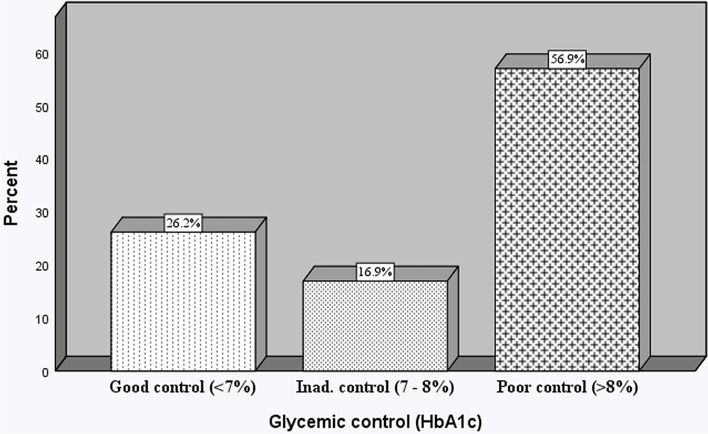
The median level of HbA1c of the participants was 8.4% (IQR 6.8-10.1). And approximately three-quarters (73.8%) of the patients had inadequate and poor glycemic control (HbA1c ≥ 7%). Older age (AOR: 2.46, 95% CI: 1.28-6.01), DM duration of > 10 years (AOR: 3.15, 95% CI: 2.22-6.54), insulin therapy (AOR: 3.07, 95% CI: 2.10-6.12), poor diet compliance (AOR: 1.97, 95% CI: 1.28-3.52) and failure to set goals for glycemic control (AOR: 3.42, 95% CI: 2.17-5.97) were factors associated with inadequate and poor glycemic control.
The study revealed that a significant number of diabetic patients had inadequate and poor glycemic control levels. And this was associated with older age, longer duration of DM, insulin therapy, poor diet compliance, and failure to set control goals. This requires a focus on the associated factors identified and tailored management mechanisms to maintain good glycemic control.
糖尿病患者血糖管理的目标是预防或延迟并发症并优化生活质量。然而,在临床实践中,推荐的血糖控制目标难以实现。因此,确定影响血糖结果的因素对于改善糖尿病管理质量非常重要。本研究旨在评估埃塞俄比亚亚的斯亚贝巴提克里安贝斯专科医院 2 型糖尿病门诊患者的血糖控制水平及其相关因素。
这是一项在提克里安贝斯专科医院糖尿病诊所就诊的 325 例 2 型糖尿病患者中进行的基于医院的横断面研究。2021 年 3 月 1 日至 5 月 30 日,使用经过预测试、结构良好且由访谈员管理的问卷收集患者的社会人口学和糖尿病相关信息。根据美国糖尿病协会建议的非妊娠成年人<7%(“良好”控制)的糖化血红蛋白(HbA1c)目标,使用 HbA1c 评估血糖控制情况。HbA1c 水平在 7-8%之间定义为“控制不足”,水平>8%定义为“控制不佳”。使用 SPSS v26 进行数据录入和分析。使用多变量逻辑回归分析确定血糖控制的决定因素。
参与者的 HbA1c 中位数水平为 8.4%(IQR 6.8-10.1)。大约四分之三(73.8%)的患者血糖控制不足和不佳(HbA1c≥7%)。年龄较大(AOR:2.46,95%CI:1.28-6.01)、DM 病程>10 年(AOR:3.15,95%CI:2.22-6.54)、胰岛素治疗(AOR:3.07,95%CI:2.10-6.12)、饮食依从性差(AOR:1.97,95%CI:1.28-3.52)和未能设定血糖控制目标(AOR:3.42,95%CI:2.17-5.97)是与血糖控制不足和不佳相关的因素。
研究表明,相当数量的糖尿病患者血糖控制水平不足和不佳。这与年龄较大、DM 病程较长、胰岛素治疗、饮食依从性差以及未能设定控制目标有关。这需要关注已确定的相关因素,并制定有针对性的管理机制,以维持良好的血糖控制。