Nečasová Ivona, Stojaspal Martin, Motyčáková Edita, Brom Tomáš, Janovič Tomáš, Hofr Ctirad
Institute of Biophysics of the Czech Academy of Sciences, Scientific Incubator, Královopolská 135, Brno 612 65, Czech Republic.
LifeB, Functional Genomics and Proteomics, National Centre for Biomolecular Research, Faculty of Science, Masaryk University, Kamenice 753/5, Brno 625 00, Czech Republic.
NAR Cancer. 2022 Mar 3;4(1):zcac005. doi: 10.1093/narcan/zcac005. eCollection 2022 Mar.
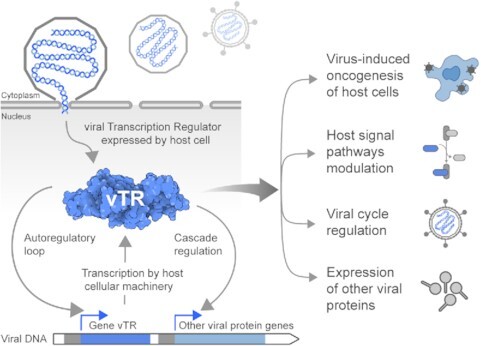
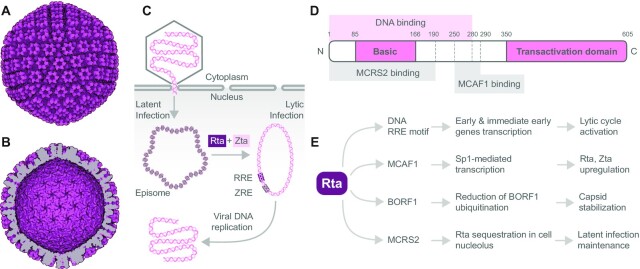
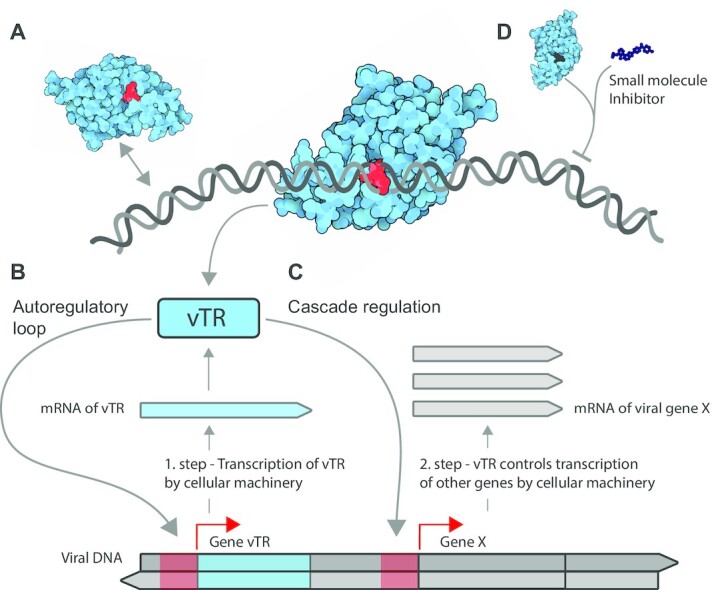
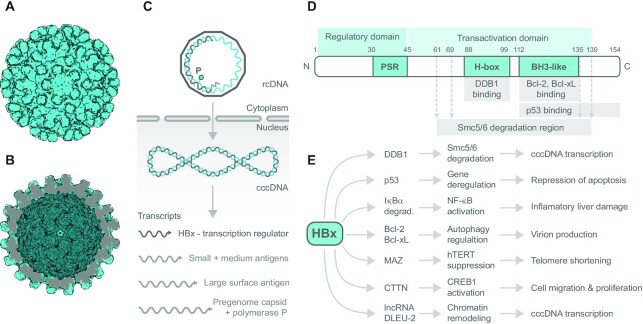
Transcription is often the first biosynthetic event of viral infection. Viruses produce preferentially viral transcriptional regulators (vTRs) essential for expressing viral genes and regulating essential host cell proteins to enable viral genome replication. As vTRs are unique viral proteins that promote the transcription of viral nucleic acid, vTRs interact with host proteins to suppress detection and immune reactions to viral infection. Thus, vTRs are promising therapeutic targets that are sequentially and structurally distinct from host cell proteins. Here, we review vTRs of three human oncoviruses: HBx of hepatitis B virus, HBZ of human T-lymphotropic virus type 1, and Rta of Epstein-Barr virus. We present three cunningly exciting and dangerous transcription strategies that make viral infections so efficient. We use available structural and functional knowledge to critically examine the potential of vTRs as new antiviral-anticancer therapy targets. For each oncovirus, we describe (i) the strategy of viral genome transcription; (ii) vTRs' structure and binding partners essential for transcription regulation; and (iii) advantages and challenges of vTR targeting in antiviral therapies. We discuss the implications of vTR regulation for oncogenesis and perspectives on developing novel antiviral and anticancer strategies.
转录通常是病毒感染的首个生物合成事件。病毒优先产生病毒转录调节因子(vTRs),这些因子对于表达病毒基因和调节关键宿主细胞蛋白以实现病毒基因组复制至关重要。由于vTRs是促进病毒核酸转录的独特病毒蛋白,它们与宿主蛋白相互作用以抑制对病毒感染的检测和免疫反应。因此,vTRs是有前景的治疗靶点,在序列和结构上与宿主细胞蛋白不同。在此,我们综述三种人类致癌病毒的vTRs:乙型肝炎病毒的HBx、1型人类嗜T淋巴细胞病毒的HBZ以及爱泼斯坦-巴尔病毒的Rta。我们展示了三种极其令人兴奋且危险的转录策略,正是这些策略使得病毒感染如此高效。我们利用现有的结构和功能知识来严格审视vTRs作为新型抗病毒抗癌治疗靶点的潜力。对于每种致癌病毒,我们描述了:(i)病毒基因组转录策略;(ii)vTRs的结构以及转录调节所必需的结合伴侣;(iii)在抗病毒治疗中靶向vTRs的优势和挑战。我们讨论了vTR调节对肿瘤发生的影响以及开发新型抗病毒和抗癌策略的前景。