Vaingankar Janhavi Ajit, van Dam Rob M, Samari Ellaisha, Chang Sherilyn, Seow Esmond, Chua Yi Chian, Luo Nan, Verma Swapna, Subramaniam Mythily
Research Division, Institute of Mental Health, Singapore, Singapore.
Saw Swee Hock School of Public Health, National University of Singapore, Singapore, Singapore.
JMIR Pediatr Parent. 2022 Mar 4;5(1):e32758. doi: 10.2196/32758.
Social media influence almost every aspect of our lives by facilitating instant many-to-many communication and self-expression. Recent research suggests strong negative and positive impacts of social media exposure on youth mental health; however, there has been more emphasis on harmful relationships.
Given the limited research on the benefits of social media for mental health, this qualitative study explored the lived experiences of youth to understand how social media use can contribute to positive mental health among youth.
Using an interpretivist epistemological approach, 25 semistructured interviews and 11 focus group discussions were conducted with male and female youth of different ethnicities (aged 15 to 24 years) residing in Singapore, who were recruited through purposive sampling from the community. We conducted inductive thematic analysis and concept mapping to address the research aims.
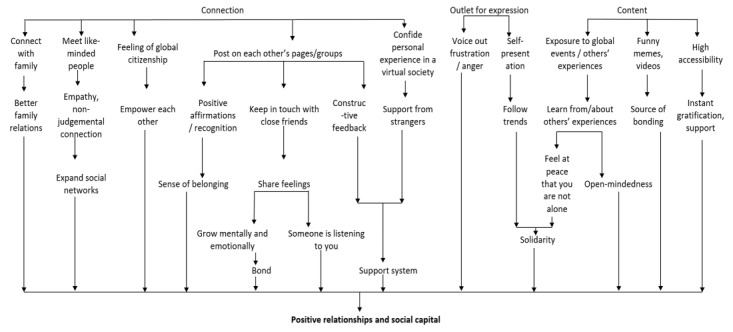
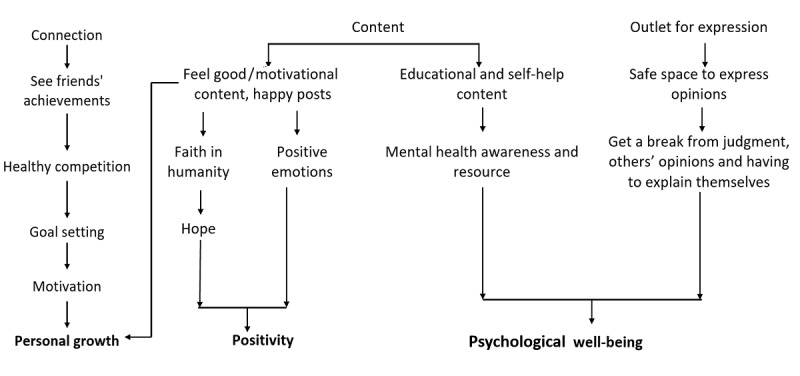
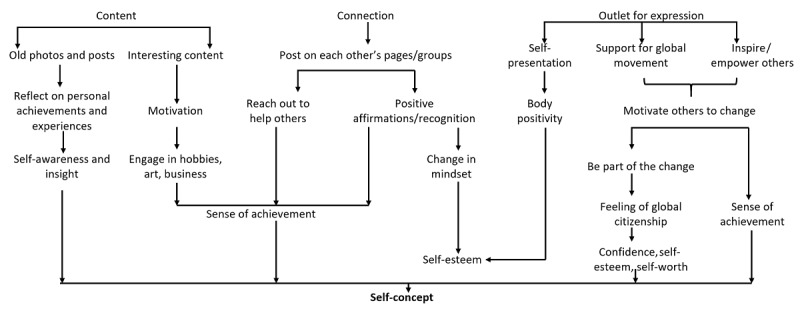
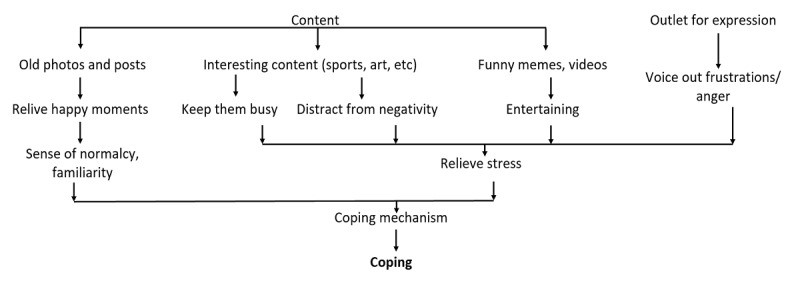
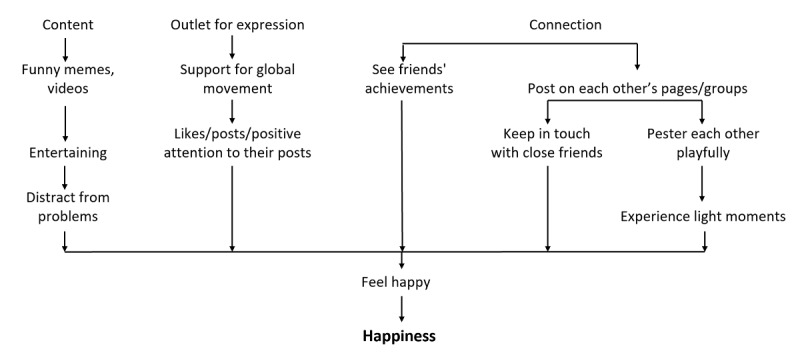
We found that youth engaged in a wide range of activities on social media from connecting with family and friends to participating in global movements, and these served as avenues for building positive mental health. Based on participants' narratives, our analysis suggested that positive mental health among youth could be influenced by 3 features of social media consumption (connection with friends and their global community, engagement with social media content, and the value of social media as an outlet for expression). Through these, pathways leading to the following 5 positive mental health components were identified: (1) positive relationships and social capital, (2) self-concept, (3) coping, (4) happiness, and (5) other relevant aspects of mental health (for example, positivity and personal growth).
The study results highlight the integral role of social media in the lives of today's youth and indicate that they can offer opportunities for positive influence, personal expression, and social support, thus contributing to positive mental health among youth. The findings of our research can be applied to optimize engagement with youth through social media and enhance the digital modes of mental health promotion.
社交媒体通过促进即时的多对多交流和自我表达,几乎影响着我们生活的方方面面。近期研究表明,接触社交媒体对青少年心理健康有着强烈的负面和正面影响;然而,人们更多地关注其有害关系。
鉴于关于社交媒体对心理健康益处的研究有限,本定性研究探索了青少年的生活经历,以了解社交媒体的使用如何有助于青少年的积极心理健康。
采用解释主义认识论方法,对居住在新加坡的不同种族(15至24岁)的青年男女进行了25次半结构化访谈和11次焦点小组讨论,这些参与者是通过从社区进行目的抽样招募的。我们进行了归纳主题分析和概念映射以实现研究目标。
我们发现,青少年在社交媒体上参与了广泛的活动,从与家人和朋友联系到参与全球运动,这些活动成为了建立积极心理健康的途径。基于参与者的叙述,我们的分析表明,青少年的积极心理健康可能受到社交媒体使用的三个特征的影响(与朋友及其全球社区的联系、对社交媒体内容的参与以及社交媒体作为表达渠道的价值)。通过这些,确定了通向以下五个积极心理健康组成部分的途径:(1)积极关系和社会资本,(2)自我概念,(3)应对,(4)幸福,以及(5)心理健康的其他相关方面(例如,积极性和个人成长)。
研究结果突出了社交媒体在当今青少年生活中的重要作用,并表明社交媒体可以提供积极影响、个人表达和社会支持的机会,从而有助于青少年的积极心理健康。我们的研究结果可应用于通过社交媒体优化与青少年的互动,并加强心理健康促进的数字模式。