Department of Ophthalmology, Shanghai Tenth People's Hospital, Tongji University School of Medicine, Shanghai, China.
Ping An Healthcare Technology, Beijing, China.
Transl Vis Sci Technol. 2022 Mar 2;11(3):4. doi: 10.1167/tvst.11.3.4.
To evaluate the performance of a telemedicine platform integrated with optical coherence tomography (OCT) and artificial intelligence (AI) techniques for retinal disease screening and referral.
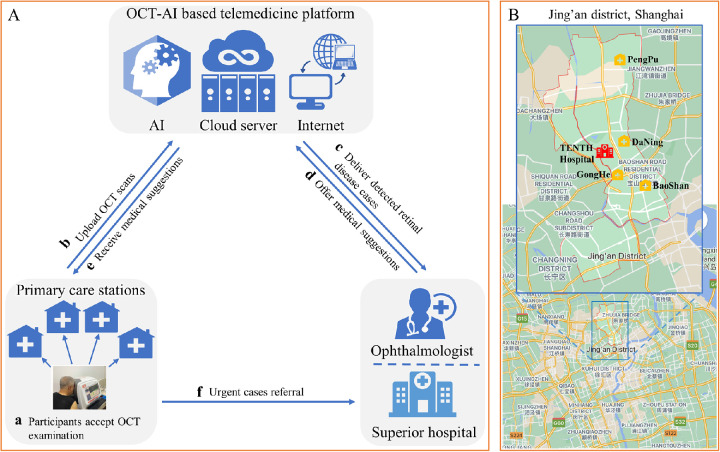
We constructed an OCT-AI-based telemedicine platform and deployed it at four primary care stations located in Jing'an district, Shanghai, to detect retinal disease cases among aged groups and refer them to Shanghai Tenth People's Hospital (TENTH Hospital). Two ophthalmologists jointly graded the data set collected from this pilot application, and then the performance of this platform was analyzed from multiple aspects.
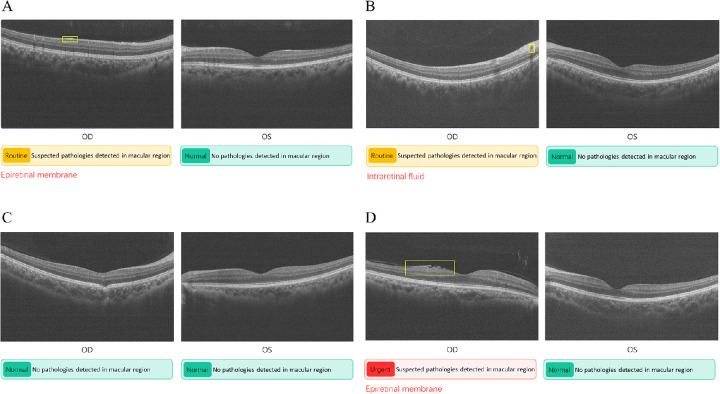
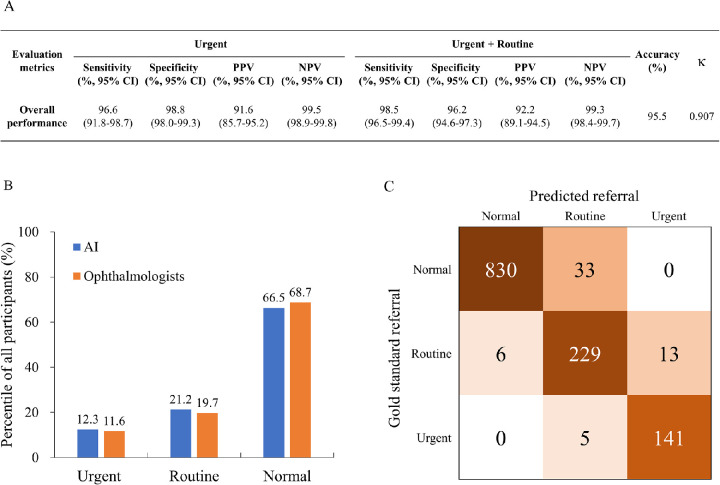
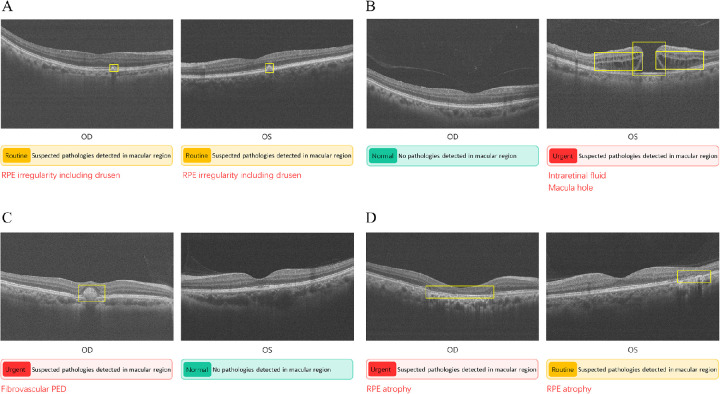
This study included 1257 participants between July 2020 and September 2020, of whom 394 had retinal pathologies and 146 were even considered urgent cases by the ophthalmologists. The OCT-AI models achieved a sensitivity of 96.6% (95% confidence interval [CI], 91.8%-98.7%) and specificity of 98.8% (95% CI, 98.0%-99.3%) for detecting urgent cases and a sensitivity of 98.5% (95% CI, 96.5%-99.4%) and specificity of 96.2% (95% CI, 94.6%-97.3%) for detecting both urgent and routine cases. Coupled with AI, our platform reduced the workload of human consultation by 96.2% for massive normal cases. The detected disease cases received online medical suggestions at an average time of 21.4 hours via this platform.
This platform can automatically identify patients with retinal disease with high sensitivity and specificity, support timely human consultation, and bring necessary referrals.
The OCT-AI-based telemedicine platform shows great practical value for retinal disease screening and referral in a real-world primary care setting.
评估集成光学相干断层扫描(OCT)和人工智能(AI)技术的远程医疗平台在视网膜疾病筛查和转诊中的性能。
我们构建了一个基于 OCT-AI 的远程医疗平台,并将其部署在上海市静安区的四个基层医疗站,以检测老年人群中的视网膜疾病病例,并将其转介至上海市第十人民医院(TENTH 医院)。两名眼科医生共同对从该试点应用中收集的数据进行分级,然后从多个方面分析该平台的性能。
本研究纳入了 2020 年 7 月至 9 月期间的 1257 名参与者,其中 394 名患有视网膜病变,146 名被眼科医生认为是紧急病例。OCT-AI 模型对检测紧急病例的敏感性为 96.6%(95%置信区间 [CI],91.8%-98.7%),特异性为 98.8%(95%CI,98.0%-99.3%),对检测紧急和常规病例的敏感性为 98.5%(95%CI,96.5%-99.4%),特异性为 96.2%(95%CI,94.6%-97.3%)。结合 AI,我们的平台使大量正常病例的人工咨询工作量减少了 96.2%。通过该平台,检测到的疾病病例平均在 21.4 小时内获得在线医疗建议。
该平台可以自动识别出具有高敏感性和特异性的视网膜疾病患者,支持及时的人工咨询,并提供必要的转诊。
医学文献