Guizhou Province Centre for Disease Control and Prevention, Guizhou Province, Guiyang, China.
School of Public Health, Key Laboratory of Public Health Safety, Fudan University, Shanghai, China.
J Clin Hypertens (Greenwich). 2022 Apr;24(4):483-492. doi: 10.1111/jch.14451. Epub 2022 Mar 7.
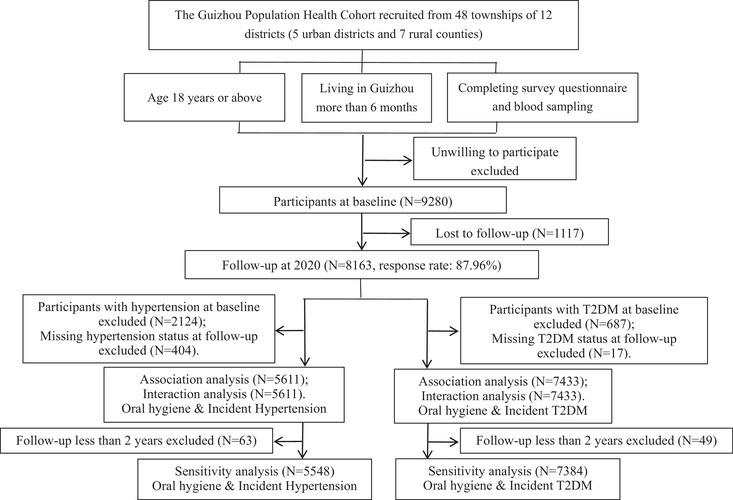
Oral health has been previously reported to be related with cardiovascular diseases (CVD). This study aimed to evaluate whether oral hygiene could reduce the risk of incident hypertension and type 2 diabetes mellitus (T2DM) in a population-based cohort. A total of 9280 people aged 18 years or above in Guizhou province were recruited from November 20th, 2010 to December 19th, 2012. Sociodemographic characteristics, lifestyles, anthropometric measurements, oral health status and care were collected by trained interviewers. The occurrences of hypertension and T2DM were ascertained until 2020. Cox proportional hazard models were used to evaluate the associations between oral hygiene and the occurrence of hypertension and T2DM, respectively. Compared with almost no tooth brushing, tooth brushing at least twice a day was associated with a 45% reduction (HR: .55; 95% CI: .42-.73) in hypertension events and reduced diabetes risk by 35% (HR: .65; 95% CI: .45-.94). For hypertension, those associations tended to be more pronounced in participants with Han ethic, or living in urban area, while those aged less than 60 or without baseline hypertension were more likely to have T2DM when they brush teeth less than twice a day. Frequent tooth brushing was associated with reduced risks of incident hypertension and T2DM. Tooth brushing at least twice a day may prevent future hypertension and T2DM events.
口腔健康先前被报道与心血管疾病(CVD)有关。本研究旨在评估口腔卫生是否可以降低人群中高血压和 2 型糖尿病(T2DM)的发病风险。2010 年 11 月 20 日至 2012 年 12 月 19 日,贵州省共招募了 9280 名 18 岁及以上的人群。通过受过培训的访谈者收集社会人口统计学特征、生活方式、人体测量学测量、口腔健康状况和护理情况。通过定期体检来确定高血压和 T2DM 的发生情况。Cox 比例风险模型用于评估口腔卫生与高血压和 T2DM 发生之间的关系。与几乎不刷牙相比,每天至少刷牙两次与高血压事件风险降低 45%(HR:.55;95%CI:.42-.73)有关,且降低糖尿病风险 35%(HR:.65;95%CI:.45-.94)。对于高血压,在汉族或居住在城市的参与者中,这些关联更为明显,而对于年龄小于 60 岁或没有基线高血压的参与者,如果每天刷牙次数少于两次,则更有可能患有 T2DM。经常刷牙与降低高血压和 T2DM 发病风险有关。每天至少刷牙两次可能有助于预防未来的高血压和 T2DM 事件。