World Health Organization (WHO) Nigeria Country Office, UN House, Plot 617/618, Diplomatic Drive, Central Business District, PMB 2861, Garki, Abuja, Nigeria.
BMC Public Health. 2022 Mar 8;22(1):467. doi: 10.1186/s12889-022-12871-0.
Yellow Fever is an acute viral hemorrhagic disease endemic in tropical Africa and Latin America and is transmitted through infected mosquitoes. The earliest outbreak of yellow fever in Nigeria was reported in Lagos in 1864 with subsequent regular outbreaks reported until 1996. A large epidemic of yellow fever occurred in Oyo State in April and May 1987 following an epidemic of sylvatic yellow fever in Eastern Nigeria the previous year. For 21 years, no further confirmed cases were reported until September 2017 following which Nigeria has been responding to successive outbreaks. The renewed onset of yellow fever outbreaks in Nigeria followed a global trend of reports and from other African countries. Yellow Fever disease has no cure, but control is through vaccination and vector control. Eliminating Yellow fever Epidemic (EYE) strategy to improve high-risk countries' prevention, preparedness, detection, management, and response to yellow fever outbreaks was developed by the WHO in 2017 and launched in Nigeria in April 2018. Yet, poor vaccination coverage continues to be a cause for concern.
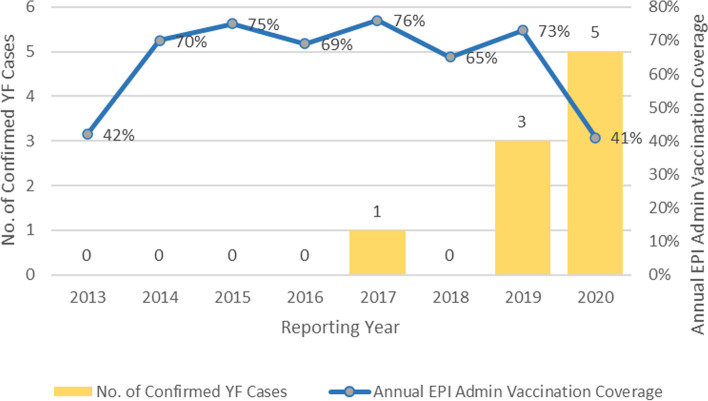
We conducted a retrospective cross-sectional study that examines the resurgence of Yellow fever cases and outbreaks from 2013 to 2020 in Oyo State, Nigeria. The Yellow Fever data for both surveillance and routine Expanded Programme on Immunization (EPI) were the focus of the review. Surveillance data were retrieved from the State's database reported by all 33 LGAs, maintained by the State and supported by the World Health Organization at the Zonal and State levels. The routine EPI data were retrieved from District Health Information Software (DHIS_2). The proportion of LGAs reporting at least one case of suspected yellow fever with a blood specimen and the number of suspected cases reported for each year within the period under review was measured. We also assessed the trend of confirmed cases and the incidence per 100,000 persons. Also, suspected cases of yellow fever were categorized into four age groups and their vaccination status was assessed. The State's annual administrative routine vaccination coverage for yellow fever vaccine was compared with the number of confirmed cases for each year.
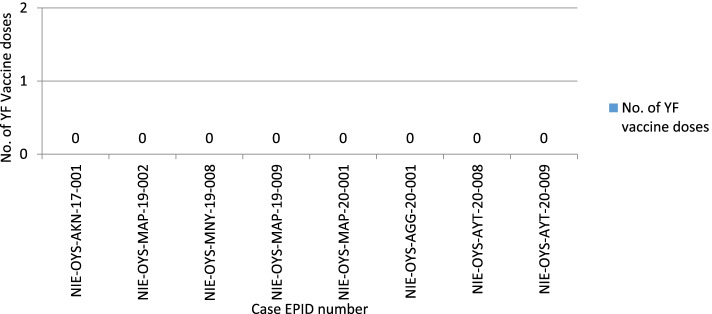
The proportion of LGAs reporting at least a case of suspected yellow fever, with blood samples collected, ranged from 6.1 to 84.9% between 2014 and 2020 while a total of 9 confirmed (8 cases) and probable (1 case) cases of yellow fever were recorded. However, there were no confirmed cases from the year 2013 to 2016, including 2018 but an upward trend of incidence of the disease per 100,000 persons from 0% to 2013 through 2018, to 3.5% in 2019, and then to 5.6% in 2020 was observed. 93 of 240 (39%) suspected yellow fever cases reported during the given period were observed to have received yellow fever vaccine.
In conclusion, the increase in the circulation of the yellow fever virus in the state reiterates the state is at a high risk of yellow fever transmission and underlines the need for viable interventions such as environmental hygiene to rid the environment of the disease vector's ecological niche and improving routine EPI coverage to provide population immunity.
黄热病是一种在热带非洲和拉丁美洲流行的急性病毒性出血性疾病,通过受感染的蚊子传播。尼日利亚最早的黄热病疫情于 1864 年在拉各斯报告,随后直到 1996 年定期报告疫情。1987 年 4 月和 5 月,在尼日利亚东部发生丛林黄热病疫情后,奥约州发生了一次大规模的黄热病疫情。在接下来的 21 年里,直到 2017 年 9 月,没有再报告确诊病例,此后尼日利亚一直在应对连续爆发的疫情。尼日利亚黄热病疫情的再次爆发与全球范围内的报告和其他非洲国家的报告趋势一致。黄热病没有治愈方法,但可以通过接种疫苗和控制病媒来控制。世界卫生组织于 2017 年制定了消灭黄热病流行(EYE)战略,以改善高危国家对黄热病爆发的预防、准备、检测、管理和应对能力,并于 2018 年在尼日利亚推出。然而,疫苗接种覆盖率低仍然令人担忧。
我们进行了一项回顾性的横断面研究,调查了 2013 年至 2020 年期间尼日利亚奥约州黄热病病例和疫情的再次出现。审查的重点是黄热病的监测和常规扩大免疫规划(EPI)数据。监测数据来自该州的数据库,该数据库由所有 33 个地方政府区报告,由州维护,并在世卫组织的支持下在区和州两级进行报告。常规 EPI 数据来自区卫生信息软件(DHIS_2)。我们测量了报告至少一例疑似黄热病并有血液样本的地方政府区的比例,以及在审查期间每年报告的疑似病例数。我们还评估了确诊病例的趋势和每 10 万人的发病率。此外,疑似黄热病病例分为四个年龄组,并评估了他们的疫苗接种状况。将该州每年的常规行政黄热病疫苗接种覆盖率与每年的确诊病例数进行了比较。
2014 年至 2020 年期间,报告至少有一例疑似黄热病并有血液样本采集的地方政府区比例在 6.1%至 84.9%之间,期间共记录了 9 例确诊(8 例)和疑似(1 例)黄热病病例。然而,2013 年至 2016 年期间没有确诊病例,包括 2018 年,但观察到每 10 万人发病率的上升趋势,从 2013 年至 2018 年的 0%,到 2019 年的 3.5%,再到 2020 年的 5.6%。在给定期间报告的 240 例疑似黄热病病例中,有 93 例(39%)被观察到已接种黄热病疫苗。
综上所述,该州黄热病病毒的传播增加再次表明该州处于黄热病传播的高风险之中,并强调需要采取可行的干预措施,如改善环境卫生以消除病媒的生态位,并提高常规 EPI 覆盖率以提供人群免疫力。