Department of Community Health Sciences, Patan Academy of Health Sciences, GPO Box 26500 Ward No.5, Bagmati Province, Lalitpur Metropolitan City, Nepal.
Department of General Practice and Emergency Medicine, Patan Academy of Health Sciences, Lalitpur, Nepal.
BMC Med Educ. 2022 Mar 8;22(1):159. doi: 10.1186/s12909-022-03188-y.
Doctors' empathy: the understanding of patients' experiences, concerns and perspectives, is highly valued by patients yet often lacking in patient care. Medical Humanities has been introduced within undergraduate curriculum to address this lack in empathy. There is a paucity of research on the impact of a course on medical humanities on the empathy of medical students, particularly in South Asia. Here we report on the impact of such an intervention in first-year medical students and aim to help outcome-based medical education and the evaluation and promotion of humanities within medical courses.
This study is a quantitative evaluation of student empathy before and after a Medical Humanities Module. The study employs the Jefferson Scale of Empathy-Student version (JSE-S). Participants were first-year medical students at Patan Academy of Health Sciences, Nepal. All cohort students were invited to participate and written consent was obtained. Data were collected both prior-to and on-completion-of, a six-week Medical Humanities Module. Pre- and post-module data were analyzed and the resulting empathy scores compared using the paired t-test or Wilcoxon signed-rank test. Subgroup analysis was undertaken to determine the association of the score with gender and preferred future speciality.
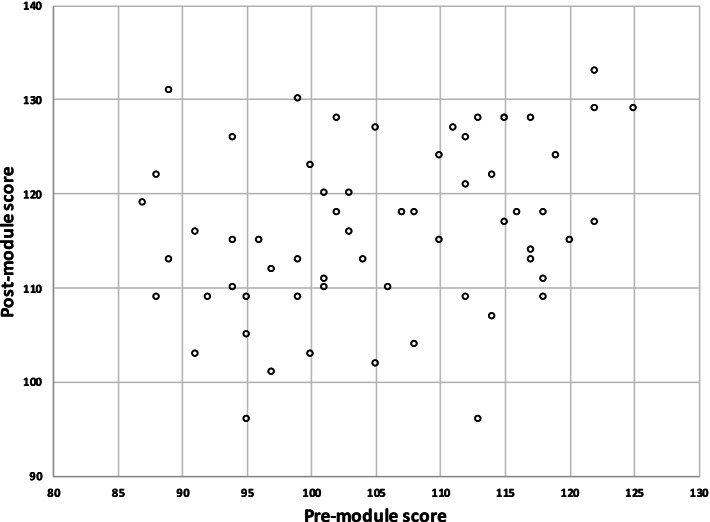
Sixty-two student responses were analyzed, 32 (52%) of whom were male. In the pre-module scores females had a slightly higher mean score than males:108 and 103 respectively. Participants who preferred people-oriented specialities also scored higher than those preferring procedure and technology-oriented specialities: 107 and 103 respectively. There was a significant increase in mean score for the entire class from pre-module to post-module: 105 to 116, p-value of < 0.001. Mean scores rose from 103 to 116 in males, and from 108 to 116 in females. Participants preferring procedure and technology-oriented specialities showed a significant increase in mean scores:103 to 117, and participants preferring people-oriented specialities demonstrated a smaller increase:107 to 111.
This study provides evidence of the impact of a Medical Humanities course for increasing medical student empathy scores at an institution in Nepal. Teaching of Medical Humanities is an important contributor to the development of empathy in medical students and its widespread expansion in the whole of South Asia should be considered.
医生的同理心——理解患者的经历、关注和观点,深受患者重视,但在患者护理中却常常缺乏。医学人文学科已被引入本科课程,以解决同理心的缺失问题。在南亚,关于医学人文课程对医学生同理心影响的研究很少。在这里,我们报告了这种干预对一年级医学生同理心的影响,并旨在帮助基于成果的医学教育以及评估和促进医学课程中的人文学科。
本研究是对医学人文学科模块前后医学生同理心的定量评估。该研究采用杰斐逊同理心量表-学生版(JSE-S)。参与者为尼泊尔巴坦学院卫生科学的一年级医学生。邀请所有队列学生参加,并获得书面同意。在六周的医学人文模块之前和完成后收集数据。使用配对 t 检验或 Wilcoxon 符号秩检验分析预模块和后模块数据,并比较得出的同理心得分。进行亚组分析,以确定分数与性别和未来首选专业之间的关系。
分析了 62 名学生的回复,其中 32 名(52%)为男性。在预模块评分中,女性的平均得分略高于男性:分别为 108 和 103。喜欢以人为导向的专业的参与者比喜欢程序和技术导向的专业的参与者得分更高:分别为 107 和 103。整个班级的平均分数从预模块到后模块显著增加:从 105 到 116,p 值<0.001。男性的平均分数从 103 上升到 116,女性的平均分数从 108 上升到 116。喜欢程序和技术导向专业的参与者的平均分数显著增加:从 103 到 117,而喜欢以人为导向专业的参与者的平均分数略有增加:从 107 到 111。
本研究提供了在尼泊尔的一所机构中,医学人文课程对提高医学生同理心分数的影响的证据。医学人文学科的教学是医学生同理心发展的重要贡献者,应考虑在整个南亚广泛推广。