MRC Centre for Global Infectious Disease Analysis, Department of Infectious Disease Epidemiology, School of Public Health, Imperial College London, London, UK.
Grantham Institute - Climate Change and the Environment - Imperial College London, London, UK.
Sci Rep. 2022 Mar 8;12(1):4124. doi: 10.1038/s41598-022-07837-6.
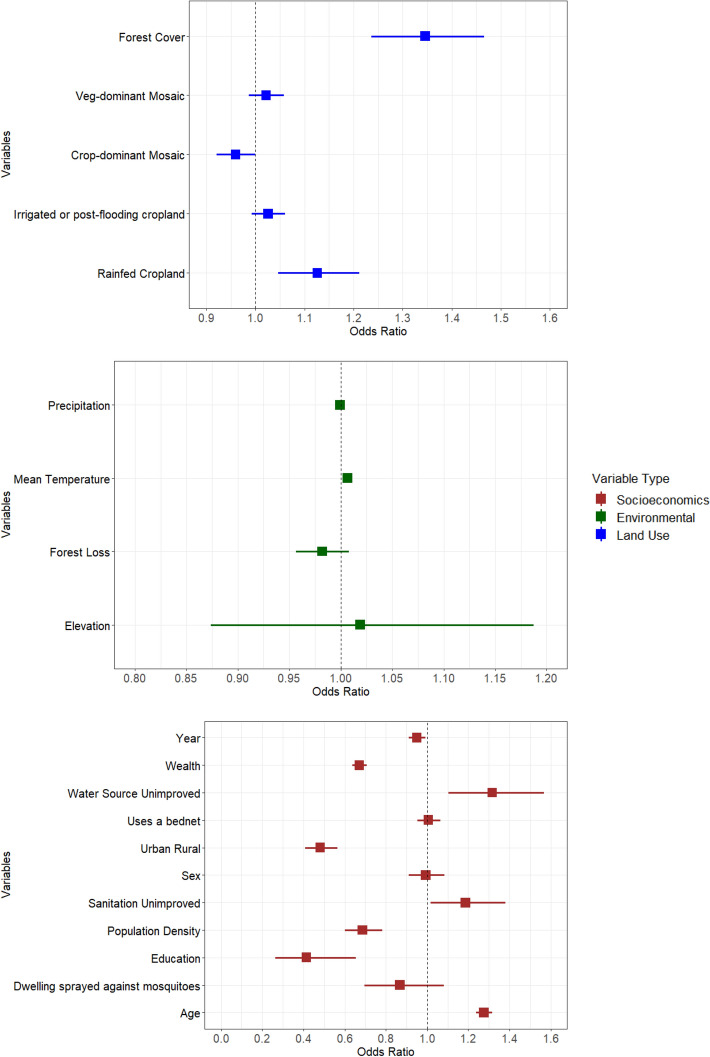
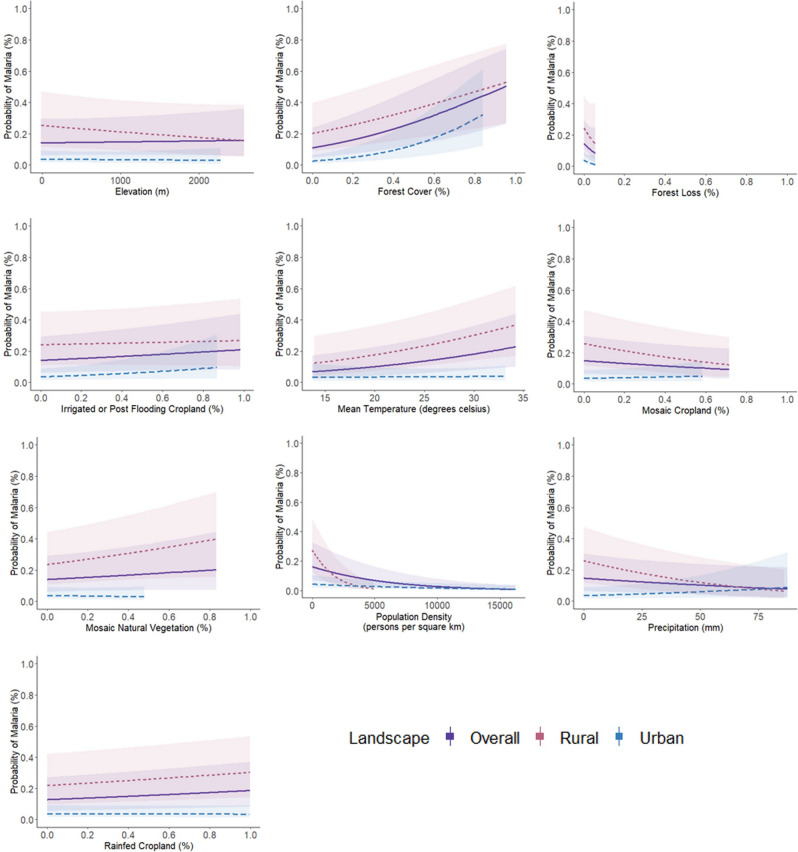
Agriculture in Africa is rapidly expanding but with this comes potential disbenefits for the environment and human health. Here, we retrospectively assess whether childhood malaria in sub-Saharan Africa varies across differing agricultural land uses after controlling for socio-economic and environmental confounders. Using a multi-model inference hierarchical modelling framework, we found that rainfed cropland was associated with increased malaria in rural (OR 1.10, CI 1.03-1.18) but not urban areas, while irrigated or post flooding cropland was associated with malaria in urban (OR 1.09, CI 1.00-1.18) but not rural areas. In contrast, although malaria was associated with complete forest cover (OR 1.35, CI 1.24-1.47), the presence of natural vegetation in agricultural lands potentially reduces the odds of malaria depending on rural-urban context. In contrast, no associations with malaria were observed for natural vegetation interspersed with cropland (veg-dominant mosaic). Agricultural expansion through rainfed or irrigated cropland may increase childhood malaria in rural or urban contexts in sub-Saharan Africa but retaining some natural vegetation within croplands could help mitigate this risk and provide environmental co-benefits.
非洲农业正在迅速扩张,但这也可能对环境和人类健康带来潜在的不利影响。在这里,我们通过回顾性评估,在控制社会经济和环境混杂因素后,研究了不同农业土地利用方式对撒哈拉以南非洲儿童疟疾的影响。我们使用多模型推理层次建模框架发现,雨养耕地与农村地区(OR1.10,CI1.03-1.18)而非城市地区的疟疾呈正相关,而灌溉或洪水后耕地与城市(OR1.09,CI1.00-1.18)而非农村地区的疟疾呈正相关。相比之下,尽管疟疾与完全森林覆盖(OR1.35,CI1.24-1.47)有关,但农业用地中存在自然植被可能会根据农村-城市背景降低疟疾的发病几率。相比之下,在耕地中散布有自然植被(植被主导镶嵌)与疟疾之间没有关联。在撒哈拉以南非洲的农村或城市地区,通过雨养或灌溉耕地的农业扩张可能会增加儿童疟疾的发病率,但在耕地中保留一些自然植被可能有助于减轻这种风险并带来环境协同效益。