Centre for Gene Regulation and Expression, School of Life Sciences, University of Dundee, Dundee, UK.
Bioessays. 2022 May;44(5):e2100246. doi: 10.1002/bies.202100246. Epub 2022 Mar 8.
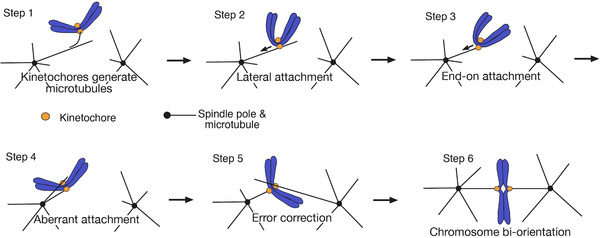
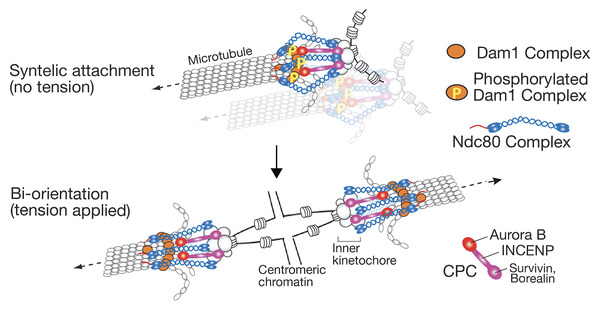
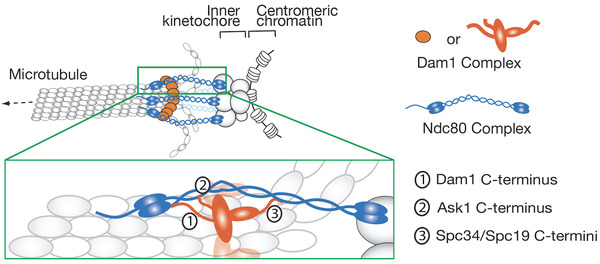
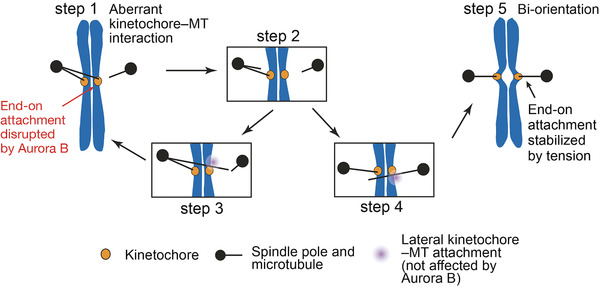
Correct chromosome segregation in mitosis relies on chromosome biorientation, in which sister kinetochores attach to microtubules from opposite spindle poles prior to segregation. To establish biorientation, aberrant kinetochore-microtubule interactions must be resolved through the error correction process. During error correction, kinetochore-microtubule interactions are exchanged (swapped) if aberrant, but the exchange must stop when biorientation is established. In this article, we discuss recent findings in budding yeast, which have revealed fundamental molecular mechanisms promoting this "swap and stop" process for error correction. Where relevant, we also compare the findings in budding yeast with mechanisms in higher eukaryotes. Evidence suggests that Aurora B kinase differentially regulates kinetochore attachments to the microtubule end and its lateral side and switches relative strength of the two kinetochore-microtubule attachment modes, which drives the exchange of kinetochore-microtubule interactions to resolve aberrant interactions. However, Aurora B kinase, recruited to centromeres and inner kinetochores, cannot reach its targets at kinetochore-microtubule interface when tension causes kinetochore stretching, which stops the kinetochore-microtubule exchange once biorientation is established.
在有丝分裂中,正确的染色体分离依赖于染色体的双定向,即姐妹动粒在分离前附着到来自纺锤体两极的微管上。为了建立双定向,必须通过错误修正过程来解决异常的动粒-微管相互作用。在错误修正过程中,如果动粒-微管相互作用异常,就会发生交换(交换),但是当建立双定向时,交换必须停止。在本文中,我们讨论了芽殖酵母的最新发现,这些发现揭示了促进这一“交换和停止”错误修正过程的基本分子机制。在相关的情况下,我们还将芽殖酵母中的发现与高等真核生物中的机制进行了比较。有证据表明,Aurora B 激酶差异调节动粒与微管末端及其侧面的附着,并切换两个动粒-微管附着模式的相对强度,这驱动了动粒-微管相互作用的交换,以解决异常相互作用。然而,当张力导致动粒拉伸时,招募到着丝粒和内动粒的 Aurora B 激酶无法到达动粒-微管界面上的靶标,这一旦建立了双定向,就会停止动粒-微管的交换。