Howard Hughes Medical Institute, Division of Basic Sciences, Fred Hutchinson Cancer Research Center, Seattle, WA, USA.
Department of Physiology and Biophysics, University of Washington, Seattle, WA, USA.
Nat Commun. 2022 Apr 20;13(1):2152. doi: 10.1038/s41467-022-29542-8.
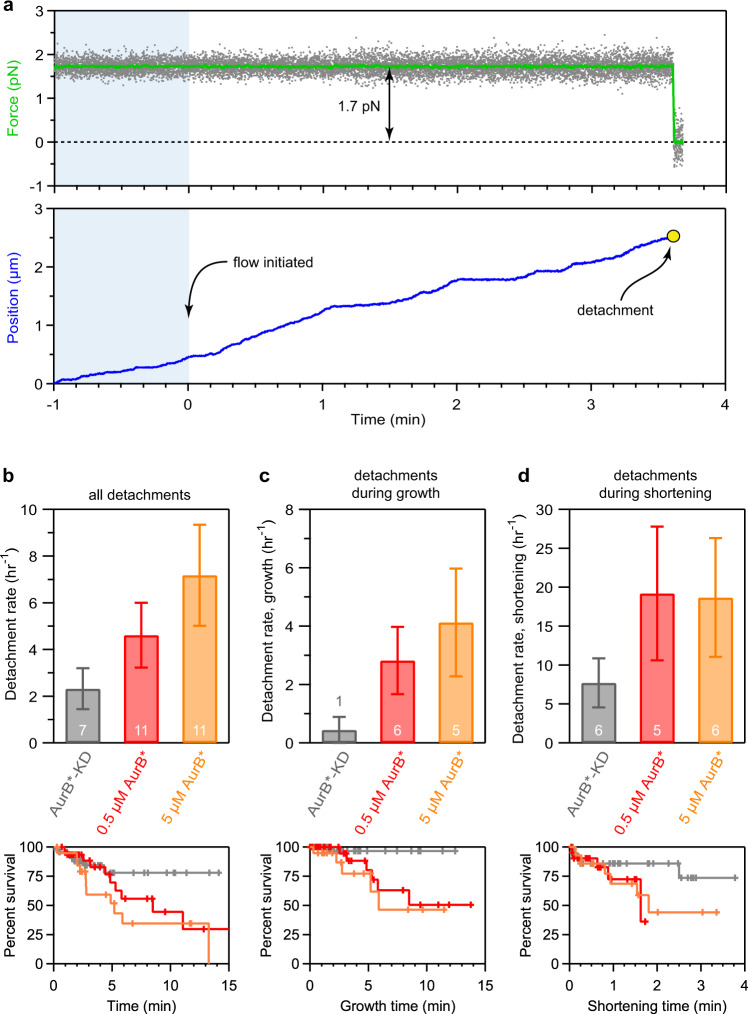
Chromosome segregation requires sister kinetochores to attach microtubules emanating from opposite spindle poles. Proper attachments come under tension and are stabilized, but defective attachments lacking tension are released, giving another chance for correct attachments to form. This error correction process depends on Aurora B kinase, which phosphorylates kinetochores to destabilize their microtubule attachments. However, the mechanism by which Aurora B distinguishes tense versus relaxed kinetochores remains unclear because it is difficult to detect kinase-triggered detachment and to manipulate kinetochore tension in vivo. To address these challenges, we apply an optical trapping-based assay using soluble Aurora B and reconstituted kinetochore-microtubule attachments. Strikingly, the tension on these attachments suppresses their Aurora B-triggered release, suggesting that tension-dependent changes in the conformation of kinetochores can regulate Aurora B activity or its outcome. Our work uncovers the basis for a key mechano-regulatory event that ensures accurate segregation and may inform studies of other mechanically regulated enzymes.
染色体分离需要姐妹动粒附着来自纺锤体两极的微管。适当的附着会产生张力并得到稳定,但缺乏张力的缺陷附着会被释放,从而有机会形成正确的附着。这个错误修正过程依赖于 Aurora B 激酶,它磷酸化动粒以使其微管附着不稳定。然而,Aurora B 区分紧张和松弛动粒的机制尚不清楚,因为很难检测激酶触发的脱离以及在体内操纵动粒张力。为了解决这些挑战,我们应用了一种基于光阱的测定方法,使用可溶性 Aurora B 和重建的动粒微管附着。引人注目的是,这些附着上的张力抑制了它们被 Aurora B 触发的释放,这表明动粒构象的张力依赖性变化可以调节 Aurora B 的活性或其结果。我们的工作揭示了确保准确分离的关键机械调节事件的基础,并且可能为其他机械调节酶的研究提供信息。