Institute of Social and Preventive Medicine, University of Bern, Bern, Switzerland.
Department of Psychiatry, University of Oxford, Oxford, UK.
Stat Med. 2022 Jun 30;41(14):2586-2601. doi: 10.1002/sim.9372. Epub 2022 Mar 8.
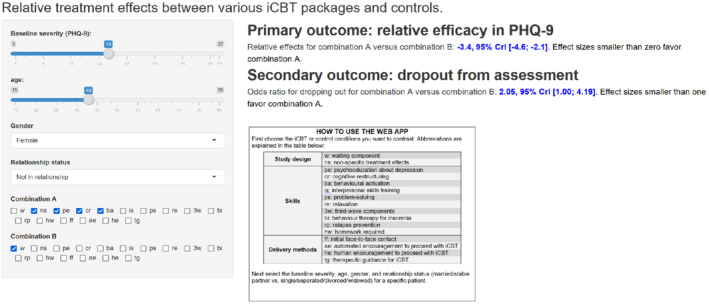
Network meta-analysis can synthesize evidence from studies comparing multiple treatments for the same disease. Sometimes the treatments of a network are complex interventions, comprising several independent components in different combinations. A component network meta-analysis (CNMA) can be used to analyze such data and can in principle disentangle the individual effect of each component. However, components may interact with each other, either synergistically or antagonistically. Deciding which interactions, if any, to include in a CNMA model may be difficult, especially for large networks with many components. In this article, we present two Bayesian CNMA models that can be used to identify prominent interactions between components. Our models utilize Bayesian variable selection methods, namely the stochastic search variable selection and the Bayesian LASSO, and can benefit from the inclusion of prior information about important interactions. Moreover, we extend these models to combine data from studies providing aggregate information and studies providing individual patient data (IPD). We illustrate our models in practice using three real datasets, from studies in panic disorder, depression, and multiple myeloma. Finally, we describe methods for developing web-applications that can utilize results from an IPD-CNMA, to allow for personalized estimates of relative treatment effects given a patient's characteristics.
网络荟萃分析可以综合比较同一疾病多种治疗方法的研究证据。有时,网络中的治疗方法是复杂的干预措施,由不同组合的几个独立成分组成。可以使用成分网络荟萃分析 (CNMA) 来分析此类数据,并且原则上可以分离每个成分的单独效果。但是,成分之间可能存在相互作用,无论是协同作用还是拮抗作用。决定在 CNMA 模型中包含哪些相互作用(如果有)可能很困难,尤其是对于具有许多成分的大型网络而言。在本文中,我们提出了两种可以用于识别成分之间突出相互作用的贝叶斯 CNMA 模型。我们的模型利用了贝叶斯变量选择方法,即随机搜索变量选择和贝叶斯 LASSO,并且可以受益于包含有关重要相互作用的先验信息。此外,我们将这些模型扩展到可以结合提供汇总信息的研究和提供个体患者数据 (IPD) 的研究的数据。我们使用来自惊恐障碍、抑郁症和多发性骨髓瘤研究的三个真实数据集在实践中说明了我们的模型。最后,我们描述了开发可以利用 IPD-CNMA 结果的网络应用程序的方法,以便根据患者的特征提供相对治疗效果的个性化估计。