Department of Medicine and Epidemiology, School of Veterinary Medicine, University of California-Davis, Davis, California, USA.
Department of Surgical and Radiological Sciences, School of Veterinary Medicine, University of California-Davis, Davis, California, USA.
J Vet Intern Med. 2022 Mar;36(2):429-440. doi: 10.1111/jvim.16380. Epub 2022 Mar 9.
Factors associated with outcome in dogs diagnosed with infective endocarditis (IE) are not well characterized.
Evaluate outcome and prognostic factors in dogs with IE.
One hundred and thirteen dogs with IE.
Medical records for dogs that fulfilled the modified Duke criteria between 2005 and 2020 were retrospectively reviewed. Signalment, preexisting conditions, clinicopathologic findings, treatment regimen, and outcomes were recorded. Univariate logistic regression was performed to identify categorical factors associated with mortality, and then multivariate analysis was performed.
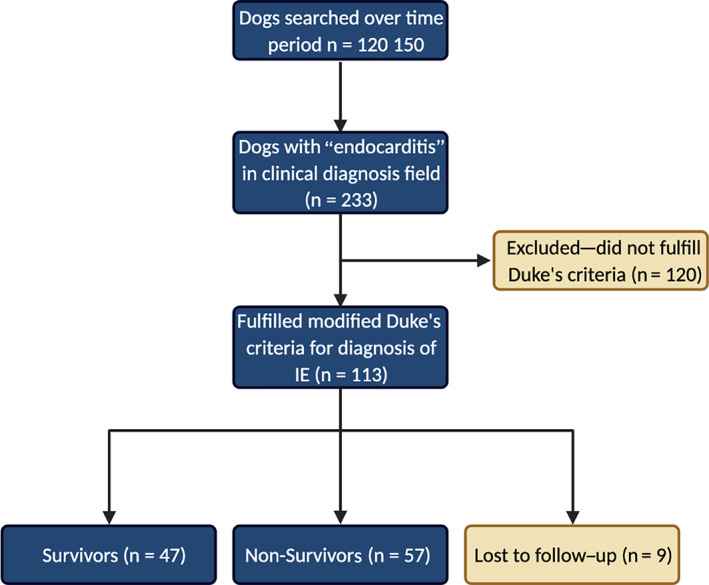
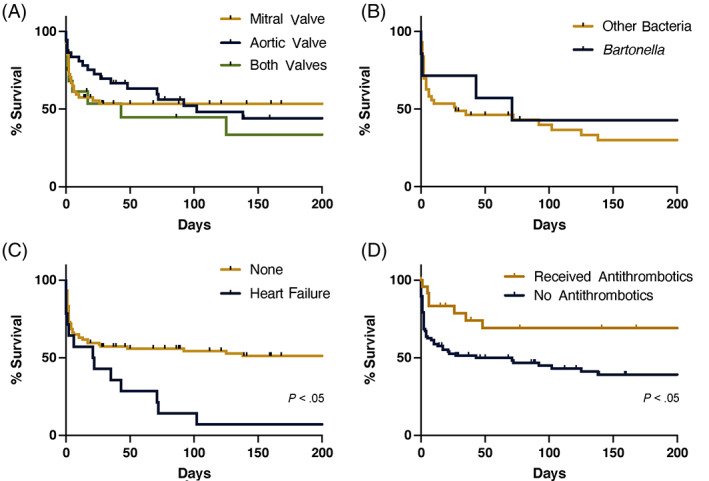
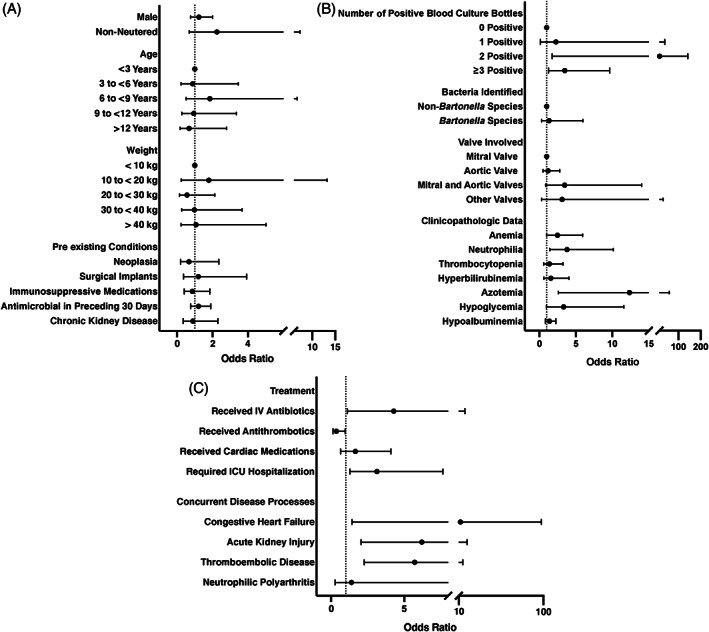
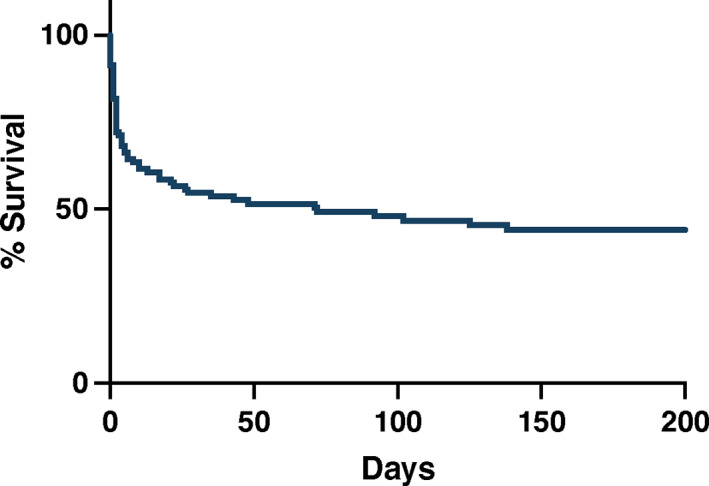
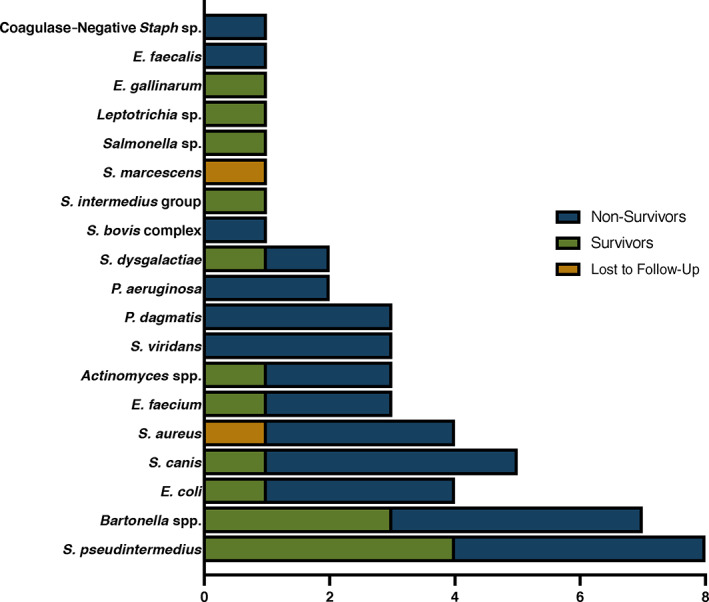
Dogs were categorized as survivors (n = 47), non-survivors (n = 57), or lost to follow-up (n = 9). Survival to discharge and at 1 month was documented in 79 (70%) of 113 and 56 (54%) of 104 dogs, respectively, with median survival time (MST) of 72 days. Risk factors associated with mortality included development of congestive heart failure (odds ratio [OR], 11.8; 95% confidence interval [CI], 1.4-97.8), thromboembolic events (OR, 5.7; 95% CI, 2.3-14.4), and acute kidney injury (OR, 6.2; 95% CI, 2.0-18.8). Administration of antithrombotic medications was associated with survival (OR, 0.35; 95% CI, 0.13-0.97). Dogs that were not treated with antithrombotics had MST of 92 days, whereas dogs treated with antithrombotics did not reach MST during the study period. The heart valves involved and etiologic agent identified did not correlate with outcome.
Dogs with IE that had thromboembolic events, acute kidney injury, or congestive heart failure had higher risk of mortality. Administration of antithrombotics was associated with prolonged survival time.
患有感染性心内膜炎(IE)的犬预后相关因素尚未得到很好的描述。
评估 IE 犬的预后和相关因素。
113 只 IE 犬。
回顾性分析 2005 年至 2020 年间符合改良 Duke 标准的 IE 犬的病历资料。记录其一般信息、基础疾病、临床病理检查结果、治疗方案及预后。对与死亡率相关的分类因素进行单因素逻辑回归分析,然后进行多因素分析。
根据生存情况,将 113 只犬分为存活组(47 只)、非存活组(57 只)和失访组(9 只)。79 只(70%)犬出院时和 56 只(54%)犬 1 个月时存活,中位生存时间(MST)分别为 72 d。死亡的风险因素包括充血性心力衰竭(OR,11.8;95%CI,1.4-97.8)、血栓栓塞事件(OR,5.7;95%CI,2.3-14.4)和急性肾损伤(OR,6.2;95%CI,2.0-18.8)。使用抗血栓药物与生存相关(OR,0.35;95%CI,0.13-0.97)。未使用抗血栓药物的犬 MST 为 92 d,而使用抗血栓药物的犬在研究期间未达到 MST。心脏瓣膜受累和确定的病原体与预后无关。
患有 IE 且有血栓栓塞事件、急性肾损伤或充血性心力衰竭的犬死亡风险更高。使用抗血栓药物与延长生存时间相关。