Department of Botany and Nature Protection, University of Warmia and Mazury in Olsztyn, Plac Łódzki 1, 10-727, Olsztyn, Poland.
Laboratory of Translational Oncology, Intercollegiate Faculty of Biotechnology, University of Gdańsk and Medical University of Gdańsk, Dębinki 1, 80-211, Gdańsk, Poland.
BMC Plant Biol. 2022 Mar 9;22(1):109. doi: 10.1186/s12870-022-03492-1.
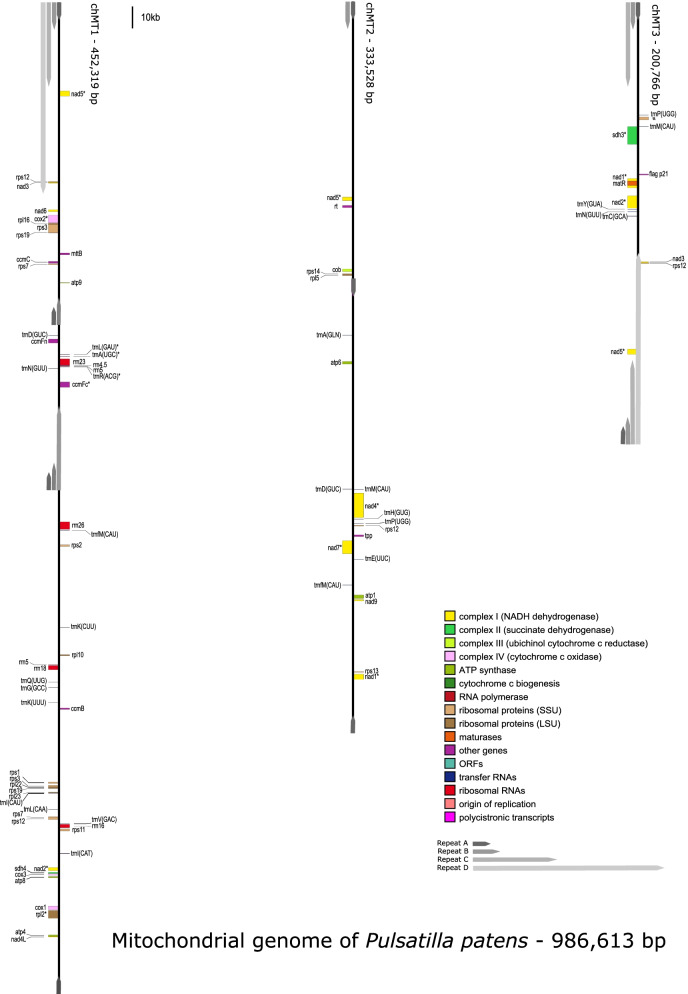
The mitogenomes of vascular plants are one of the most structurally diverse molecules. In the present study we characterize mitogenomes of a rare and endangered species Pulsatilla patens. We investigated the gene content and its RNA editing potential, repeats distribution and plastid derived sequences.
The mitogenome structure of early divergent eudicot, endangered Pulsatilla patens does not support the master chromosome hypothesis, revealing the presence of three linear chromosomes of total length 986 613 bp. The molecules are shaped by the presence of extremely long, exceeding 87 kbp repeats and multiple chloroplast-derived regions including nearly complete inverted repeat. Since the plastid IR content of Ranunculales is very characteristic, the incorporation into mitogenome could be explained rather by intracellular transfer than mitochondrial HGT. The mitogenome contains almost a complete set of genes known from other vascular plants with exception of rps10 and sdh3, the latter being present but pseudogenized. Analysis of long ORFs enabled the identification of genes which are rarely present in plant mitogenomes, including RNA and DNA polymerases, albeit their presence even at species level is variable. Mitochondrial transcripts of P. patens were edited with a high frequency, which exceeded the level known in other analyzed angiosperms, despite the strict qualification criteria of counting the editing events and taking into analysis generally less frequently edited leaf transcriptome. The total number of edited sites was 902 and nad4 was identified as the most heavily edited gene with 65 C to U changes. Non-canonical, reverse U to C editing was not detected. Comparative analysis of mitochondrial genes of three Pulsatilla species revealed a level of variation comparable to chloroplast CDS dataset and much higher infrageneric differentiation than in other known angiosperm genera. The variation found in CDS of mitochondrial genes is comparable to values found among Pulsatilla plastomes. Despite the complicated mitogenome structure, 14 single copy regions of 329 kbp, not splitted by repeats or plastid-derived sequences (MTPT), revealed the potential for phylogenetic, phylogeographic and population genetics studies by revealing intra- and interspecific collinearity.
This study provides valuable new information about mitochondrial genome of early divergent eudicots, Pulsatilla patens, revealed multi-chromosomal structure and shed new light on mitogenomics of early eudicots.
维管植物的线粒体基因组是结构多样性最高的分子之一。本研究对一种稀有濒危物种白头翁的线粒体基因组进行了特征描述。我们研究了基因含量及其 RNA 编辑潜力、重复序列分布和质体衍生序列。
早期分化的真双子叶植物、濒危白头翁的线粒体基因组结构不支持主染色体假说,显示出总长度为 986613bp 的三条线性染色体的存在。分子结构由超长的重复序列(超过 87 kbp)和多个质体衍生区形成,包括近完整的反向重复。由于毛茛目植物的质体 IR 含量非常特征,因此将其整合到线粒体基因组中可以通过细胞内转移而不是线粒体 HGT 来解释。线粒体基因组包含几乎完整的一套已知的其他维管植物基因,但不包括 rps10 和 sdh3,后者存在但已失活。长 ORF 的分析能够识别在植物线粒体基因组中很少出现的基因,包括 RNA 和 DNA 聚合酶,尽管它们在物种水平上的存在是可变的。白头翁的线粒体转录物编辑频率很高,超过了在其他分析的被子植物中已知的水平,尽管编辑事件的计数标准严格,并且通常对编辑频率较低的叶片转录组进行分析。总共鉴定出 902 个编辑位点,nad4 被鉴定为编辑最多的基因,有 65 个 C 到 U 的变化。未检测到非典型的反向 U 到 C 编辑。对三个白头翁物种的线粒体基因的比较分析显示,其变异水平与质体 CDS 数据集相当,而种内分化水平远高于其他已知的被子植物属。在线粒体基因 CDS 中发现的变异与在白头翁质体中发现的值相当。尽管线粒体基因组结构复杂,但通过重复序列或质体衍生序列(MTPT)未分割的 329kbp 的 14 个单拷贝区(MTPT)揭示了种内和种间共线性,为系统发育、系统地理学和群体遗传学研究提供了潜力。
本研究提供了有关早期分化真双子叶植物白头翁线粒体基因组的宝贵新信息,揭示了多染色体结构,并为早期真双子叶植物的线粒体基因组学提供了新的见解。