Department of Health Sciences, College of Life Sciences, University of Leicester, Leicester, UK
Department of Health Sciences, College of Life Sciences, University of Leicester, Leicester, UK.
BMJ Open. 2022 Mar 9;12(2):e057412. doi: 10.1136/bmjopen-2021-057412.
To investigate inequalities in stillbirth rates by ethnicity to facilitate development of initiatives to target those at highest risk.
Population-based perinatal mortality surveillance linked to national birth and death registration (Mothers and Babies: Reducing Risk through Audits and Confidential Enquiries across the UK).
UK.
4 391 569 singleton births at ≥24 weeks gestation between 2014 and 2019.
Stillbirth rate difference per 1000 total births by ethnicity.
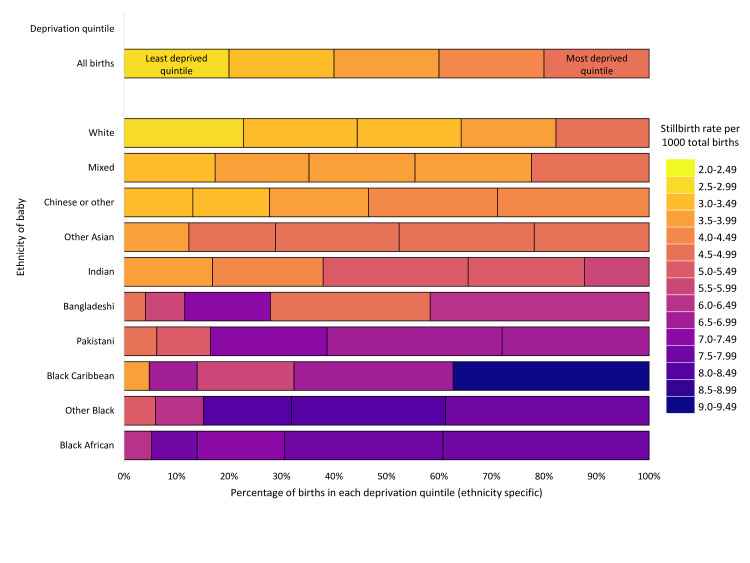
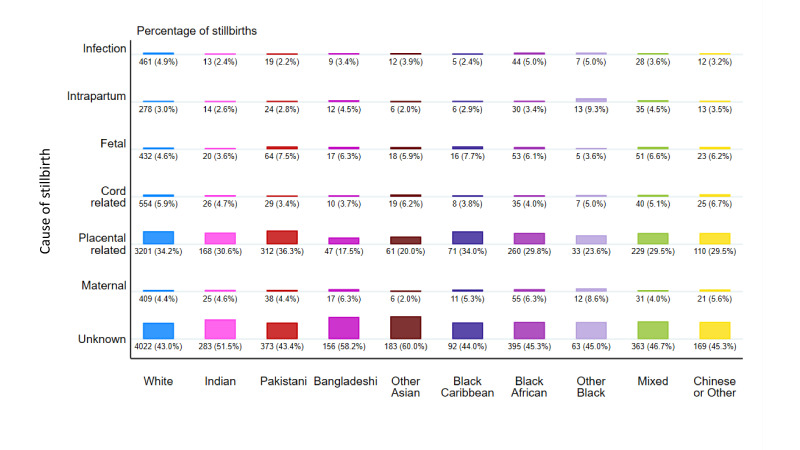
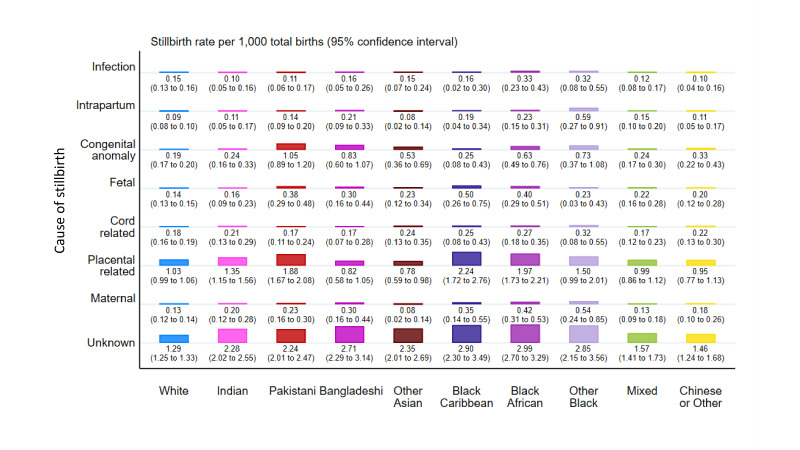
Adjusted absolute differences in stillbirth rates were higher for babies of black African (3.83, 95% CI 3.35 to 4.32), black Caribbean (3.60, 95% CI 2.65 to 4.55) and Pakistani (2.99, 95% CI 2.58 to 3.40) ethnicities compared with white ethnicities. Higher proportions of babies of Bangladeshi (42%), black African (39%), other black (39%) and black Caribbean (37%) ethnicities were from most deprived areas, which were associated with an additional risk of 1.50 stillbirths per 1000 births (95% CI 1.32 to 1.67). Exploring primary cause of death, higher stillbirth rates due to congenital anomalies were observed in babies of Pakistani, Bangladeshi and black African ethnicities (range 0.63-1.05 per 1000 births) and more placental causes in black ethnicities (range 1.97 to 2.24 per 1000 births). For the whole population, over 40% of stillbirths were of unknown cause; however, this was particularly high for babies of other Asian (60%), Bangladeshi (58%) and Indian (52%) ethnicities.
Stillbirth rates declined in the UK, but substantial excess risk of stillbirth persists among babies of black and Asian ethnicities. The combined disadvantage for black, Pakistani and Bangladeshi ethnicities who are more likely to live in most deprived areas is associated with considerably higher rates. Key causes of death were congenital anomalies and placental causes. Improved strategies for investigation of stillbirth causes are needed to reduce unexplained deaths so that interventions can be targeted to reduce stillbirths.
通过研究不同族裔之间的死胎率不平等现象,为制定针对高危人群的措施提供便利。
基于人群的围产期死亡率监测与国家出生和死亡登记系统相关联(英国母婴:通过审计和机密调查降低风险)。
英国。
2014 年至 2019 年间,4391569 名 24 周以上的单胎妊娠产妇。
按族裔划分的每 1000 例总出生数的死胎率差异。
与白种人相比,黑种非洲人(3.83,95%置信区间 3.35 至 4.32)、黑种加勒比人(3.60,95%置信区间 2.65 至 4.55)和巴基斯坦人(2.99,95%置信区间 2.58 至 3.40)的死胎率调整后绝对差异更高。更多的孟加拉国(42%)、黑种非洲人(39%)、其他黑人(39%)和黑种加勒比人(37%)的婴儿来自最贫困地区,这与每 1000 例出生额外增加 1.50 例死胎的风险相关(95%置信区间 1.32 至 1.67)。探索主要死因后发现,巴基斯坦人、孟加拉国人和黑种非洲人(每 1000 例出生 0.63-1.05 例)的死胎率因先天性异常而升高,而黑人的胎盘原因(每 1000 例出生 1.97 至 2.24 例)更多。对于整个人群来说,超过 40%的死胎原因不明;然而,其他亚洲人(60%)、孟加拉国人(58%)和印度人(52%)的婴儿中,这一比例尤其高。
英国的死胎率有所下降,但黑人及亚洲裔婴儿的死胎风险仍明显较高。黑种人、巴基斯坦人和孟加拉国人的综合劣势使他们更有可能生活在最贫困地区,这与更高的死亡率密切相关。主要死因是先天性异常和胎盘原因。需要改进对死胎原因的调查策略,以减少不明原因的死亡,从而使干预措施能够有针对性地降低死胎率。