From the University of British Columbia (Hunter), Vancouver, BC; the Division of Orthopaedics (Grewal), Department of Surgery, University of Western Ontario, London, Ont.; the Division of Orthopaedics (Nam), Department of Surgery, University of Toronto, Toronto, Ont.; and the Department of Orthopaedics (Lefaivre), University of British Columbia, Vancouver, BC
From the University of British Columbia (Hunter), Vancouver, BC; the Division of Orthopaedics (Grewal), Department of Surgery, University of Western Ontario, London, Ont.; the Division of Orthopaedics (Nam), Department of Surgery, University of Toronto, Toronto, Ont.; and the Department of Orthopaedics (Lefaivre), University of British Columbia, Vancouver, BC.
Can J Surg. 2022 Mar 9;65(2):E159-E169. doi: 10.1503/cjs.008920. Print 2022 Mar-Apr.
The majority of the literature on gender disparity in orthopedic surgery is from the United States; the Canadian perspective is lacking. The objective of this study was to determine the representation of women faculty members and the proportion of women faculty in published leadership positions in academic orthopedic divisions and departments across Canada.
In this cross-sectional study, we used a Web-based search strategy to identify faculty listings for all 17 academic orthopedic programs affiliated with the Association of Faculties of Medicine of Canada for the 2018/19 academic year. For each faculty member identified, we determined gender (man or woman), professorial rank and leadership positions. We compared regional gender differences among 3 groups: schools in eastern Canada and Quebec (6), Ontario (6) and western Canada (5). Gender comparisons were made for all variables of interest.
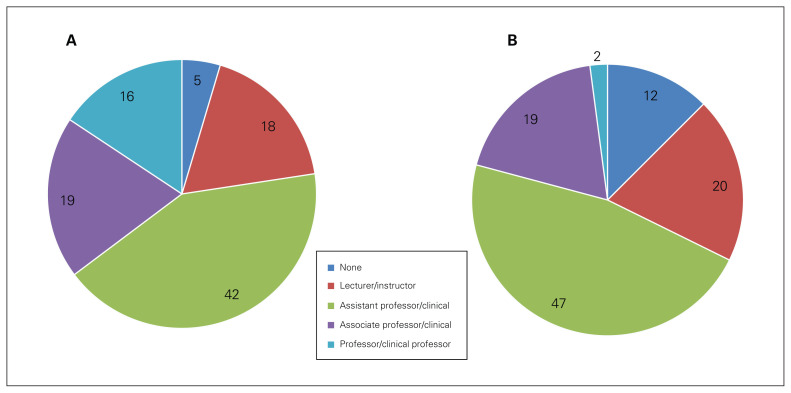
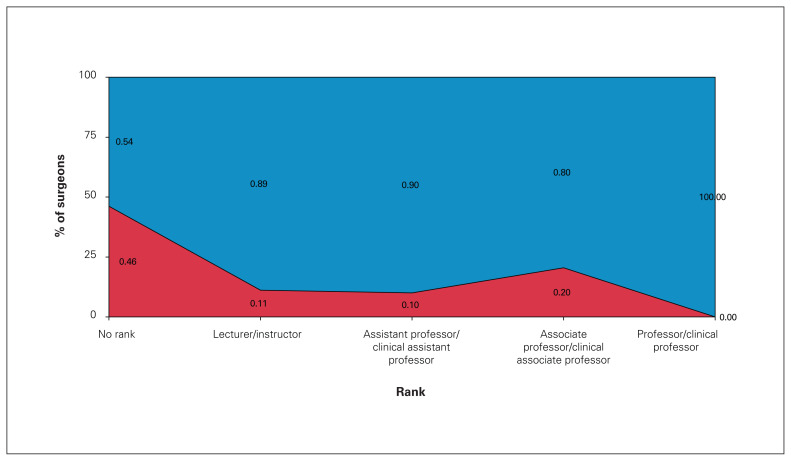
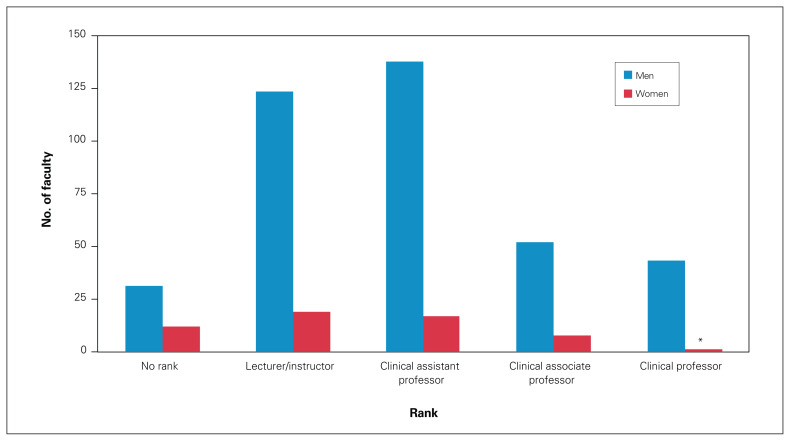
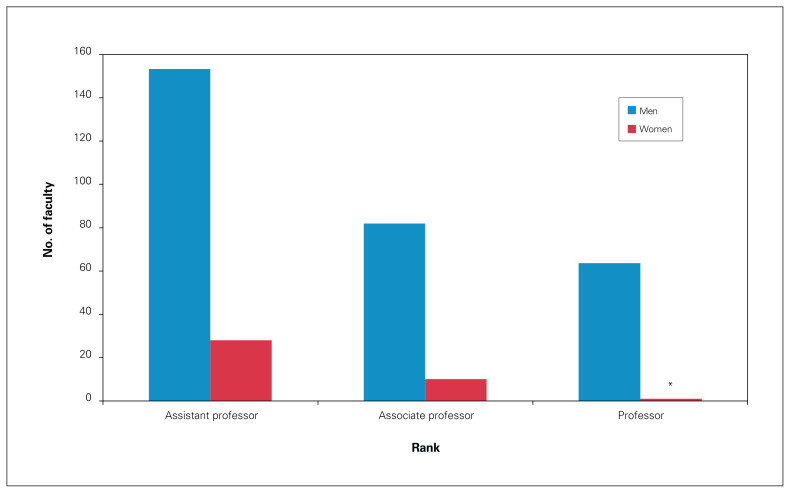
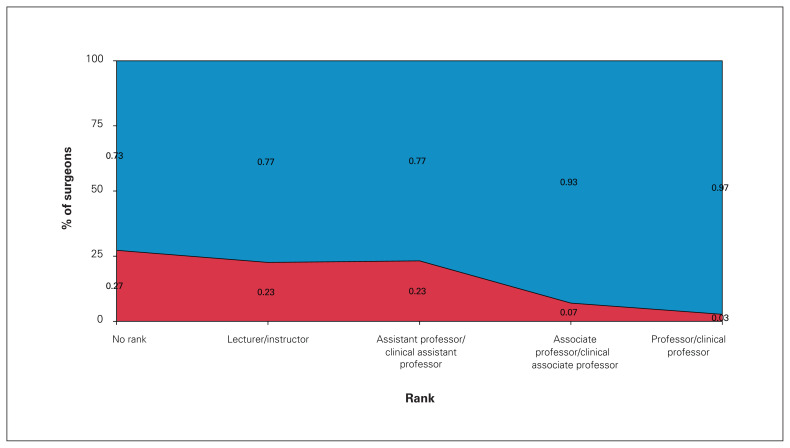
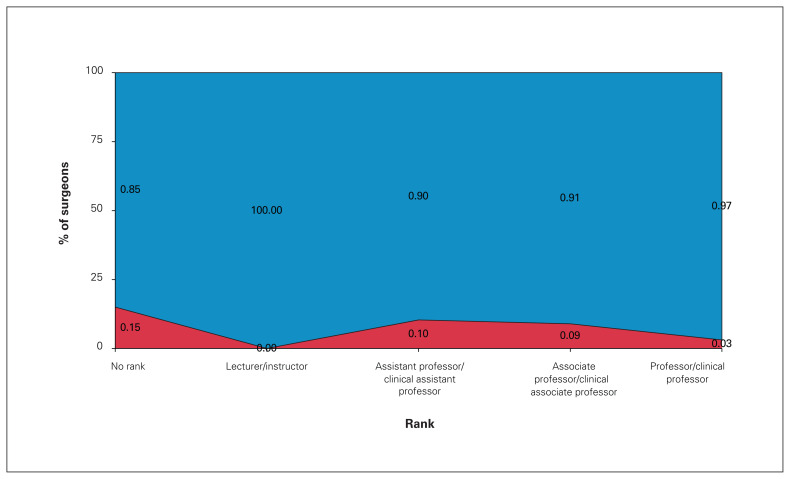
We identified 809 orthopedic surgeons at the 17 Canadian academic institutions, of whom 96 (11.9%) were women. In eastern Canada and Quebec, 16.2% of the faculty were women, significantly above the national average ( = 0.03). The corresponding values for Ontario and western Canada were 8.9% ( = 0.1) and 11.4% ( = 0.7). There were no significant differences in the proportions of women and men at lower levels of promotion, but significantly more men than women had attained full professorship (65 [9%] v. 1 [1%], = 0.002). Women surgeons were not represented in leadership roles or within faculty roles of distinction.
In 2018/19, women orthopedic surgeons were underrepresented in faculty positions across academic orthopedic training programs in Canada, and were disproportionately underrepresented in promoted academic faculty roles and leadership positions. These data can be used to review and educate on equity in hiring and promotion, as well as to foster mentorship and transition planning.
大多数关于矫形外科性别差异的文献都来自美国,而加拿大的情况则缺乏相关研究。本研究的目的是确定加拿大学术矫形部门和单位中女性教员的比例以及女性教员在发表的领导职位中的比例。
在这项横断面研究中,我们使用基于网络的搜索策略来确定 2018/19 学年与加拿大医学学院协会相关的 17 个学术矫形项目的所有教员名单。对于确定的每个教员,我们确定了性别(男性或女性)、教授职级和领导职位。我们比较了加拿大东部和魁北克省(6 个)、安大略省(6 个)和西部(5 个)三个地区的性别差异。对所有感兴趣的变量进行了性别比较。
我们在 17 所加拿大学术机构中确定了 809 名矫形外科医生,其中 96 名(11.9%)为女性。在加拿大东部和魁北克省,女性教员占 16.2%,明显高于全国平均水平( = 0.03)。安大略省和西部的相应值分别为 8.9%( = 0.1)和 11.4%( = 0.7)。在较低职级的晋升中,女性和男性的比例没有显著差异,但获得终身教授职位的男性明显多于女性(65 [9%] 比 1 [1%], = 0.002)。女性外科医生没有担任领导职务或在杰出教员职位中任职。
在 2018/19 年,加拿大学术矫形培训项目中的女性矫形外科医生在教职员工中的比例不足,在晋升的学术教职员工角色和领导职位中比例严重不足。这些数据可用于审查和教育招聘和晋升方面的公平性,以及促进指导和过渡计划。