Churamani Nikhil, Barros Pablo, Gunes Hatice, Wermter Stefan
Department of Computer Science and Technology, University of Cambridge, Cambridge, United Kingdom.
Cognitive Architecture for Collaborative Technologies (CONTACT) Unit, Istituto Italiano di Tecnologia, Genova, Italy.
Front Robot AI. 2022 Feb 21;9:717193. doi: 10.3389/frobt.2022.717193. eCollection 2022.
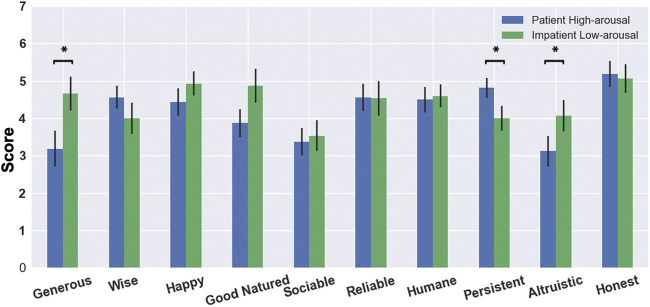
Collaborative interactions require social robots to share the users' perspective on the interactions and adapt to the dynamics of their affective behaviour. Yet, current approaches for affective behaviour generation in robots focus on instantaneous perception to generate a one-to-one mapping between observed human expressions and static robot actions. In this paper, we propose a novel framework for affect-driven behaviour generation in social robots. The framework consists of (i) a hybrid neural model for evaluating facial expressions and speech of the users, forming intrinsic affective representations in the robot, (ii) an , that employs self-organising neural models to embed behavioural traits like and that modulate the robot's affective appraisal, and (iii) a Reinforcement Learning model that uses the robot's appraisal to learn interaction behaviour. We investigate the effect of modelling different affective core dispositions on the affective appraisal and use this affective appraisal as the motivation to generate robot behaviours. For evaluation, we conduct a user study (n = 31) where the NICO robot acts as a in the Ultimatum Game. The effect of the robot's affective core on its negotiation strategy is witnessed by participants, who rank a robot with higher on , while an robot with is rated higher on its and behaviour.
协作交互要求社交机器人能够从用户的角度看待交互,并适应其情感行为的动态变化。然而,当前机器人情感行为生成方法侧重于即时感知,以在观察到的人类表情和静态机器人动作之间生成一对一映射。在本文中,我们提出了一种用于社交机器人情感驱动行为生成的新颖框架。该框架包括:(i)一个混合神经模型,用于评估用户的面部表情和语音,在机器人中形成内在情感表征;(ii)一个……,它采用自组织神经模型来嵌入诸如……和……等行为特征,这些特征会调节机器人的情感评估;(iii)一个强化学习模型,该模型利用机器人的评估来学习交互行为。我们研究了对不同情感核心倾向进行建模对情感评估的影响,并将这种情感评估用作生成机器人行为的动机。为了进行评估,我们开展了一项用户研究(n = 31),其中NICO机器人在最后通牒博弈中充当……。参与者见证了机器人情感核心对其谈判策略的影响,他们认为具有……的机器人在……方面得分更高,而具有……的机器人在其……和……行为方面得分更高。