Rawlings Gregg H, Beail Nigel, Armstrong Iain, Thompson Andrew R
Psychology Department, Nottingham Trent University, Nottingham, UK.
Clinical Psychology Unit, University of Sheffield, Sheffield, UK.
ERJ Open Res. 2022 Mar 7;8(1). doi: 10.1183/23120541.00526-2021. eCollection 2022 Jan.
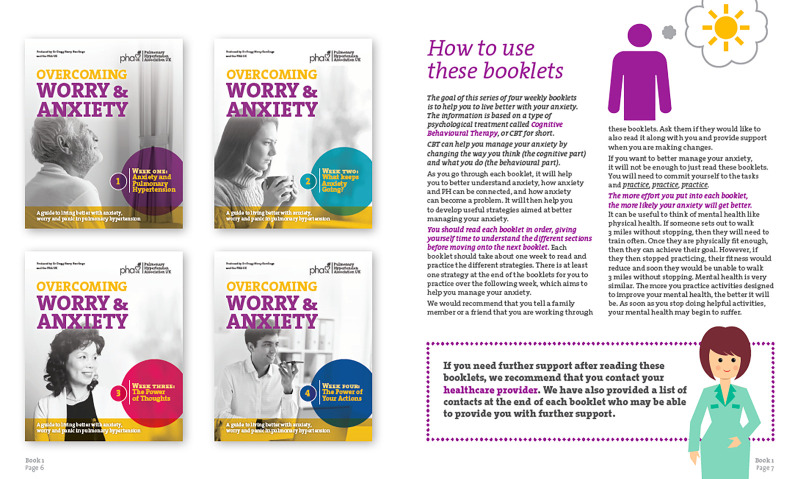
People with pulmonary hypertension (PH) are at an increased risk of experiencing anxiety disorders. This study developed and tested the acceptability, feasibility and preliminary effectiveness of a cognitive behavioural self-help intervention for anxiety in adults with PH using a pilot randomised control trial design.
Individuals with PH recruited from pulmonary hypertension associations were randomised to either receive a newly developed self-help intervention (n=37) or a wait-list condition (n=40). Acceptability was explored using mixed-methods questionnaires. A 2×3 repeated-measures analysis of variance was used to explore anxiety (GAD-7), depression (PHQ-9), health-related quality of life (emPHAsis-10), dyspnoea (D-12), self-mastery (Self-Mastery Scale) and mood-related cognitions and behaviours (CBP-Q) at baseline, post-intervention and 1-month follow up. A mediation analysis was performed to examine potential mechanisms of change.
Dropout was low at 15.6%. All participants would recommend the intervention to another person with PH and felt it had helped with their anxiety. Participants in the intervention group reported a reduction in anxiety, depression and cognitive and behavioural processes linked with mood disorders, compared to the control group. Change in unhelpful cognitions and behaviours mediated the relationship between intervention condition and change in anxiety and depression.
The intervention was found to be acceptable, feasible and safe. Anxiety at baseline was higher than previously observed, which could be associated with the additional burden caused by COVID-19 as the intervention was trialled during the pandemic. Findings add to the growing evidence supporting the use of psychological therapies, including cognitive behavioural therapy, in this clinical group.
肺动脉高压(PH)患者患焦虑症的风险增加。本研究采用试点随机对照试验设计,开发并测试了一种针对成年PH患者焦虑症的认知行为自助干预措施的可接受性、可行性和初步有效性。
从肺动脉高压协会招募的PH患者被随机分为两组,一组接受新开发的自助干预(n = 37),另一组接受等待名单对照(n = 40)。使用混合方法问卷探讨可接受性。采用2×3重复测量方差分析,在基线、干预后和1个月随访时评估焦虑(广泛性焦虑障碍量表-7,GAD-7)、抑郁(患者健康问卷-9,PHQ-9)、健康相关生活质量(肺动脉高压重点关注量表-10,emPHAsis-10)、呼吸困难(12项呼吸困难量表,D-12)、自我掌控感(自我掌控量表)以及与情绪相关的认知和行为(认知行为问卷,CBP-Q)。进行中介分析以检验潜在的变化机制。
脱落率较低,为15.6%。所有参与者都表示会向另一位PH患者推荐该干预措施,并认为它对缓解焦虑有帮助。与对照组相比,干预组参与者报告焦虑、抑郁以及与情绪障碍相关的认知和行为过程有所减少。无益认知和行为的变化介导了干预条件与焦虑和抑郁变化之间的关系。
该干预措施被认为是可接受、可行且安全的。基线时的焦虑水平高于先前观察到的情况,这可能与在疫情期间进行干预试验时新冠疫情带来的额外负担有关。研究结果进一步证明了在这一临床群体中使用包括认知行为疗法在内的心理治疗方法的证据越来越多。