Sambol Stjepan, Suleyman Emra, Scarfo Jessica, Ball Michelle
Institute for Health and Sport (IHES), Victoria University, Melbourne, Victoria, Australia.
Heliyon. 2022 Feb 3;8(2):e08882. doi: 10.1016/j.heliyon.2022.e08882. eCollection 2022 Feb.
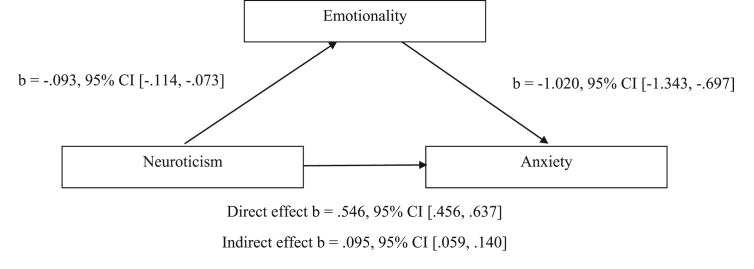
There is ongoing debate on the utility of trait emotional intelligence and whether it is distinguishable from the five-factor model of personality. In study 1, we investigated the incremental validity of trait emotional intelligence in predicting negative emotional states, after controlling for the five-factor model personality traits. The TEIQue, Mini-IPIP, and DASS-21 were administered to a community based Australian sample. Three significant predictive models emerged: (1) wellbeing, and neuroticism predicting depression; (2) emotionality, and neuroticism predicting anxiety; and (3) self-control, and neuroticism predicting stress. In Study 2, we further explored the relationship between TEIQue domains, neuroticism, and negative emotional states. Three partial mediation models were found: (1) wellbeing mediated the relationship between neuroticism and depression; (2) emotionality mediated the relationship between neuroticism and anxiety; and (3) self-control mediated the relationship between neuroticism and stress. The findings highlight that trait emotional intelligence is related to, and yet distinct from extraversion, conscientiousness, agreeableness, neuroticism, and openness. They also provide support for the incremental validity of the TEIQue domains in predicting depression, anxiety, and stress, beyond the five-factor model personality traits in a community based Australian sample, with the domains of trait emotional intelligence potentially operating as protective factors from pervasive negative moods.
关于特质情绪智力的效用以及它是否与人格五因素模型有所区别,目前仍存在争议。在研究1中,我们在控制了人格五因素模型特质之后,调查了特质情绪智力在预测负面情绪状态方面的增量效度。对一个基于澳大利亚社区的样本施测了特质情绪智力问卷(TEIQue)、简易国际人格五因素问卷(Mini - IPIP)和抑郁焦虑压力量表(DASS - 21)。出现了三个显著的预测模型:(1)幸福感和神经质预测抑郁;(2)情绪性和神经质预测焦虑;(3)自我控制和神经质预测压力。在研究2中,我们进一步探讨了特质情绪智力问卷各维度、神经质与负面情绪状态之间的关系。发现了三个部分中介模型:(1)幸福感中介了神经质与抑郁之间的关系;(2)情绪性中介了神经质与焦虑之间的关系;(3)自我控制中介了神经质与压力之间的关系。研究结果表明,特质情绪智力与外向性、尽责性、宜人性、神经质和开放性相关,但又有所不同。它们还为特质情绪智力问卷各维度在预测抑郁、焦虑和压力方面的增量效度提供了支持,这超出了基于澳大利亚社区样本的人格五因素模型特质,特质情绪智力各维度可能作为抵御普遍负面情绪的保护因素发挥作用。