Lee Min-Kyeong, Jeong Hyeon Hak, Kim Myeong-Jin, Ryu Heeyeon, Baek Jiwon, Lee Bonggi
Department of Food Science and Nutrition, Pukyong National University, Nam-gu, Daeyeon-dong, Busan 48513, Korea.
Foods. 2022 Feb 25;11(5):687. doi: 10.3390/foods11050687.
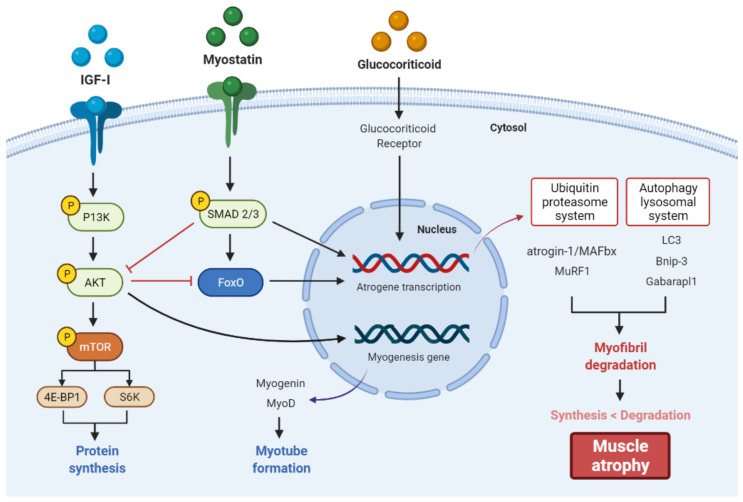
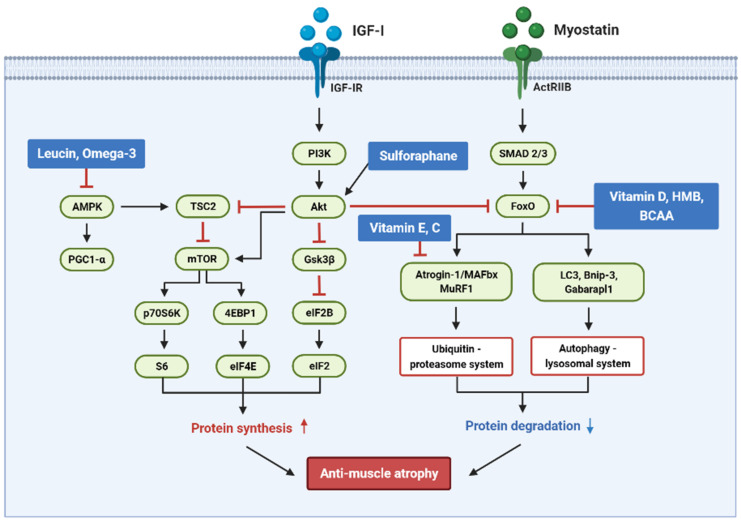
Glucocorticoid excess is a critical factor contributing to muscle atrophy. Both endogenous and exogenous glucocorticoids negatively affect the preservation of muscle mass and function. To date, the most effective intervention to prevent muscle atrophy is to apply a mechanical load in the form of resistance exercise. However, glucocorticoid-induced skeletal muscle atrophy easily causes fatigue in daily physical activities, such as climbing stairs and walking at a brisk pace, and reduces body movements to cause a decreased ability to perform physical activity. Therefore, providing adequate nutrients in these circumstances is a key factor in limiting muscle wasting and improving muscle mass recovery. The present review will provide an up-to-date review of the effects of various nutrients, including amino acids such as branched-chain amino acids (BCAAs) and β-hydroxy β-methylbutyrate (HMB), fatty acids such as omega-3, and vitamins and their derivates on the prevention and improvement of glucocorticoid-induced muscle atrophy.
糖皮质激素过量是导致肌肉萎缩的关键因素。内源性和外源性糖皮质激素均会对肌肉质量和功能的维持产生负面影响。迄今为止,预防肌肉萎缩最有效的干预措施是以抗阻运动的形式施加机械负荷。然而,糖皮质激素诱导的骨骼肌萎缩很容易在日常体力活动中引发疲劳,如爬楼梯和快走,并减少身体活动,导致身体活动能力下降。因此,在这些情况下提供充足的营养是限制肌肉消耗和促进肌肉质量恢复的关键因素。本综述将对各种营养素的作用进行最新综述,这些营养素包括支链氨基酸(BCAAs)等氨基酸、β-羟基-β-甲基丁酸(HMB)、ω-3等脂肪酸以及维生素及其衍生物,它们对预防和改善糖皮质激素诱导的肌肉萎缩的作用。