Schulz Susanne, Stein Jamal M, Schumacher Anne, Kupietz David, Yekta-Michael Sareh S, Schittenhelm Florian, Conrads Georg, Schaller Hans-Günter, Reichert Stefan
Department of Operative Dentistry and Periodontology, Martin-Luther-University Halle-Wittenberg, 06108 Halle, Germany.
Department of Operative Dentistry, Periodontology and Preventive Dentistry, University Hospital (RWTH) Aachen, 52074 Aachen, Germany.
J Clin Med. 2022 Feb 23;11(5):1187. doi: 10.3390/jcm11051187.
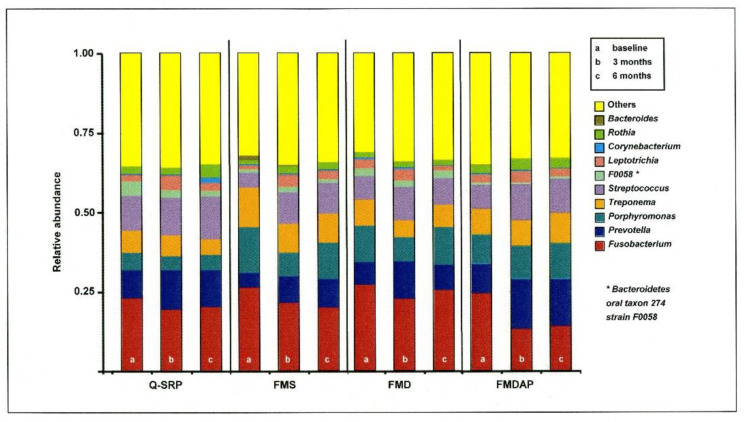
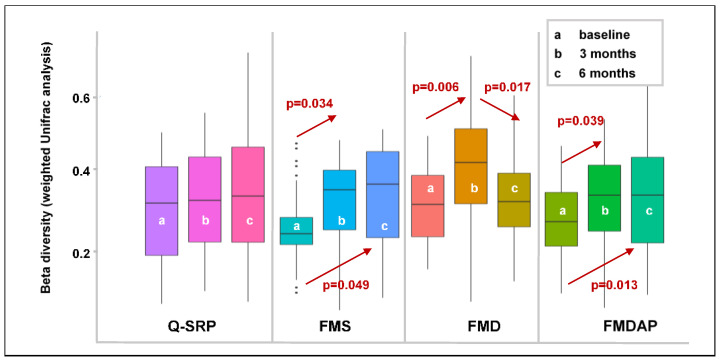
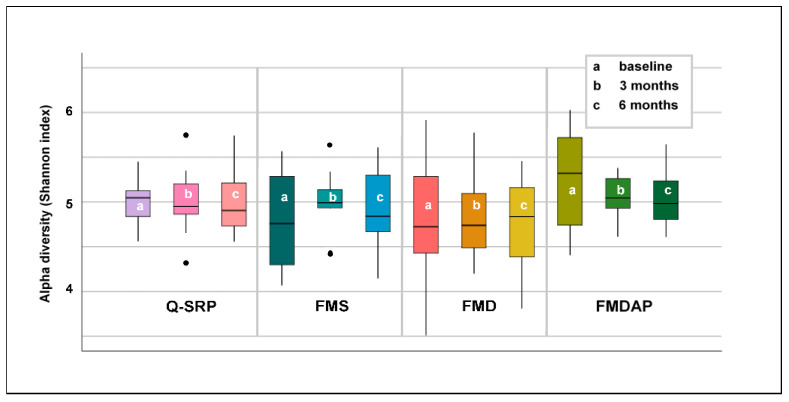
Different periodontal treatment methods (quadrant-wise debridement, scaling and root planing (Q-SRP), full-mouth scaling (FMS), full-mouth disinfection (FMD), and FMD with adjuvant erythritol air-polishing (FMDAP)) were applied in periodontitis patients (stage III/IV). The study objective (substudy of ClinicalTrials.gov Identifier: NCT03509233) was to compare the impact of treatments on subgingival colonization.
Forty patients were randomized to the treatment groups. Periodontal parameters and subgingival colonization were evaluated at baseline and 3 and 6 months after treatment.
Positive changes in clinical parameters were recorded in every treatment group during the 3-month follow-up period, but did not always continue. In three groups, specific bacteria decreased after 3 months; however, this was associated with a renewed increase after 6 months (FMS: ; FMD: , ; and FMDAP: uncultured sp.).
The benefit of all clinical treatments measured after 3 months was associated with a decrease in pathogenic bacteria in the FMS, FMD, and FMDAP groups. However, after 6 months, we observed further improvement or some stagnation in clinical outcomes accompanied by deterioration of the microbiological profile. Investigating the subgingival microbiota might help appraise successful periodontal treatment and implement individualized therapy.
对牙周炎患者(III/IV期)采用了不同的牙周治疗方法(象限刮治、龈下刮治和根面平整(Q-SRP)、全口洁治(FMS)、全口消毒(FMD)以及FMD联合辅助赤藓糖醇空气抛光(FMDAP))。本研究目的(ClinicalTrials.gov标识符:NCT03509233的子研究)是比较这些治疗方法对龈下菌群定植的影响。
40例患者被随机分配至各治疗组。在基线以及治疗后3个月和6个月时评估牙周参数和龈下菌群定植情况。
在3个月的随访期内,每个治疗组的临床参数均出现了积极变化,但并非始终持续。3个月后,三组中特定细菌数量减少;然而,6个月后又再次增加(FMS组:;FMD组:,;FMDAP组:未培养的 菌属)。
3个月后所测量的所有临床治疗的益处与FMS、FMD和FMDAP组中病原菌数量的减少有关。然而,6个月后,我们观察到临床结果进一步改善或出现停滞,同时微生物学特征恶化。研究龈下微生物群可能有助于评估牙周治疗的成功与否并实施个体化治疗。