National Laboratory of Biomacromolecules, CAS Center for Excellence in Biomacromolecules, Institute of Biophysics, Chinese Academy of Sciences, 15 Datun Road, Chaoyang District, Beijing 100101, China.
University of the Chinese Academy of Sciences, 19 Yuquan Road, Shijingshan District, Beijing 100049, China.
Cells. 2022 Feb 28;11(5):829. doi: 10.3390/cells11050829.
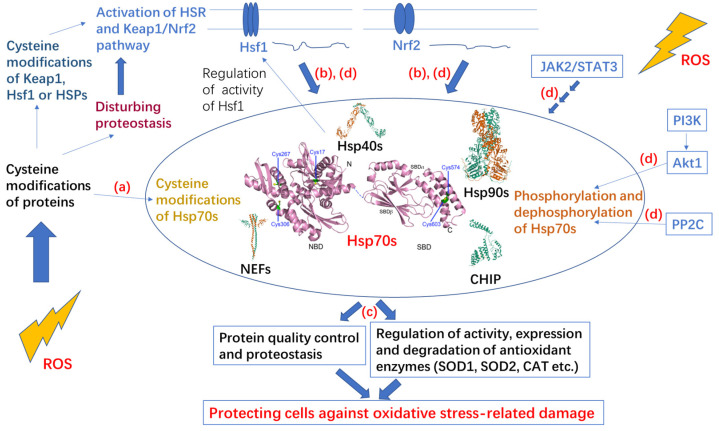
Cellular redox homeostasis is precisely balanced by generation and elimination of reactive oxygen species (ROS). ROS are not only capable of causing oxidation of proteins, lipids and DNA to damage cells but can also act as signaling molecules to modulate transcription factors and epigenetic pathways that determine cell survival and death. Hsp70 proteins are central hubs for proteostasis and are important factors to ameliorate damage from different kinds of stress including oxidative stress. Hsp70 members often participate in different cellular signaling pathways via their clients and cochaperones. ROS can directly cause oxidative cysteine modifications of Hsp70 members to alter their structure and chaperone activity, resulting in changes in the interactions between Hsp70 and their clients or cochaperones, which can then transfer redox signals to Hsp70-related signaling pathways. On the other hand, ROS also activate some redox-related signaling pathways to indirectly modulate Hsp70 activity and expression. Post-translational modifications including phosphorylation together with elevated Hsp70 expression can expand the capacity of Hsp70 to deal with ROS-damaged proteins and support antioxidant enzymes. Knowledge about the response and role of Hsp70 in redox homeostasis will facilitate our understanding of the cellular knock-on effects of inhibitors targeting Hsp70 and the mechanisms of redox-related diseases and aging.
细胞氧化还原稳态是通过活性氧(ROS)的产生和消除来精确平衡的。ROS 不仅能够氧化蛋白质、脂质和 DNA 从而损伤细胞,还可以作为信号分子来调节转录因子和表观遗传途径,从而决定细胞的存活和死亡。Hsp70 蛋白是蛋白质稳态的核心枢纽,是改善各种应激包括氧化应激造成损伤的重要因素。Hsp70 成员通常通过其客户蛋白和共伴侣参与不同的细胞信号通路。ROS 可以直接导致 Hsp70 成员的氧化半胱氨酸修饰,改变其结构和伴侣活性,导致 Hsp70 与其客户蛋白或共伴侣之间的相互作用发生变化,从而将氧化还原信号传递给与 Hsp70 相关的信号通路。另一方面,ROS 还可以激活一些与氧化还原相关的信号通路,从而间接调节 Hsp70 的活性和表达。包括磷酸化在内的翻译后修饰以及 Hsp70 表达的增加,可以扩大 Hsp70 处理 ROS 损伤蛋白的能力,并支持抗氧化酶。了解 Hsp70 在氧化还原稳态中的反应和作用,将有助于我们理解针对 Hsp70 的抑制剂的细胞级联效应以及与氧化还原相关的疾病和衰老的机制。