Department of Medical Laboratory Diagnostics-Fahrenheit Biobank BBMRI.pl, Medical University of Gdansk, 80-210 Gdansk, Poland.
Beckman Institute for Advanced Science and Technology, University of Illinois at Urbana-Champaign, 405 N Mathews Ave, MC-251, Urbana, IL 61801, USA.
Int J Mol Sci. 2022 Feb 28;23(5):2658. doi: 10.3390/ijms23052658.
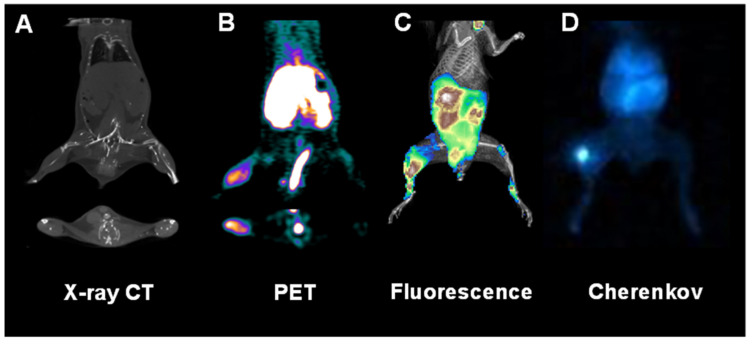
Personalized medicine is emerging as a new goal in the diagnosis and treatment of diseases. This approach aims to establish differences between patients suffering from the same disease, which allows to choose the most effective treatment. Molecular imaging (MI) enables advanced insight into molecule interactions and disease pathology, improving the process of diagnosis and therapy and, for that reason, plays a crucial role in personalized medicine. Nanoparticles are widely used in MI techniques due to their size, high surface area to volume ratio, and multifunctional properties. After conjugation to specific ligands and drugs, nanoparticles can transport therapeutic compounds directly to their area of action and therefore may be used in theranostics-the simultaneous implementation of treatment and diagnostics. This review summarizes different MI techniques, including optical imaging, ultrasound imaging, magnetic resonance imaging, nuclear imaging, and computed tomography imaging with theranostics nanoparticles. Furthermore, it explores the potential use of constructs that enables multimodal imaging and track diseases in real time.
个性化医学正在成为疾病诊断和治疗的新目标。这种方法旨在确定患有同种疾病的患者之间的差异,从而可以选择最有效的治疗方法。分子成像(MI)能够深入了解分子相互作用和疾病病理学,改善诊断和治疗过程,因此在个性化医学中发挥着至关重要的作用。由于其尺寸、高表面积与体积比和多功能特性,纳米粒子广泛应用于 MI 技术中。经过与特定配体和药物的结合,纳米粒子可以将治疗化合物直接输送到其作用部位,因此可用于治疗诊断学——同时进行治疗和诊断。本文综述了不同的 MI 技术,包括光学成像、超声成像、磁共振成像、核医学成像和计算机断层扫描成像与治疗诊断纳米粒子。此外,还探讨了构建能够进行多模态成像和实时跟踪疾病的构建体的潜在用途。