Cai Hong, Bai Wei, Liu Huanzhong, Chen Xu, Qi Han, Liu Rui, Cheung Teris, Su Zhaohui, Lin Jingxia, Tang Yi-Lang, Jackson Todd, Zhang Qinge, Xiang Yu-Tao
Unit of Psychiatry, Department of Public Health and Medicinal Administration, & Institute of Translational Medicine, Faculty of Health Sciences, University of Macau, Macao SAR, China.
Centre for Cognitive and Brain Sciences, University of Macau, Macao SAR, China.
Transl Psychiatry. 2022 Mar 10;12(1):98. doi: 10.1038/s41398-022-01838-9.
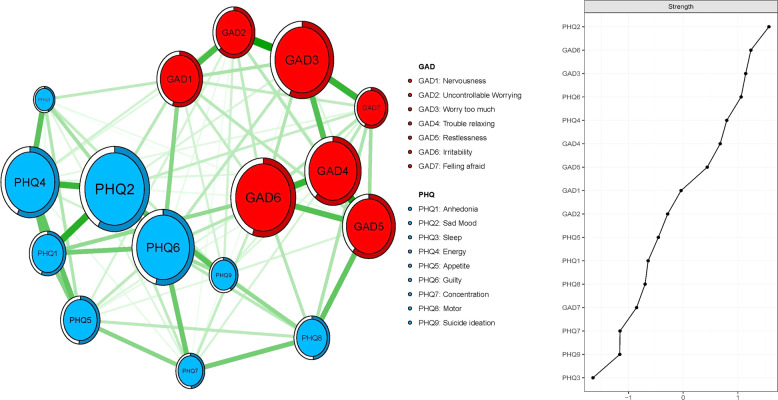
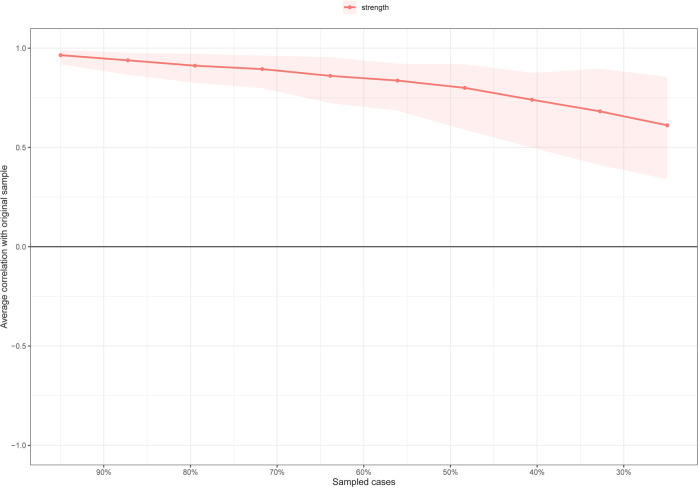
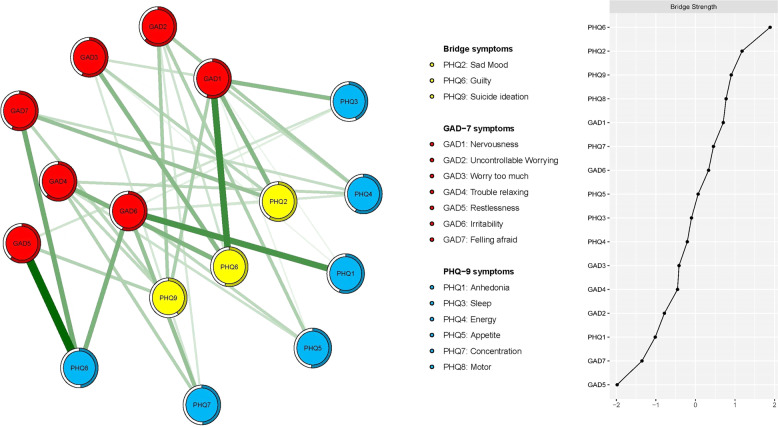
Network analysis is an effective approach for examining complex relationships between psychiatric symptoms. This study was designed to examine item-level relationships between depressive and anxiety symptoms using network analysis in an adolescent sample and identified the most central symptoms within the depressive-anxiety symptoms network model. Depressive and anxiety symptoms were assessed using the Patient Health Questionire-9 (PHQ-9) and Generalized Anxiety Disorder Screener (GAD-7), respectively. The structure of depressive and anxiety symptoms was characterized using "Strength" and "Bridge Strength" as centrality indices in the symptom network. Network stability was tested using a case-dropping bootstrap procedure. Finally, a Network Comparison Test (NCT) was conducted to examine whether network characteristics differed on the basis of gender, school grade and residence. Network analysis revealed that nodes PHQ2 ("Sad mood"), GAD6 ("Irritability"), GAD3 ("Worry too much"), and PHQ6 ("Guilty") were central symptoms in the network model of adolescents. Additionally, bridge symptoms linking anxiety and depressive symptoms in this sample were nodes PHQ6 ("Guilty"), PHQ2 ("Sad mood"), and PHQ9 ("Suicide ideation"). Gender, school grade and residence did not significantly affect the network structure. Central symptoms (e.g., Sad mood, Irritability, Worry too much, and Guilty) and key bridge symptoms (e.g., Guilty, Sad mood, and Suicide ideation) in the depressive and anxiety symptoms network may be useful as potential targets for intervention among adolescents who are at risk for or suffer from depressive and anxiety symptoms.
网络分析是检验精神症状之间复杂关系的一种有效方法。本研究旨在使用网络分析来检验青少年样本中抑郁症状和焦虑症状之间的条目级关系,并确定抑郁 - 焦虑症状网络模型中最核心的症状。分别使用患者健康问卷 - 9(PHQ - 9)和广泛性焦虑障碍筛查量表(GAD - 7)评估抑郁症状和焦虑症状。使用“强度”和“桥梁强度”作为症状网络中的中心性指标来表征抑郁和焦虑症状的结构。使用逐个剔除的自助法检验网络稳定性。最后,进行网络比较测试(NCT)以检验网络特征是否因性别、年级和居住地而有所不同。网络分析显示,节点PHQ2(“情绪低落”)、GAD6(“易怒”)、GAD3(“过度担忧”)和PHQ6(“内疚”)是青少年网络模型中的核心症状。此外,在该样本中连接焦虑和抑郁症状的桥梁症状是节点PHQ6(“内疚”)、PHQ2(“情绪低落”)和PHQ9(“自杀观念”)。性别、年级和居住地对网络结构没有显著影响。抑郁和焦虑症状网络中的核心症状(如情绪低落、易怒、过度担忧和内疚)以及关键桥梁症状(如内疚、情绪低落和自杀观念)可能作为对有抑郁和焦虑症状风险或患有抑郁和焦虑症状的青少年进行干预的潜在目标。