Ahmed Arfan, Aziz Sarah, Khalifa Mohamed, Shah Uzair, Hassan Asma, Abd-Alrazaq Alaa, Househ Mowafa
Division of Information and Computing Technology, College of Science and Engineering, Hamad Bin Khalifa University, Qatar Foundation, Doha, Qatar.
AI Center for Precision Health, Weill Cornell Medicine-Qatar, Doha, Qatar.
JMIR Form Res. 2022 Mar 11;6(3):e27654. doi: 10.2196/27654.
Anxiety and depression are among the most commonly prevalent mental health disorders worldwide. Chatbot apps can play an important role in relieving anxiety and depression. Users' reviews of chatbot apps are considered an important source of data for exploring users' opinions and satisfaction.
This study aims to explore users' opinions, satisfaction, and attitudes toward anxiety and depression chatbot apps by conducting a thematic analysis of users' reviews of 11 anxiety and depression chatbot apps collected from the Google Play Store and Apple App Store. In addition, we propose a workflow to provide a methodological approach for future analysis of app review comments.
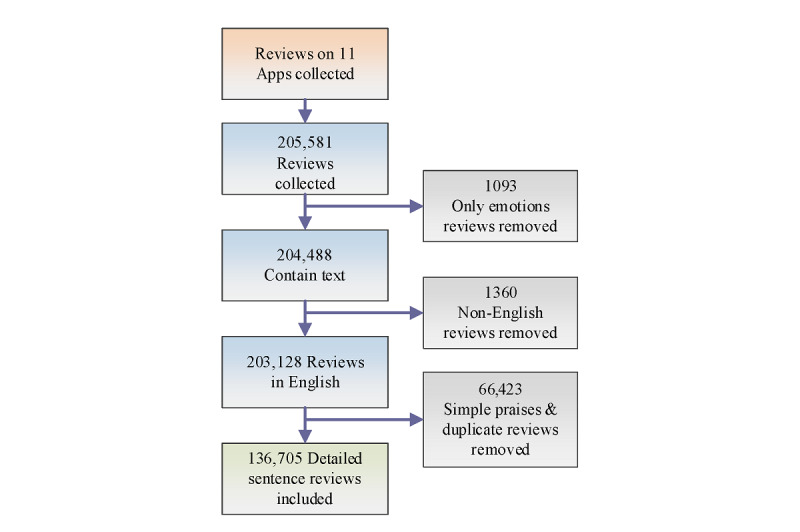
We analyzed 205,581 user review comments from chatbots designed for users with anxiety and depression symptoms. Using scraper tools and Google Play Scraper and App Store Scraper Python libraries, we extracted the text and metadata. The reviews were divided into positive and negative meta-themes based on users' rating per review. We analyzed the reviews using word frequencies of bigrams and words in pairs. A topic modeling technique, latent Dirichlet allocation, was applied to identify topics in the reviews and analyzed to detect themes and subthemes.
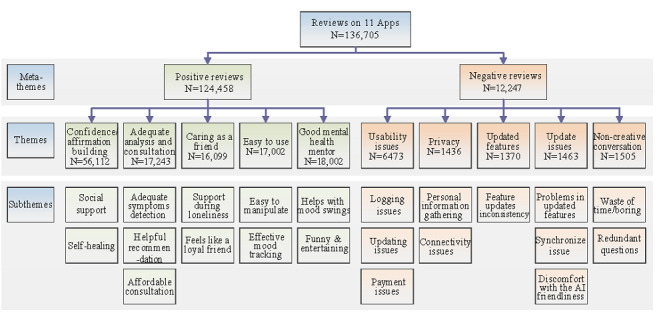
Thematic analysis was conducted on 5 topics for each sentimental set. Reviews were categorized as positive or negative. For positive reviews, the main themes were confidence and affirmation building, adequate analysis, and consultation, caring as a friend, and ease of use. For negative reviews, the results revealed the following themes: usability issues, update issues, privacy, and noncreative conversations.
Using a machine learning approach, we were able to analyze ≥200,000 comments and categorize them into themes, allowing us to observe users' expectations effectively despite some negative factors. A methodological workflow is provided for the future analysis of review comments.
焦虑和抑郁是全球最常见的心理健康障碍。聊天机器人应用程序在缓解焦虑和抑郁方面可以发挥重要作用。用户对聊天机器人应用程序的评价被认为是探索用户意见和满意度的重要数据来源。
本研究旨在通过对从谷歌Play商店和苹果应用商店收集的11款焦虑和抑郁聊天机器人应用程序的用户评价进行主题分析,探索用户对焦虑和抑郁聊天机器人应用程序的意见、满意度和态度。此外,我们提出了一个工作流程,为未来应用程序评价评论的分析提供一种方法。
我们分析了针对有焦虑和抑郁症状用户设计的聊天机器人的205,581条用户评价评论。使用爬虫工具以及谷歌Play爬虫和应用商店爬虫Python库,我们提取了文本和元数据。根据每条评论的用户评分,将评论分为正面和负面元主题。我们使用双词搭配和成对单词的词频对评论进行分析。应用一种主题建模技术——潜在狄利克雷分配,来识别评论中的主题,并进行分析以检测主题和子主题。
对每个情感集的5个主题进行了主题分析。评论被分类为正面或负面。对于正面评论,主要主题是建立信心和肯定、充分的分析和咨询、像朋友一样关怀以及易用性。对于负面评论,结果揭示了以下主题:可用性问题、更新问题、隐私和缺乏创意的对话。
使用机器学习方法,我们能够分析≥200,000条评论并将它们分类为主题,尽管存在一些负面因素,但仍能有效地观察用户的期望。为未来的评论分析提供了一种方法工作流程。