Gonçalves Meline Gomes, Medeiros Matheus Anselmo, de Lemos Licyanne Ingrid Carvalho, de Fátima Campos Pedrosa Lucia, de Andrade Santos Pedro Paulo, Abreu Bento João, Lima João Paulo Matos Santos
Biochemistry and Molecular Biology Graduate Program, Biosciences Center, Federal University of Rio Grande do Norte, Natal 59078-970, RN, Brazil.
Bioinformatics Graduate Program, Digital Metropolis Institute, Federal University of Rio Grande do Norte, Natal 59078-400, RN, Brazil.
Nutrients. 2022 Jan 19;14(3):431. doi: 10.3390/nu14030431.
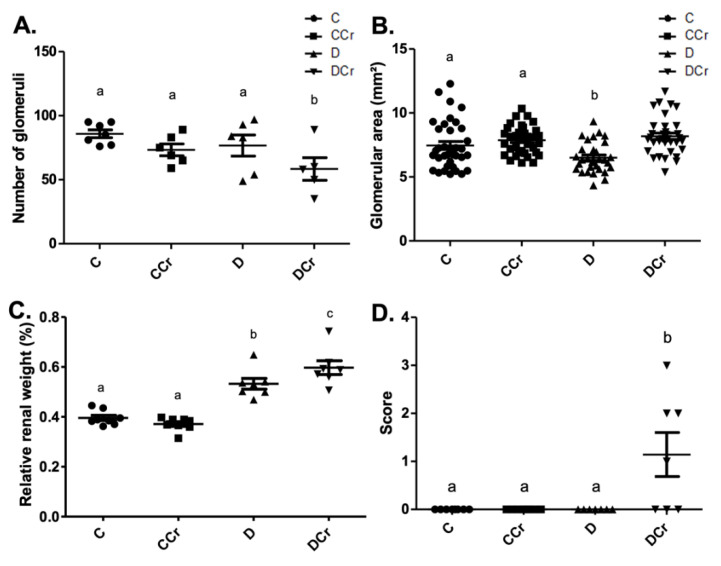
Diabetes mellitus (DM) is a worldwide health concern, and projections state that cases will reach 578 million by 2030. Adjuvant therapies that can help the standard treatment and mitigate DM effects are necessary, especially those using nutritional supplements to improve glycemic control. Previous studies suggest creatine supplementation as a possible adjuvant therapy for DM, but they lack the evaluation of potential morphological parameters alterations and tissue injury caused by this compound. The present study aimed to elucidate clinical, histomorphometric, and histopathological consequences and the cellular oxidative alterations of creatine supplementation in streptozotocin (STZ)-induced type 1 DM rats. We could estimate whether the findings are due to DM or the supplementation from a factorial experimental design. Although creatine supplementation attenuated some biochemical parameters, the morphological analyses of pancreatic and renal tissues made clear that the supplementation did not improve the STZ-induced DM1 injuries. Moreover, creatine-supplemented non-diabetic animals were diagnosed with pancreatitis and showed renal tubular necrosis. Therefore, even in the absence of clinical symptoms and unaltered biochemical parameters, creatine supplementation as adjuvant therapy for DM should be carefully evaluated.
糖尿病(DM)是一个全球性的健康问题,据预测,到2030年病例数将达到5.78亿。有助于标准治疗并减轻糖尿病影响的辅助疗法是必要的,特别是那些使用营养补充剂来改善血糖控制的疗法。先前的研究表明补充肌酸可能是糖尿病的一种辅助疗法,但这些研究缺乏对该化合物引起的潜在形态学参数改变和组织损伤的评估。本研究旨在阐明补充肌酸对链脲佐菌素(STZ)诱导的1型糖尿病大鼠的临床、组织形态计量学、组织病理学后果以及细胞氧化改变。我们可以通过析因实验设计来估计这些发现是由于糖尿病还是补充剂所致。尽管补充肌酸减轻了一些生化参数,但胰腺和肾脏组织的形态学分析清楚地表明,补充肌酸并不能改善STZ诱导的1型糖尿病损伤。此外,补充肌酸的非糖尿病动物被诊断为胰腺炎,并出现肾小管坏死。因此,即使没有临床症状且生化参数未改变,将补充肌酸作为糖尿病的辅助疗法也应谨慎评估。