Molecular Cell Biology and Public Health, University of Hawaii at Manoa (UHM), Honolulu, HI 96822, USA.
Population Sciences in the Pacific Program, University of Hawaii Cancer Center, UHM, Honolulu, HI 96813, USA.
Nutrients. 2022 Feb 4;14(3):660. doi: 10.3390/nu14030660.
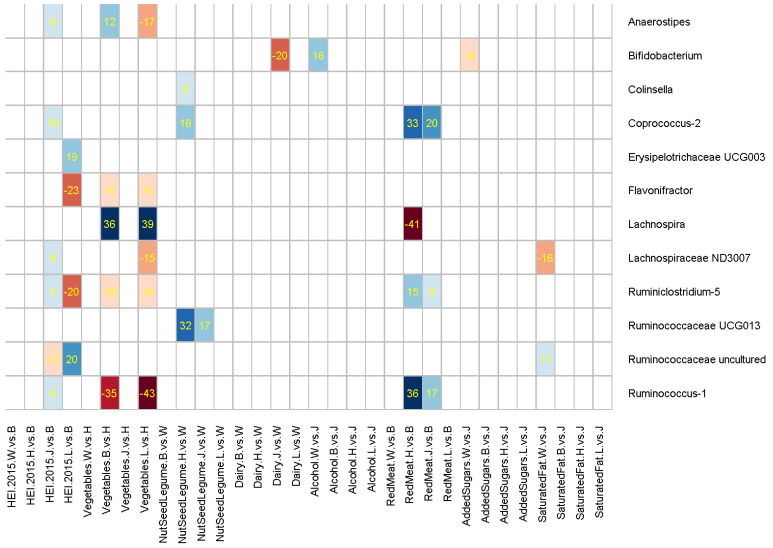
Background: The human gut microbiome (GM) has been observed to vary by race/ethnicity. Objective: Assess whether racial/ethnic GM variation is mediated by differences in diet. Design: Stool samples collected from 2013 to 2016 from 5267 healthy Multiethnic Cohort participants (age 59−98) were analyzed using 16S rRNA gene sequencing to estimate the relative abundance of 152 bacterial genera. For 63 prevalent genera (>50% in each ethnic group), we analyzed the mediation of GM differences among African Americans, Japanese Americans, Latinos, Native Hawaiians, and Whites by overall diet quality (Healthy Eating Index score (HEI-2015)) and intake amounts of 14 component foods/nutrients assessed from 2003 to 2008. For each significant mediation (p < 1.3 × 10⁻⁵), we determined the percent of the total ethnicity effect on genus abundance mediated by the dietary factor. Results: Ethnic differences in the abundance of 12 genera were significantly mediated by one or more of eight dietary factors, most frequently by overall diet quality and intakes of vegetables and red meat. Lower vegetable intake mediated differences in Lachnospira (36% in African Americans, 39% in Latinos) and Ruminococcus-1 (−35% in African Americans, −43% in Latinos) compared to Native Hawaiians who consumed the highest amount. Higher red meat intake mediated differences in Lachnospira (−41%) and Ruminococcus-1 (36%) in Native Hawaiians over African Americans, who consumed the least. Dairy and alcohol intakes appeared to mediate and counterbalance the difference in Bifidobacterium between Whites and Japanese Americans. Conclusions: Overall diet quality and component food intakes may contribute to ethnic differences in GM composition and to GM-related racial/ethnic health disparities.
人类肠道微生物组(GM)已被观察到因种族/民族而异。目的:评估种族/民族 GM 差异是否受饮食差异的影响。设计:从 2013 年至 2016 年,从 5267 名健康的多民族队列参与者(年龄 59-98 岁)中收集粪便样本,使用 16S rRNA 基因测序来估计 152 种细菌属的相对丰度。对于 63 种常见属(每种族群体中超过 50%的属),我们分析了非洲裔美国人、日裔美国人、拉丁裔、夏威夷原住民和白人之间 GM 差异的中介作用,这些差异是由总体饮食质量(健康饮食指数评分(HEI-2015))和 2003 年至 2008 年评估的 14 种成分食物/营养素的摄入量决定的。对于每个显著的中介作用(p < 1.3×10⁻⁵),我们确定了饮食因素介导的属丰度总种族效应的百分比。结果:12 种属的丰度存在种族差异,这些差异受一个或多个 8 种饮食因素的显著中介作用影响,最常见的是总体饮食质量和蔬菜和红肉的摄入量。与食用量最高的夏威夷原住民相比,较低的蔬菜摄入量调节了 Lachnospira(36%的非洲裔美国人,39%的拉丁裔人)和 Ruminococcus-1(非洲裔美国人中减少 35%,拉丁裔人减少 43%)的差异。较高的红肉摄入量调节了夏威夷原住民中 Lachnospira(-41%)和 Ruminococcus-1(36%)与非洲裔美国人之间的差异,后者的摄入量最低。乳制品和酒精的摄入量似乎调节和平衡了白人和日裔美国人之间双歧杆菌的差异。结论:总体饮食质量和成分食物摄入量可能导致 GM 组成的种族差异,并导致与 GM 相关的种族/民族健康差距。