Department of Animal Medicine, Surgery and Pathology, Mammary Oncology Unit, Veterinary Teaching Hospital, Veterinary Medicine School, Complutense University of Madrid, Madrid, Spain.
Institute of Laboratory Animal Science, University of Zurich, Schlieren, Switzerland.
J Immunother Cancer. 2022 Mar;10(3). doi: 10.1136/jitc-2021-004044.
Inflammatory mammary cancer (IMC), the counterpart of human inflammatory breast cancer (IBC), is the deadliest form of canine mammary tumors. IMC patients lack specific therapy and have poor outcomes. This proof-of-principle preclinical study evaluated the efficacy, safety, and effect on survival of neoadjuvant intratumoral (in situ) empty cowpea mosaic virus (eCPMV) immunotherapy in companion dogs diagnosed with IMC.
Ten IMC-bearing dogs were enrolled in the study. Five dogs received medical therapy, and five received weekly neoadjuvant in situ eCPMV immunotherapy (0.2-0.4 mg per injection) and medical therapy after the second eCPMV injection. Efficacy was evaluated by reduction of tumor growth; safety by hematological and biochemistry changes in blood and plasma; and patient outcome by survival analysis. eCPMV-induced immune changes in blood cells were analyzed by flow cytometry; changes in the tumor microenvironment were evaluated by CD3 (T lymphocytes), CD20 (B lymphocytes), FoxP3 (Treg lymphocytes), myeloperoxidase (MPO; neutrophils), Ki-67 (proliferation index, PI; tumor cell proliferation), and Cleaved Caspase-3 (CC-3; apoptosis) immunohistochemistry.
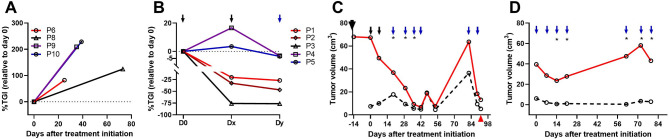
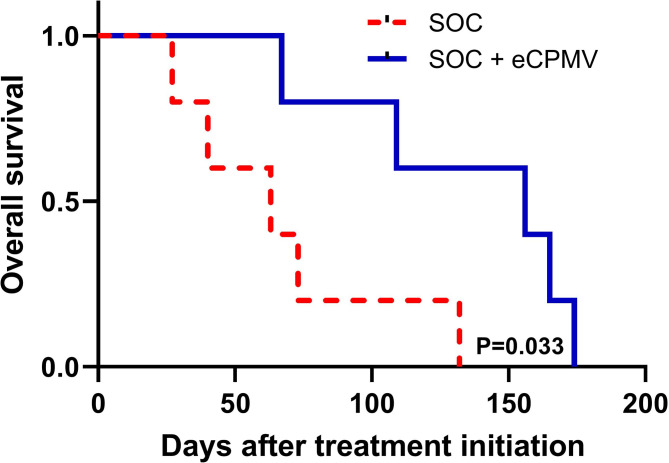
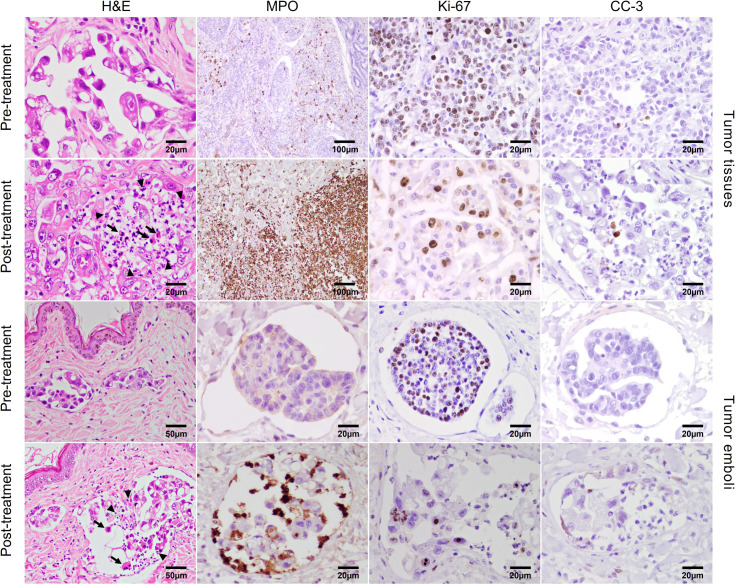
Two neoadjuvant in situ eCPMV injections resulted in tumor shrinkage in all patients by day 14 without systemic adverse events. Although surgery for IMC is generally not an option, reduction in tumor size allowed surgery in two IMC patients. In peripheral blood, in situ eCPMV immunotherapy was associated with a significant decrease of Treg/CD8 ratio and changes in CD8Granzyme B T cells, which behave as a lagging predictive biomarker. In the TME, higher neutrophilic infiltration and MPO expression, lower tumor Ki-67 PI, increase in CD3 lymphocytes, decrease in FoxP3/CD3 ratio (p0.04 for all comparisons), and no changes in CC-3 immunostainings were observed in post-treatment tumor tissues when compared with pretreatment tumor samples. eCPMV-treated IMC patients had a statistically significant (p=0.033) improved overall survival than patients treated with medical therapy.
Neoadjuvant in situ eCPMV immunotherapy demonstrated anti-tumor efficacy and improved survival in IMC patients without systemic adverse effects. eCPMV-induced changes in immune cells point to neutrophils as a driver of immune response. Neoadjuvant in situ eCPMV immunotherapy could be a groundbreaking immunotherapy for canine IMC and a potential future immunotherapy for human IBC patients.
炎性乳腺癌(IMC)是人类炎性乳腺癌(IBC)的对应物,是犬乳腺肿瘤中最致命的形式。IMC 患者缺乏特定的治疗方法,预后不良。这项初步临床前研究评估了在诊断为 IMC 的伴侣犬中,新辅助瘤内(原位)空豇豆花叶病毒(eCPMV)免疫疗法的疗效、安全性和对生存的影响。
10 只患有 IMC 的犬被纳入研究。5 只狗接受了药物治疗,5 只狗在接受第二次 eCPMV 注射后每周接受新辅助原位 eCPMV 免疫治疗(每次注射 0.2-0.4mg)和药物治疗。通过肿瘤生长减少来评估疗效;通过血液和血浆中血液学和生化变化来评估安全性;通过生存分析来评估患者的结局。通过流式细胞术分析 eCPMV 诱导的血细胞免疫变化;通过 CD3(T 淋巴细胞)、CD20(B 淋巴细胞)、FoxP3(Treg 淋巴细胞)、髓过氧化物酶(MPO;中性粒细胞)、Ki-67(增殖指数,PI;肿瘤细胞增殖)和 Cleaved Caspase-3(CC-3;凋亡)免疫组化评估肿瘤微环境的变化。
两次新辅助原位 eCPMV 注射后,所有患者在第 14 天肿瘤缩小,无全身不良反应。虽然 IMC 的手术一般不是一个选择,但肿瘤大小的减小允许对两名 IMC 患者进行手术。在外周血中,原位 eCPMV 免疫治疗与 Treg/CD8 比值的显著降低以及 Granzyme B CD8 T 细胞的变化相关,后者是一种滞后的预测性生物标志物。在 TME 中,与治疗前肿瘤样本相比,治疗后肿瘤组织中观察到更高的中性粒细胞浸润和 MPO 表达、更低的肿瘤 Ki-67 PI、增加的 CD3 淋巴细胞、降低的 FoxP3/CD3 比值(所有比较均为 p0.04)和 CC-3 免疫染色无变化。接受新辅助原位 eCPMV 免疫治疗的 IMC 患者的总生存时间明显优于接受药物治疗的患者(p=0.033)。
新辅助原位 eCPMV 免疫治疗在不产生全身不良反应的情况下,对 IMC 患者表现出抗肿瘤疗效并提高了生存率。eCPMV 诱导的免疫细胞变化表明中性粒细胞是免疫反应的驱动因素。新辅助原位 eCPMV 免疫治疗可能成为犬 IMC 的突破性免疫疗法,并可能成为人类 IBC 患者的潜在未来免疫疗法。