Division of Infectious Diseases, Mayo Clinic in Arizona, 5777 e Mayo Blvd, Phoenix, AZ, 85054, USA.
Department of Medicine, Washington University School of Medicine, St. Louis, MO, USA.
BMC Infect Dis. 2022 Mar 12;22(1):245. doi: 10.1186/s12879-022-07256-y.
Effective treatment options for recurrent Clostridioides difficile infection (rCDI) are limited, with high recurrence rates associated with the current standard of care. Herein we report results from an open-label Phase 2 trial to evaluate the safety, efficacy, and durability of RBX2660-a standardized microbiota-based investigational live biotherapeutic-and a closely-matched historical control cohort.
This prospective, multicenter, open-label Phase 2 study enrolled patients who had experienced either ≥ 2 recurrences of CDI, treated by standard-of-care antibiotic therapy, after a primary CDI episode, or ≥ 2 episodes of severe CDI requiring hospitalization. Participants received up to 2 doses of RBX2660 rectally administered with doses 7 days apart. Treatment success was defined as the absence of CDI diarrhea without the need for retreatment for 8 weeks after completing study treatment. A historical control group with matched inclusion and exclusion criteria was identified from a retrospective chart review of participants treated with standard-of-care antibiotics for recurrent CDI who matched key criteria for the study. The primary objective was to compare treatment success of RBX2660 to the historical control group. A key secondary outcome was the safety profile of RBX2660, including adverse events and CDI occurrence through 24 months after treatment. In addition, fecal samples from RBX2660-treated participants were sequenced to evaluate microbiome composition and functional changes from before to after treatment.
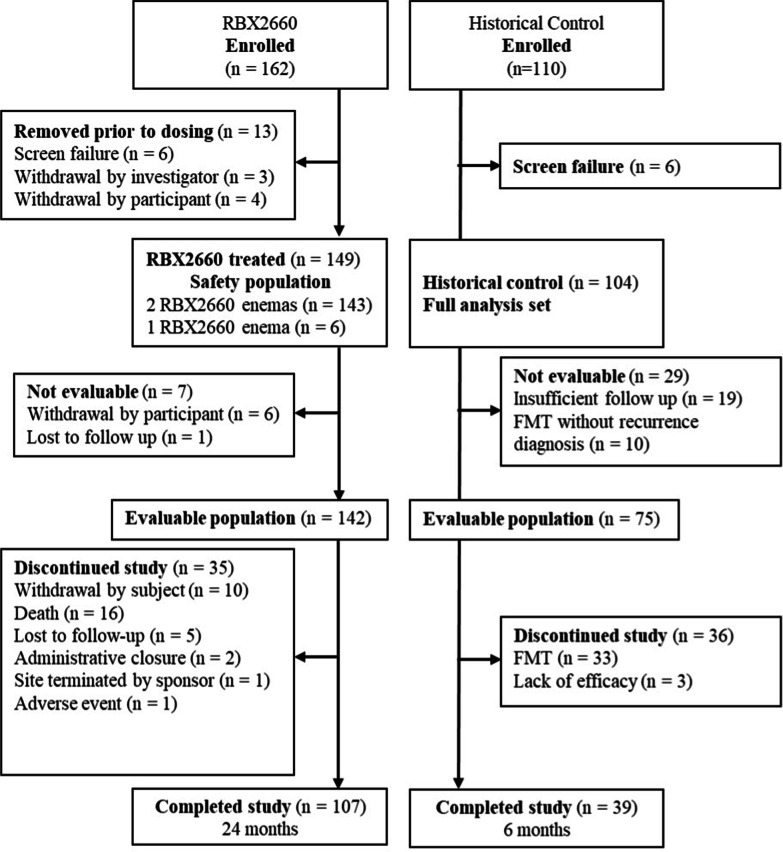
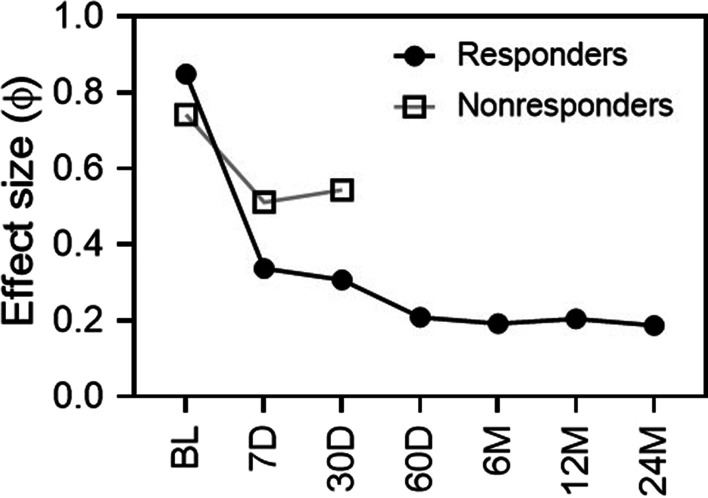
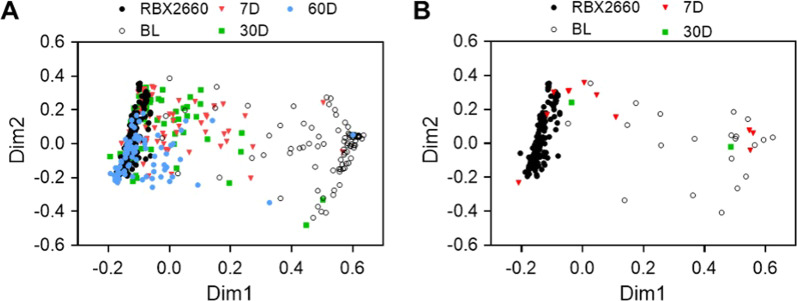
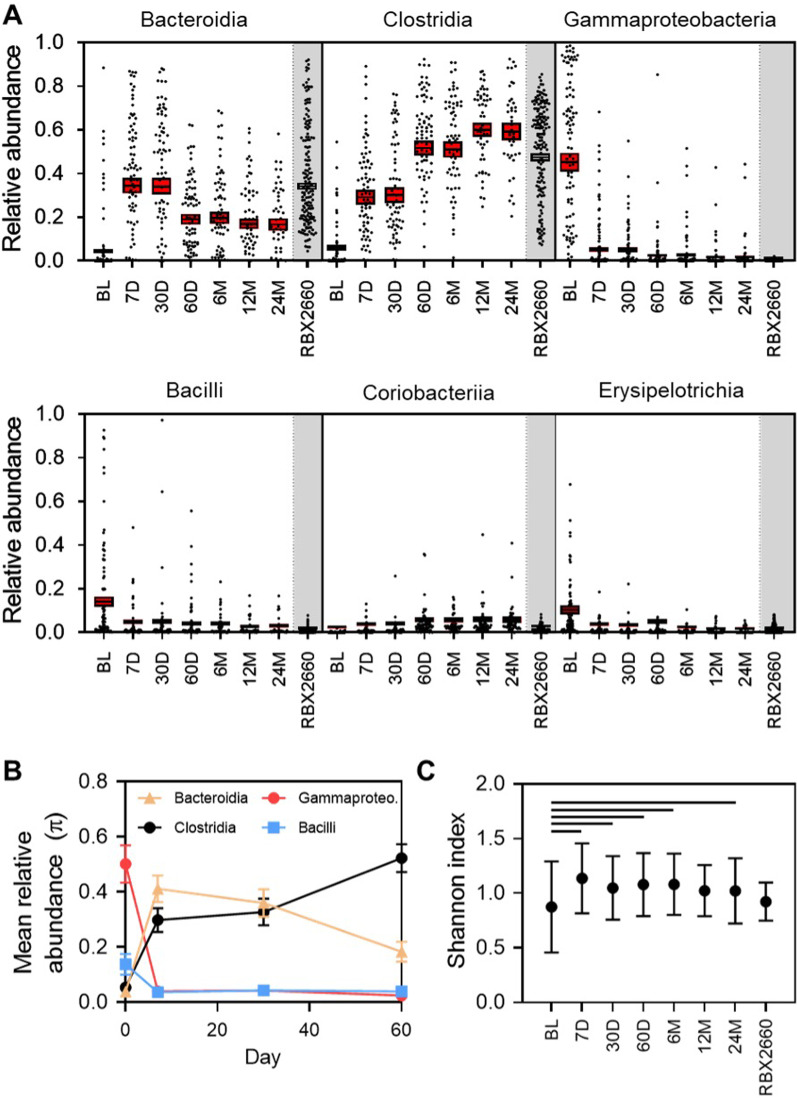
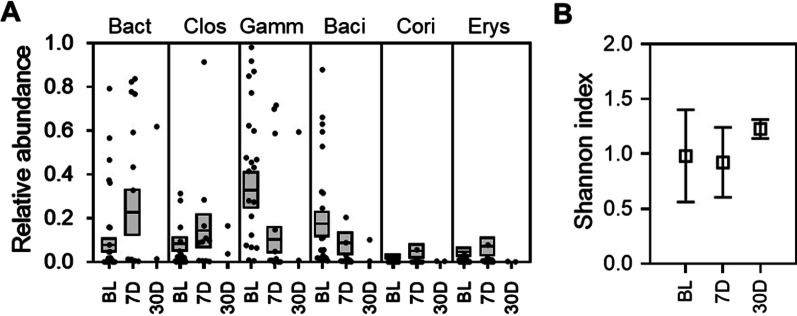
In this Phase 2 open-label clinical trial, RBX2660 demonstrated a 78.9% (112/142) treatment success rate compared to a 30.7% (23/75) for the historical control group (p < 0.0001; Chi-square test). Post-hoc analysis indicated that 91% (88/97) of evaluable RBX2660 responders remained CDI occurrence-free to 24 months after treatment demonstrating durability. RBX2660 was well-tolerated with mostly mild to moderate adverse events. The composition and diversity of RBX2660 responders' fecal microbiome significantly changed from before to after treatment to become more similar to RBX2660, and these changes were durable to 24 months after treatment.
In this Phase 2 trial, RBX2660 was safe and effective for reducing rCDI recurrence as compared to a historical control group. Microbiome changes are consistent with restorative changes implicated in resisting C. difficile recurrence. Clinical Trials Registration NCT02589847 (10/28/2015).
复发性艰难梭菌感染(rCDI)的有效治疗选择有限,目前的标准治疗方案与高复发率相关。在此,我们报告了一项开放标签的 2 期临床试验的结果,该试验评估了 RBX2660(一种标准化基于微生物组的研究性活体生物治疗药物)的安全性、疗效和持久性,以及与之匹配的历史对照队列。
这项前瞻性、多中心、开放标签的 2 期研究纳入了经历过以下情况的患者:在首次艰难梭菌感染后,接受标准护理抗生素治疗后发生了≥2 次 rCDI 复发;或经历了≥2 次需要住院治疗的严重 CDI 发作。参与者接受了最多 2 次 RBX2660 直肠给药,剂量间隔为 7 天。治疗成功的定义为在完成研究治疗后 8 周内没有 CDI 腹泻且无需再次治疗。从接受标准护理抗生素治疗 rCDI 的参与者的回顾性图表审查中确定了一个具有匹配纳入和排除标准的历史对照组,该组符合研究的关键标准。主要目标是比较 RBX2660 的治疗成功率与历史对照组。一个关键的次要结果是 RBX2660 的安全性概况,包括治疗后 24 个月内的不良事件和 CDI 发生情况。此外,对接受 RBX2660 治疗的参与者的粪便样本进行了测序,以评估治疗前后微生物组组成和功能的变化。
在这项 2 期开放标签临床试验中,RBX2660 的治疗成功率为 78.9%(112/142),而历史对照组为 30.7%(23/75)(p<0.0001;卡方检验)。事后分析表明,在可评估的 RBX2660 应答者中,91%(88/97)在治疗后 24 个月内保持无 CDI 发作,表明具有持久性。RBX2660 耐受性良好,大多数不良反应为轻度至中度。RBX2660 应答者粪便微生物组的组成和多样性在治疗前后发生了显著变化,变得更类似于 RBX2660,并且这些变化在治疗后 24 个月内具有持久性。
在这项 2 期试验中,与历史对照组相比,RBX2660 治疗 rCDI 复发是安全有效的。微生物组的变化与抵抗艰难梭菌复发所涉及的恢复性变化一致。临床试验注册 NCT02589847(2015 年 10 月 28 日)。