Priya Gagan, Bajaj Sarita, Kalra Bharti, Coetzee Ankia, Kalra Sanjay, Dutta Deep, Lim Vivien, Diwakar Hema, Deshmukh Vaishali, Mehta Roopa, Sahay Rakesh, Gupta Yashdeep, Sharma J B, Dasgupta Arundhati, Patnala S, Afsana Faria, Giri Mimi, Sheikh Aisha, Baruah Manash P, Asirvatham A R, Sheikh Shehla, Cooray Samanthi, Acharya Kirtida, Langi Y A, Jacob Jubbin J, Malhotra Jaideep, George Belinda, Grewal Emmy, Chandrasekharan Sruti, Nadeem Sarah, Lamptey Roberta, Khandelwal Deepak
Department of Endocrinology, Fortis Hospital, Chandigarh, Punjab, India.
Department of Medicine, MLN Medical College, Prayagraj, Uttar Pradesh, India.
J Family Med Prim Care. 2021 Dec;10(12):4350-4363. doi: 10.4103/jfmpc.jfmpc_653_21. Epub 2021 Dec 27.
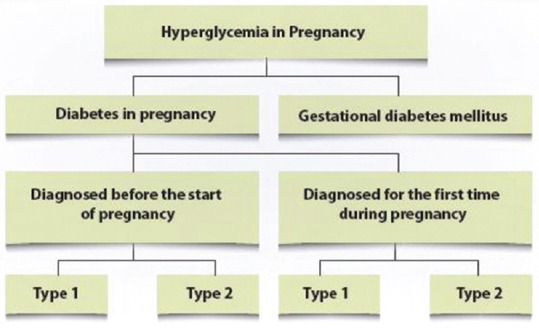
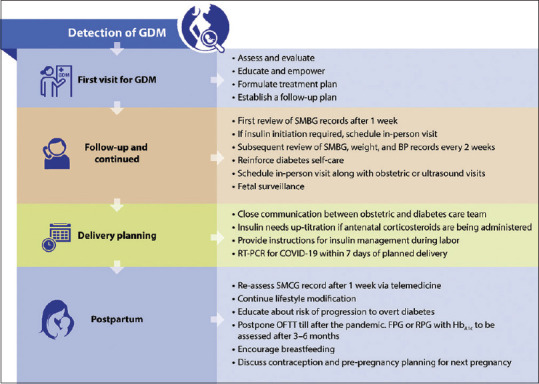
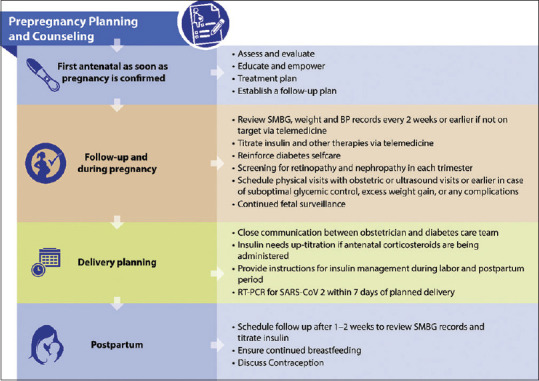
The human coronavirus disease 2019 (COVID-19) pandemic has affected overall healthcare delivery, including prenatal, antenatal and postnatal care. Hyperglycemia in pregnancy (HIP) is the most common medical condition encountered during pregnancy. There is little guidance for primary care physicians for providing delivery of optimal perinatal care while minimizing the risk of COVID-19 infection in pregnant women. This review aims to describe pragmatic modifications in the screening, detection and management of HIP during the COVID- 19 pandemic. In this review, articles published up to June 2021 were searched on multiple databases, including PubMed, Medline, EMBASE and ScienceDirect. Direct online searches were conducted to identify national and international guidelines. Search criteria included terms to extract articles describing HIP with and/or without COVID-19 between 1 March 2020 and 15 June 2021. Fasting plasma glucose, glycosylated hemoglobin (HbA1c) and random plasma glucose could be alternative screening strategies for gestational diabetes mellitus screening (at 24-28 weeks of gestation), instead of the traditional 2 h oral glucose tolerance test. The use of telemedicine for the management of HIP is recommended. Hospital visits should be scheduled to coincide with obstetric and ultrasound visits. COVID-19 infected pregnant women with HIP need enhanced maternal and fetal vigilance, optimal diabetes care and psychological support in addition to supportive measures. This article presents pragmatic options and approaches for primary care physicians, diabetes care providers and obstetricians for GDM screening, diagnosis and management during the pandemic, to be used in conjunction with routine antenatal care.
2019年人类冠状病毒病(COVID-19)大流行影响了包括产前、产时和产后护理在内的整体医疗服务。妊娠期间高血糖(HIP)是妊娠期间最常见的医学状况。对于初级保健医生而言,在提供最佳围产期护理的同时尽量降低孕妇感染COVID-19的风险,几乎没有相关指导。本综述旨在描述COVID-19大流行期间HIP筛查、检测和管理方面的实用调整。在本综述中,我们在多个数据库中检索了截至2021年6月发表的文章,包括PubMed、Medline、EMBASE和ScienceDirect。进行了直接在线搜索以确定国家和国际指南。搜索标准包括用于提取描述2020年3月1日至2021年6月15日期间患有和/或未患有COVID-19的HIP的文章的术语。空腹血糖、糖化血红蛋白(HbA1c)和随机血糖可作为妊娠糖尿病筛查(妊娠24 - 28周时)的替代筛查策略,而非传统的2小时口服葡萄糖耐量试验。建议使用远程医疗来管理HIP。应安排医院就诊时间与产科和超声检查时间一致。感染COVID-19的患有HIP的孕妇除了采取支持性措施外,还需要加强母婴监测、最佳的糖尿病护理和心理支持。本文为初级保健医生、糖尿病护理提供者和产科医生在大流行期间进行妊娠期糖尿病(GDM)筛查、诊断和管理提供了实用的选择和方法,可与常规产前护理结合使用。