Yilmazkuday Hakan
Department of Economics, Florida International University, Miami, FL, 33199, USA.
Transp Policy (Oxf). 2022 May;120:40-46. doi: 10.1016/j.tranpol.2022.03.003. Epub 2022 Mar 5.
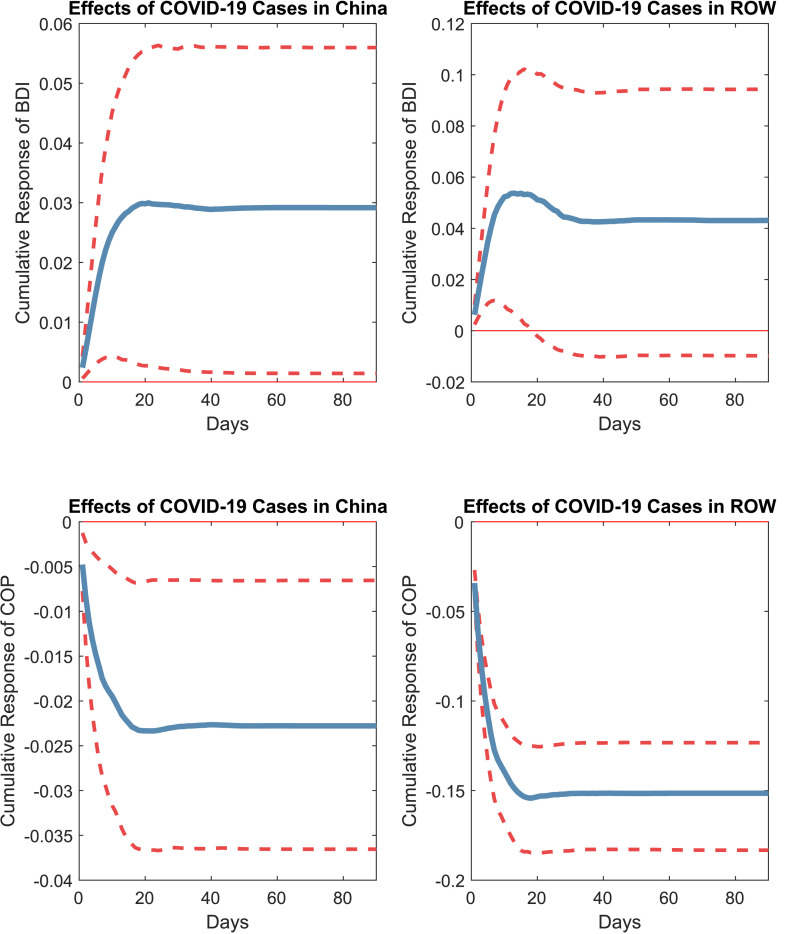
Using daily data on the coronavirus disease 2019 (COVID-19) cases from China and the rest of the world, this paper investigates the corresponding effects on the global economic activity. The empirical results based on a structural vector autoregression model using crude oil prices (COP) and the Baltic Exchange Dry Index (BDI) are consistent with increases in COVID-19 cases acting as negative demand shocks in the global economic activity (reflected as reductions in COP) and negative supply shocks in the global transportation of commodities (reflected as increases in BDI). The historical decomposition results further suggest that the effects of COVID-19 cases on COP and BDI have been mostly observed in the early COVID-19 period.
本文利用来自中国和世界其他地区的2019冠状病毒病(COVID-19)病例的每日数据,研究了其对全球经济活动的相应影响。基于使用原油价格(COP)和波罗的海干散货运价指数(BDI)的结构向量自回归模型的实证结果表明,COVID-19病例的增加对全球经济活动起到了负面需求冲击(表现为COP下降),对全球商品运输起到了负面供给冲击(表现为BDI上升)。历史分解结果进一步表明,COVID-19病例对COP和BDI的影响主要出现在COVID-19早期阶段。