Zhao Chongyu, Chen Yu, Gao Lvfen, Huang Jue, Yang Xiurou, Pei Luowei, Ye Zhangying, Zhu Linyan
Department of Pharmacology, School of Medicine, Jinan University, Guangzhou, China.
Department of Urology, The Third Affiliated Hospital, Sun Yat-sen University, Guangzhou, China.
Front Med (Lausanne). 2022 Feb 25;9:817957. doi: 10.3389/fmed.2022.817957. eCollection 2022.
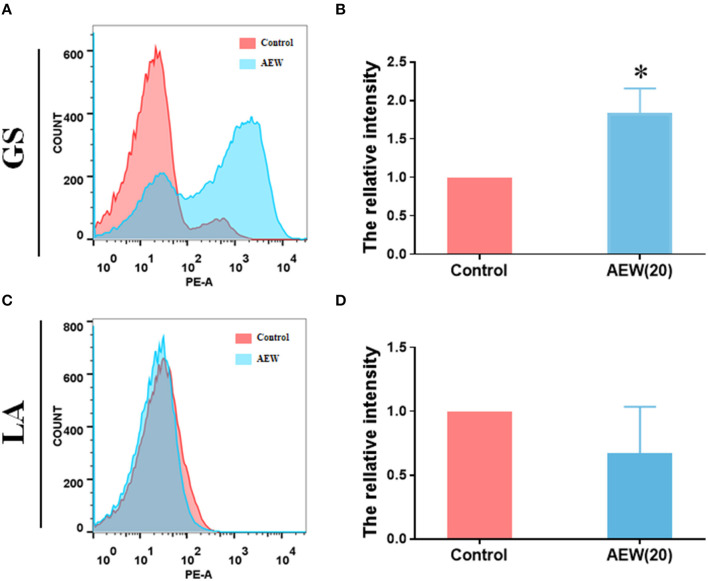
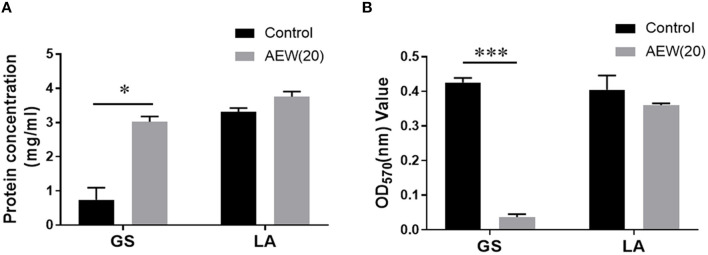
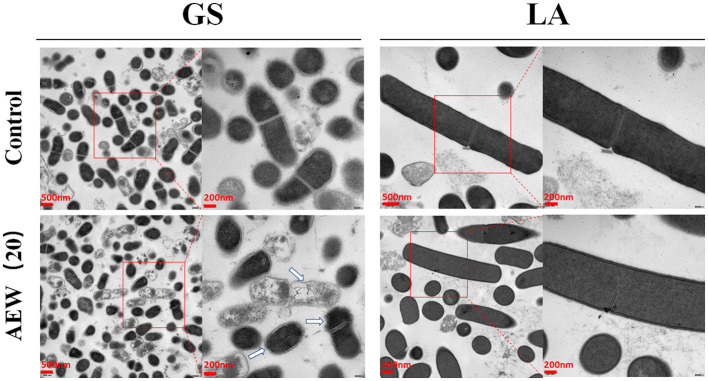
The vaginal microbiota, dominated by Lactobacilli, plays an important role in maintaining women's health. Disturbance of the vaginal microbiota allows infection by various pathogens such as spp. (GS) and related anaerobic bacteria resulting in bacterial vaginosis (BV). At present, the treatment options for BV are extremely limited. Treatment of antibacterial drugs and vaginal acidification are the two primary therapeutic methods. Acid electrolyzed water (AEW) is known to inactivate microorganisms and is considered a medical application in recent years. Studies have found that (LA) probiotics helps to inhibit GS-induced BV. Our study took GS and LA as the research object, which aims to explore AEW as a potential alternative therapy for BV and its underlying mechanisms. We first obtained the pH of AEW (3.71-4.22) close to normal vaginal pH (3.8-4.5) to maintain normal vaginal acidification conditions. Plate counting experiments showed that AEW (pH: 4.07, ORP: 890.67, ACC: 20 ppm) (20 ppm) could better inhibit the viability of GS but had a more negligible effect on LA. Then, we preliminarily explored the possible mechanism of AEW anti-GS using cell biology experiments and transmission electron microscopy. Results showed that the membrane permeability was significantly increased and the integrity of cell membrane was destroyed by AEW in GS than those in LA. AEW also caused protein leakage and cell lysis in GS without affecting LA. Meanwhile, AEW induced a number of reactive oxygen species (ROS) production in GS, with no obvious LA changes. Finally, we found that 20 ppm AEW exhibited excellent antibacterial effect on the vaginal secretions of women diagnosed with BV by Amsel criteria and sialic acid plum method. Taken together, our findings manifest that 20 ppm AEW has an excellent antibacterial effect in GS with less effect on LA, which might be expected to become a potential therapy for BV.
以乳酸杆菌为主导的阴道微生物群在维持女性健康方面发挥着重要作用。阴道微生物群的紊乱会使各种病原体如加德纳菌属(GS)及相关厌氧菌感染,从而导致细菌性阴道病(BV)。目前,BV的治疗选择极其有限。抗菌药物治疗和阴道酸化是两种主要的治疗方法。酸性电解水(AEW)已知可使微生物失活,近年来被视为一种医学应用。研究发现,嗜酸乳杆菌(LA)益生菌有助于抑制GS诱导的BV。我们的研究以GS和LA为研究对象,旨在探索AEW作为BV的一种潜在替代疗法及其潜在机制。我们首先使AEW的pH值(3.71 - 4.22)接近正常阴道pH值(3.8 - 4.5),以维持正常的阴道酸化条件。平板计数实验表明,AEW(pH:4.07,氧化还原电位:890.67,有效氯含量:20 ppm)(20 ppm)能更好地抑制GS的活力,但对LA的影响可忽略不计。然后,我们利用细胞生物学实验和透射电子显微镜初步探索了AEW抗GS的可能机制。结果表明,与LA相比,AEW使GS的膜通透性显著增加,细胞膜完整性遭到破坏。AEW还导致GS发生蛋白质渗漏和细胞裂解,而对LA没有影响。同时,AEW诱导GS产生大量活性氧(ROS),LA无明显变化。最后,我们发现20 ppm的AEW对通过Amsel标准和唾液酸酶法诊断为BV的女性阴道分泌物具有优异的抗菌效果。综上所述,我们的研究结果表明,20 ppm的AEW对GS具有优异的抗菌效果,对LA影响较小,有望成为BV的一种潜在治疗方法。