Afrash Mohammad Reza, Kazemi-Arpanahi Hadi, Shanbehzadeh Mostafa, Nopour Raoof, Mirbagheri Esmat
Department of Health Information Technology and Management, School of Allied Medical Sciences, Shahid Beheshti University of Medical Sciences, Tehran, Iran.
Department of Health Information Technology, Abadan Faculty of Medical Sciences, Abadan, Iran.
Inform Med Unlocked. 2022;30:100908. doi: 10.1016/j.imu.2022.100908. Epub 2022 Mar 8.
The Coronavirus 2019 (COVID-19) epidemic stunned the health systems with severe scarcities in hospital resources. In this critical situation, decreasing COVID-19 readmissions could potentially sustain hospital capacity. This study aimed to select the most affecting features of COVID-19 readmission and compare the capability of Machine Learning (ML) algorithms to predict COVID-19 readmission based on the selected features.
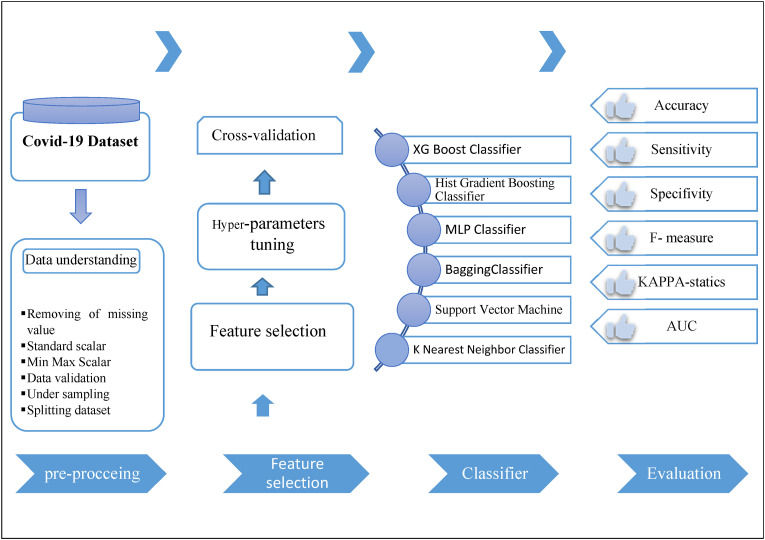
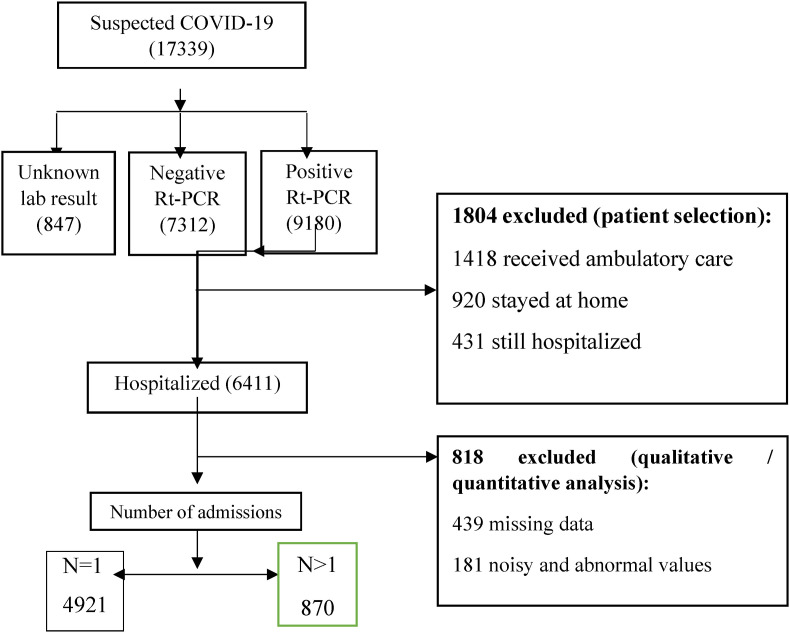
The data of 5791 hospitalized patients with COVID-19 were retrospectively recruited from a hospital registry system. The LASSO feature selection algorithm was used to select the most important features related to COVID-19 readmission. HistGradientBoosting classifier (HGB), Bagging classifier, Multi-Layered Perceptron (MLP), Support Vector Machine ((SVM) kernel = linear), SVM (kernel = RBF), and Extreme Gradient Boosting (XGBoost) classifiers were used for prediction. We evaluated the performance of ML algorithms with a 10-fold cross-validation method using six performance evaluation metrics.
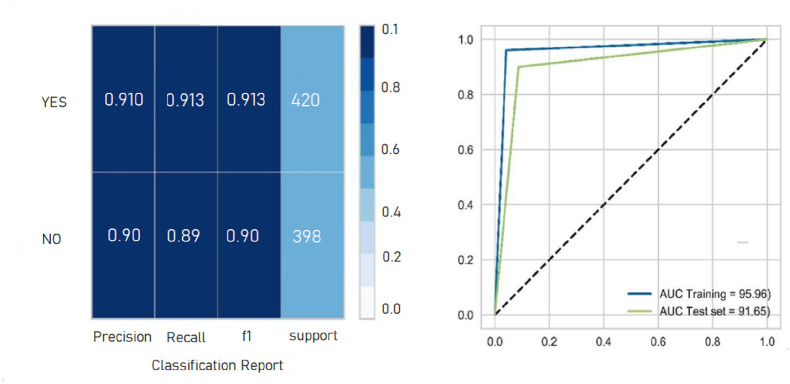
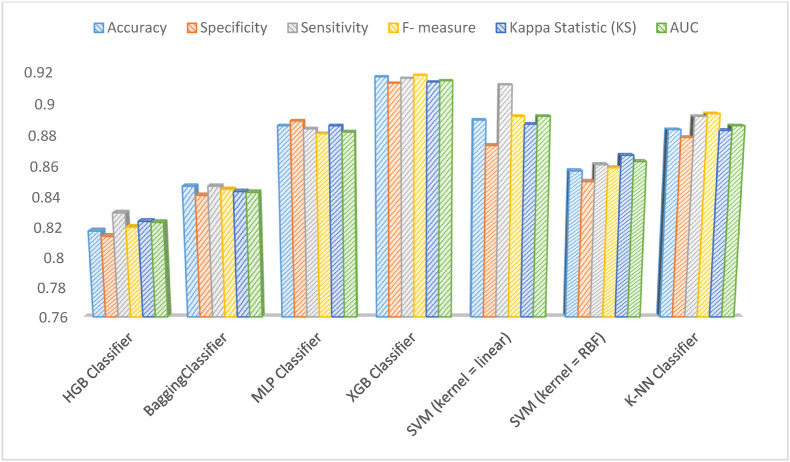
Out of the 42 features, 14 were identified as the most relevant predictors. The XGBoost classifier outperformed the other six ML models with an average accuracy of 91.7%, specificity of 91.3%, the sensitivity of 91.6%, F-measure of 91.8%, and AUC of 0.91%.
The experimental results prove that ML models can satisfactorily predict COVID-19 readmission. Besides considering the risk factors prioritized in this work, categorizing cases with a high risk of reinfection can make the patient triaging procedure and hospital resource utilization more effective.
2019年冠状病毒病(COVID-19)疫情使卫生系统陷入医院资源严重短缺的困境。在这种危急情况下,减少COVID-19再入院人数可能有助于维持医院的收治能力。本研究旨在选择影响COVID-19再入院的最主要特征,并比较机器学习(ML)算法基于所选特征预测COVID-19再入院的能力。
从医院登记系统中回顾性招募了5791例COVID-19住院患者的数据。使用LASSO特征选择算法来选择与COVID-19再入院相关的最重要特征。采用直方图梯度提升分类器(HGB)、Bagging分类器、多层感知器(MLP)、支持向量机((SVM)核=线性)、SVM(核=径向基函数)和极端梯度提升(XGBoost)分类器进行预测。我们使用六种性能评估指标,通过10折交叉验证方法评估ML算法的性能。
在42个特征中,有14个被确定为最相关的预测因子。XGBoost分类器的表现优于其他六个ML模型,平均准确率为91.7%,特异性为91.3%,灵敏度为91.6%,F值为91.8%,曲线下面积为0.91%。
实验结果证明,ML模型能够令人满意地预测COVID-19再入院情况。除了考虑本研究中确定的优先风险因素外,对再感染高风险病例进行分类可以使患者分诊程序和医院资源利用更加有效。